
Discover the Best AI Tools to boost your productivity, business and creativity
 4412+ AI tools in 88 categories
Featured AI Tools
Featured AI tools submitted by AI founders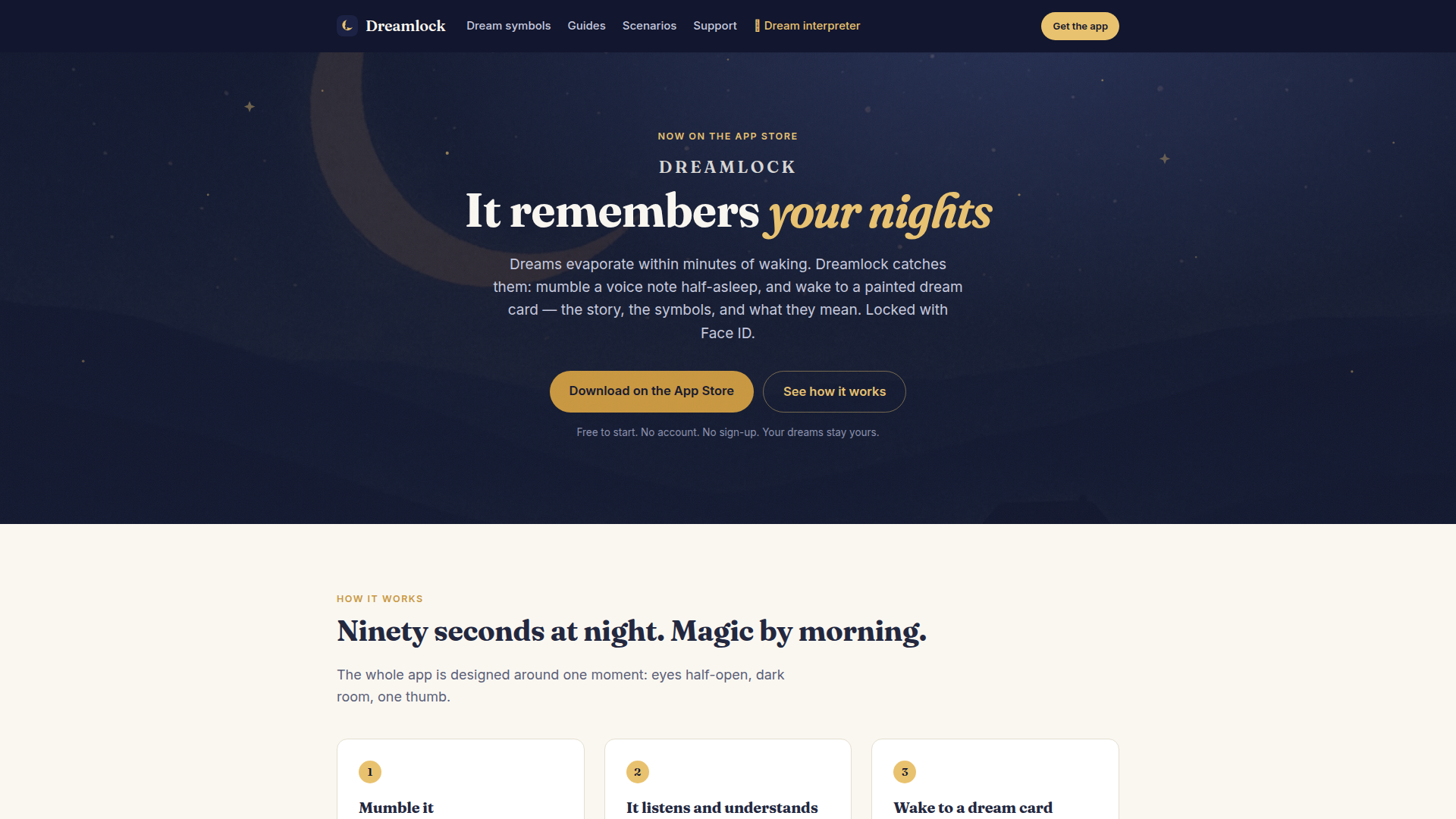
FEATURED
Dreamlock is a private, Face ID-locked dream journal and AI-powered dream interpretation app for iPhone. Positioned as a personal vault for dreams rather than a social feed, it targets people who wake up curious about their dreams but forget them within minutes, as well as journalers, lucid dreamers, therapy clients, and anyone exploring dream symbols. Core features include one-tap voice capture, on-device voice understanding, AI interpretation that reads each dream through tradition and psychology, and beautifully painted dream cards. Users can build a personal symbol index, ask questions about their own dream history, and receive monthly reports. Content features include a dream dictionary, guides, scenarios, and free tools such as a sleep calculator, dream symbol finder, and cross-cultural dream reader. The user experience is designed for half-asleep use: dark-friendly, minimal taps, no account or sign-up. Technically, Dreamlock processes audio on-device, uses Face ID, avoids server storage of dream text, and optionally syncs via the user's own iCloud. It is free to start with a Plus subscription for unlimited interpretation and painting.
FEATURED
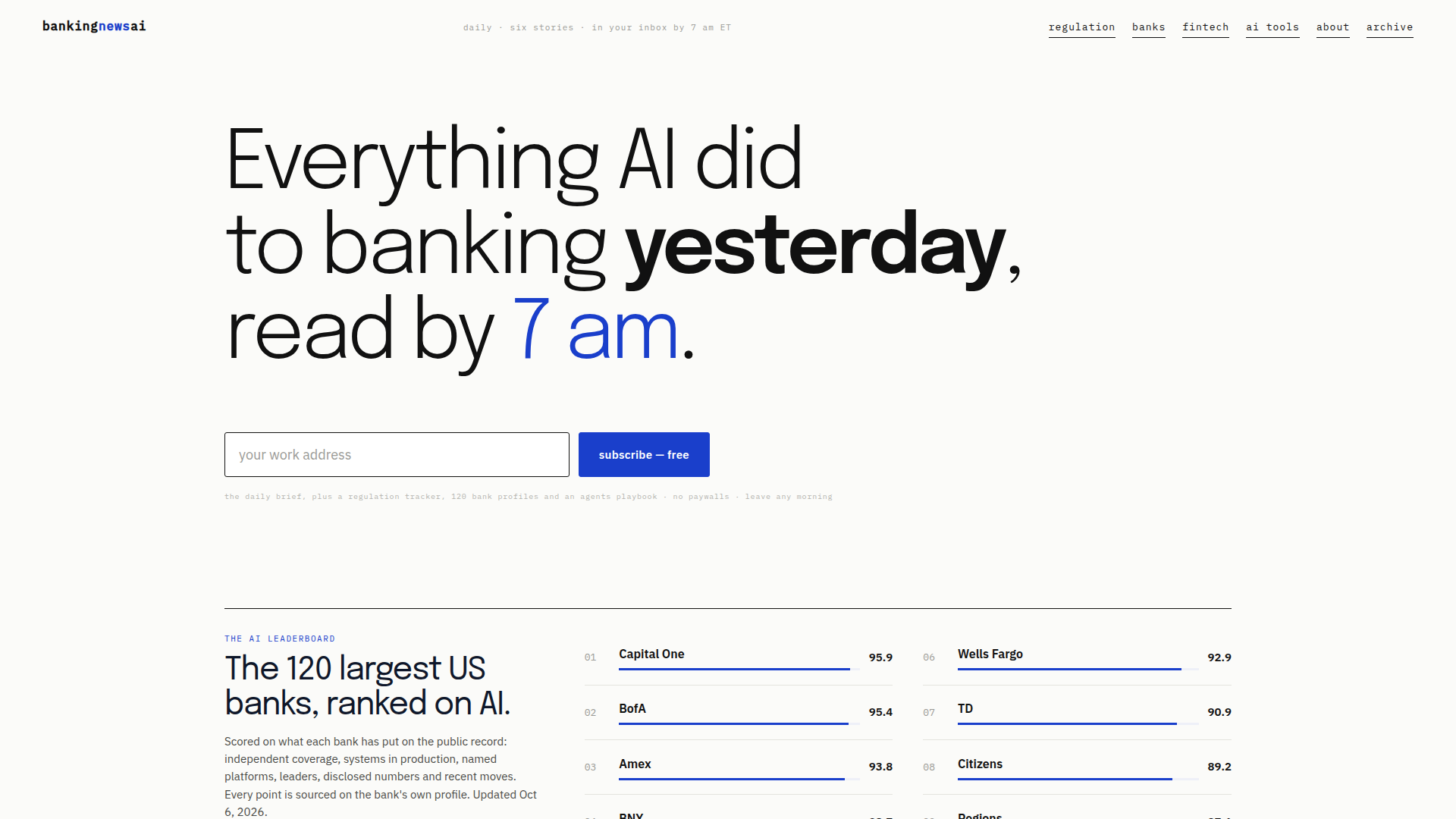
Banking News AI is a daily intelligence platform for professionals who need to understand how artificial intelligence is reshaping banking. Positioned as a free, no-paywall briefing service, it delivers six carefully curated stories to subscribers' inboxes by 7 am ET, covering institutions, regulators, deals, models, vendors and infrastructure. Its target audience includes bank executives, board members, compliance officers, risk managers, fintech strategists, AI governance leads and consultants who need concise, decision-ready updates without wading through endless news feeds. Core features include the daily brief, a regulation tracker covering 41 regulators and 237 documents, a compliance checklist, regulator warnings, deadlines, and an operating system/playbook for AI agents in banking. The platform also maintains AI strategy profiles for the 120 largest US banks and 20 fintechs/neobanks, plus an AI Leaderboard ranking banks on public AI evidence such as production systems, named platforms, disclosed numbers, leaders and recent moves. Content is organized around banking AI, general AI, regulation, banks, fintech, AI tools, governance, model risk management, fraud detection, chatbots, treasury and agentic banking. User experience is newsletter-first, with a clean archive, straightforward navigation, and links to specialized trackers and bank profiles; subscription is free, and users can leave at any time. Technical features include daily curation, sourced scoring, structured bank profiles, updated regulatory documents, and AI-curated delivery. The site is designed for quick scanning, with briefs, rankings, checklists and maps that help executives and compliance teams act on AI developments.

FEATURED
Buyer24 is an AI-powered procurement automation network that connects buyers and suppliers through intelligent agents handling the entire request-for-quote (RFQ) lifecycle. Positioned as "THE PROCUREMENT NETWORK," the platform's core promise is straightforward: better prices with less work. Buyers simply forward an incoming customer RFQ to Buyer24, and the system extracts every line item from emails, PDFs, Excel files, and even photos, auto-translates the request into each supplier's native language, distributes it across a vetted supplier network, and chases replies automatically via email or WhatsApp. Supplier quotes return normalized into a single side-by-side comparison table showing landed costs, lead times, and terms, with AI-flagged best picks that can be awarded in one click. Buyers can then convert the winning offer into a customer-ready quote on their own letterhead, complete with configured margins, and track every order from one dashboard. The target audience spans procurement and sourcing teams, distributors, electronics and MRO resellers, construction firms, entertainment production buyers, and public sector organizations such as K-12 school districts, universities, fire and EMS departments, police departments, and municipal governments. Suppliers benefit from one-of-a-kind visibility into live purchasing decisions the moment RFQs are created, the ability to respond directly from email with no rekeying, and guaranteed format-compliant quotes that are never disqualified for a missed attachment. Core features include automated RFQ forwarding with buyer-identity redaction for supplier confidentiality, line-item structuring, bidirectional multilingual translation, automated follow-ups, landed-cost comparison, one-click awarding, customer quote generation, supplier management, public bid conversion, and free quote comparison for existing quotes. Technically, Buyer24 is an agentic AI SaaS platform that integrates with existing email and spreadsheets without requiring ERP replacement, is available as a verified listing on Google Cloud Marketplace, and emphasizes a no-credit-card, free-to-start onboarding with setup in minutes. The network effect is central to the value proposition: every buyer adds live demand and every supplier improves coverage, making the platform more valuable with each new member.
FEATURED
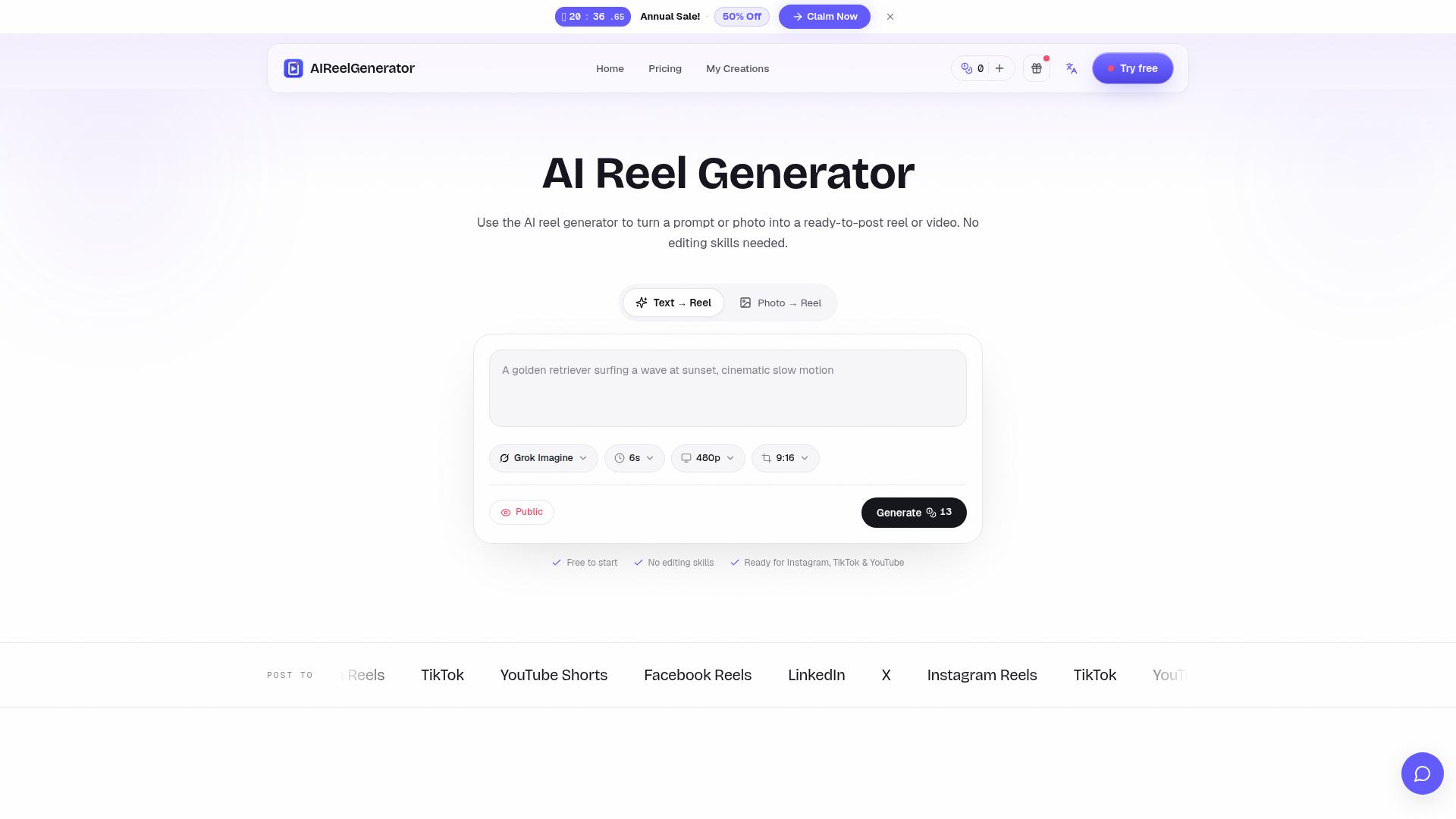
AIReelGenerator is an AI-powered web platform that transforms simple text prompts or single photos into polished, ready-to-post vertical reels and short videos for major social platforms. Website Positioning: It functions as a prompt-to-reel and photo-to-reel generator, positioning itself as a fast, no-skill alternative to traditional video editing, stock footage, and freelance production. Instead of learning a timeline-based editor, users describe the reel they want and let the AI handle scene writing, motion, pacing, and rendering in a single pass. Target Audience: The tool serves solo content creators who need to maintain a daily posting streak, small brands and e-commerce sellers producing product videos on a zero budget, agencies that need to prototype client concepts in minutes, and complete beginners with no editing experience whatsoever. Core Features: text-to-reel generation from a written prompt, photo-to-reel creation that adds camera movement, depth, and rhythm to a single image, native 9:16 vertical rendering with caption-safe margins, and feed-first pacing optimized for Instagram Reels, TikTok, YouTube Shorts, Facebook Reels, LinkedIn, and X. Content Features: the site offers a showcase gallery of example reels (travel, surfing dog, citrus product), a comparison table contrasting the traditional editing workflow with the AI workflow, and use-case sections for creators, brands, agencies, and beginners. User Experience: The interface is bilingual and available in English, Simplified and Traditional Chinese, Japanese, Korean, German, French, Spanish, Italian, and Brazilian Portuguese, with a simple prompt input or photo upload and a free, no-credit-card starting flow. Technical Features: cloud-based AI video synthesis, single-pass generation that delivers a first draft in roughly one minute, credit-based consumption, and multi-language localisation. Overall, AIReelGenerator lowers the barrier to short-form video creation by letting anyone turn an idea into a scroll-stopping reel within seconds.
FEATURED
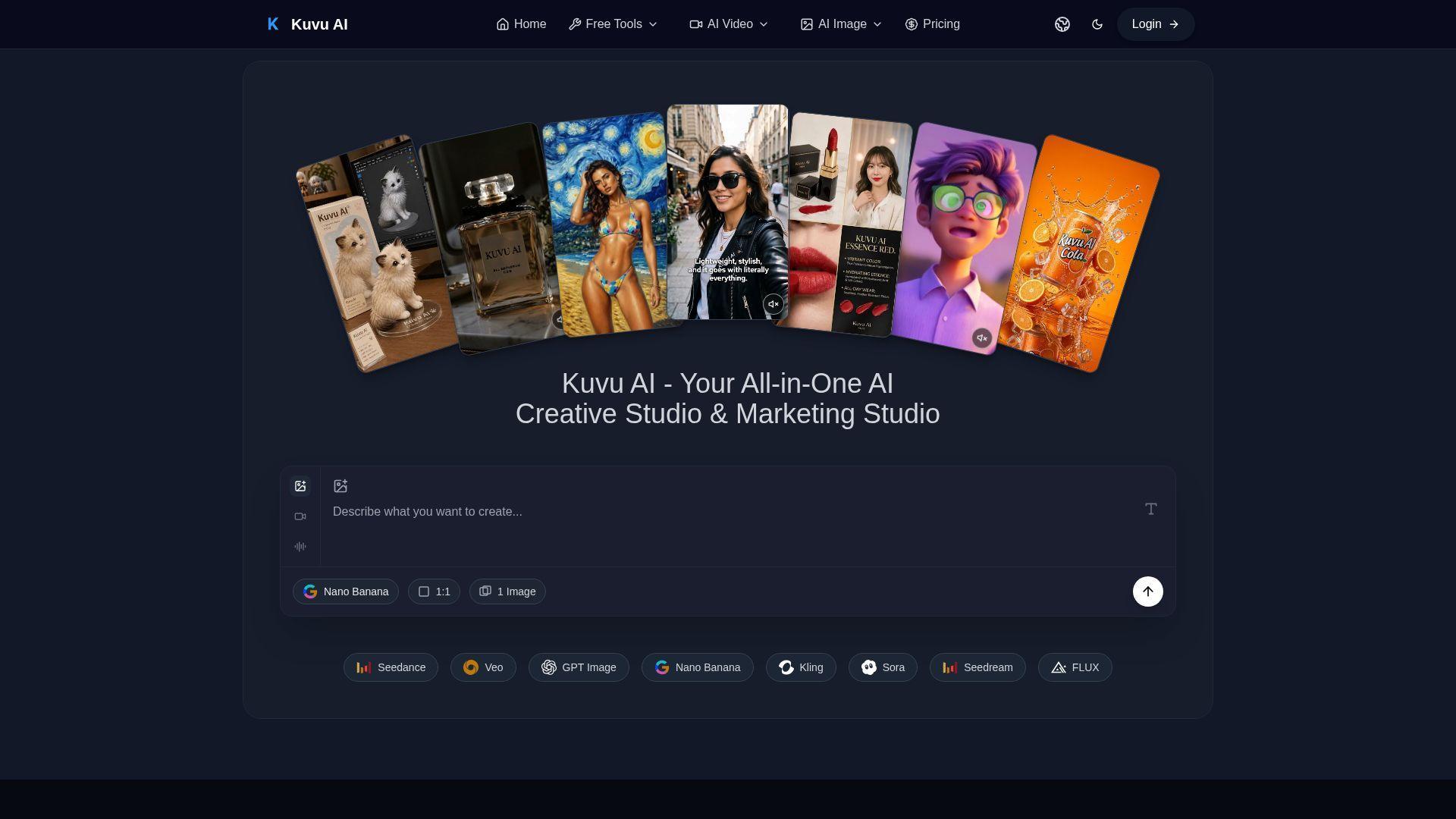
Kuvu AI is an all-in-one AI creative studio designed to give creators access to the world’s best image and video generation models through a single unified interface. It targets content creators, marketers, designers, and business owners who need high-quality visuals without managing multiple subscriptions. Core features include text-to-image generation up to 4K, text-to-video and image-to-video creation using Seedance, Veo, Kling, and Hailuo, AI audio generation, prompt enhancement, batch generation, and commercial licensing. The platform also offers free tools such as image-to-prompt, background removal, and AI image upscaling. With flexible credit-based pricing, one-time packs, and 50% off yearly plans, Kuvu AI delivers professional-grade creative technology at a fraction of the cost of separate model subscriptions.
FEATURED
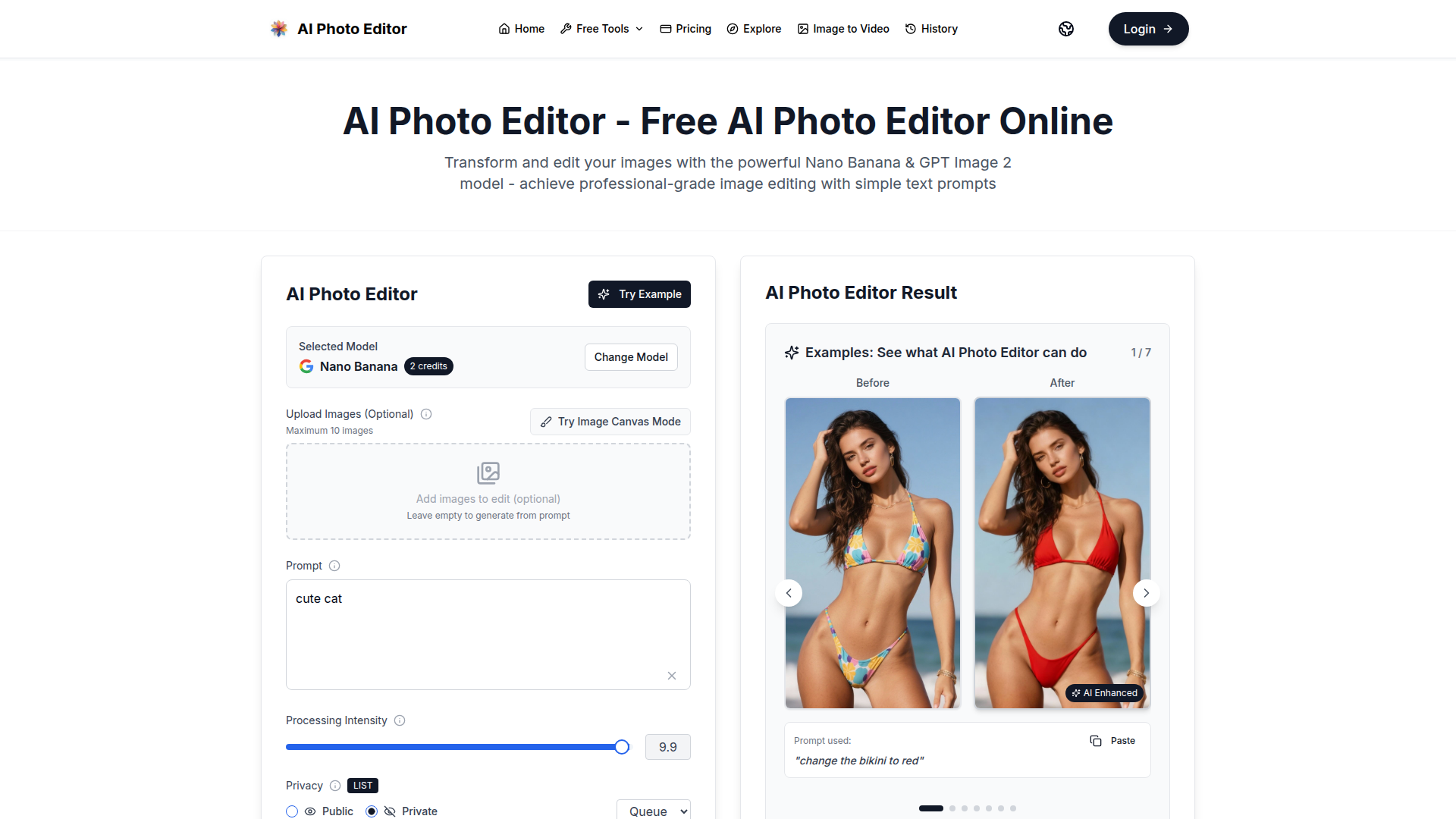
AI Photo Editor is a free online AI-powered photo editing tool that leverages advanced models like Nano Banana and GPT Image 2 to transform images with simple text prompts. It offers one-shot perfect generation with a 95% first-try success rate, lightning-fast processing under one second, face completion technology, and consistent character editing. The platform supports both image editing and generation, allowing users to upload images or generate from prompts. It provides enterprise-grade security with SOC 2, GDPR, and ISO 27001 certifications. With no credit card required to get started, it is accessible to everyone. Users can choose from various subscription plans or one-time credit packages to suit their needs, including options for individual creators, small teams, and large enterprises. The tool is ideal for photo restoration, style transfer, product mockups, and creating AI influencers. Its intuitive interface and natural language processing make professional-quality editing accessible without any design skills.
FEATURED
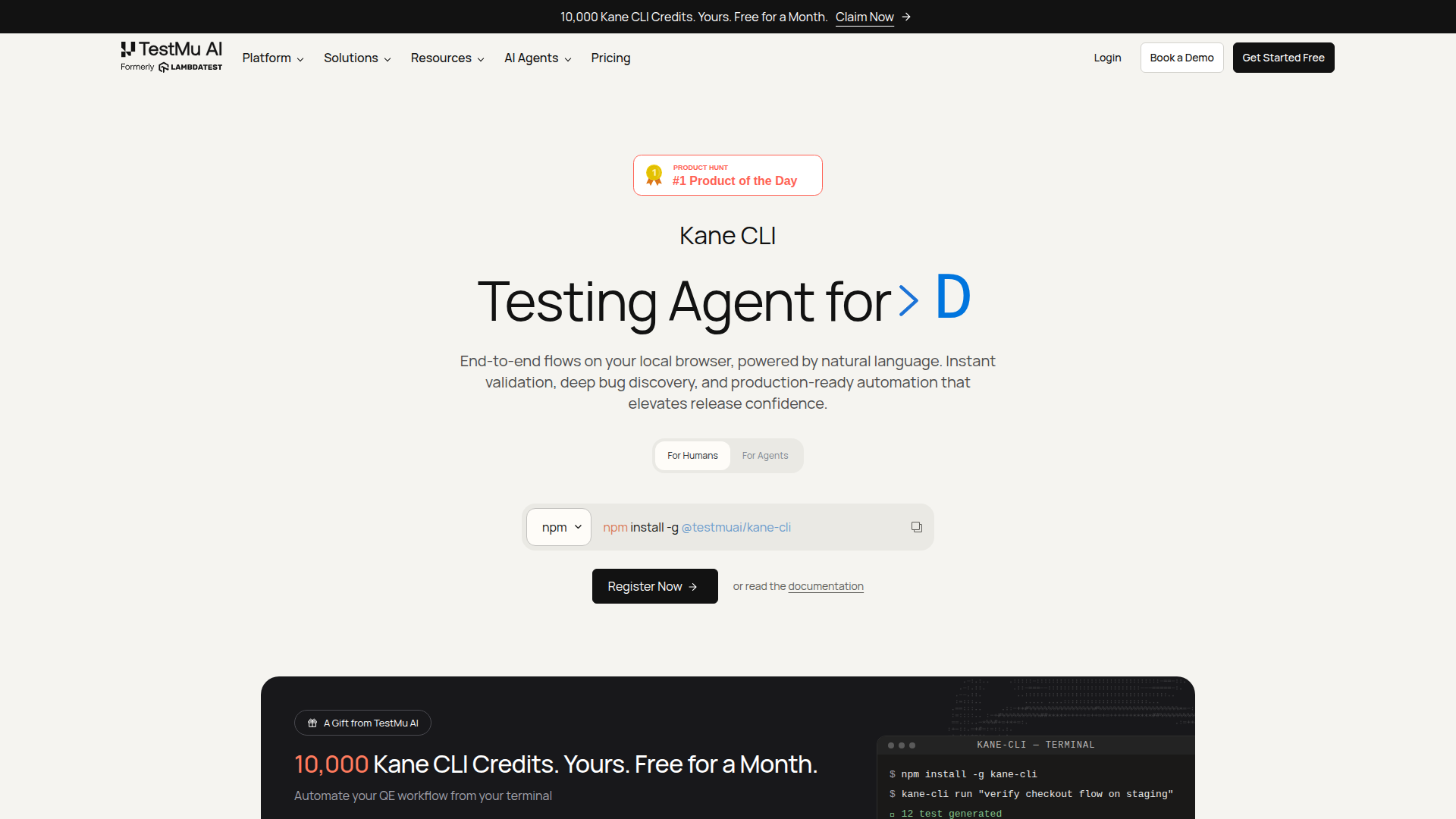
Kane CLI is an AI-driven, terminal-native testing agent that transforms how developers, QA engineers, and AI coding agents validate web applications. By allowing users to describe test scenarios in plain English, Kane CLI automates end-to-end browser flows, eliminating the need for brittle selector-based scripts. It reads PRDs, tickets, and existing test suites to generate comprehensive coverage maps, then executes tests in a real Chrome browser—locally or on the cloud—producing portable .evidence packs with screenshots, logs, and metadata for every run. This ensures that acceptance criteria are proven with traceable, tamper-evident artifacts. Kane CLI is built for modern software teams that want to integrate AI agents into their workflows, enabling seamless collaboration between human and machine testers. It offers a free tier for local runs, with cloud execution available through TestMu AI's scalable grid. Whether you're a solo developer pushing a quick fix or a large enterprise managing complex release cycles, Kane CLI empowers you to ship with confidence, backed by rigorous, evidence-based validation.
FEATURED
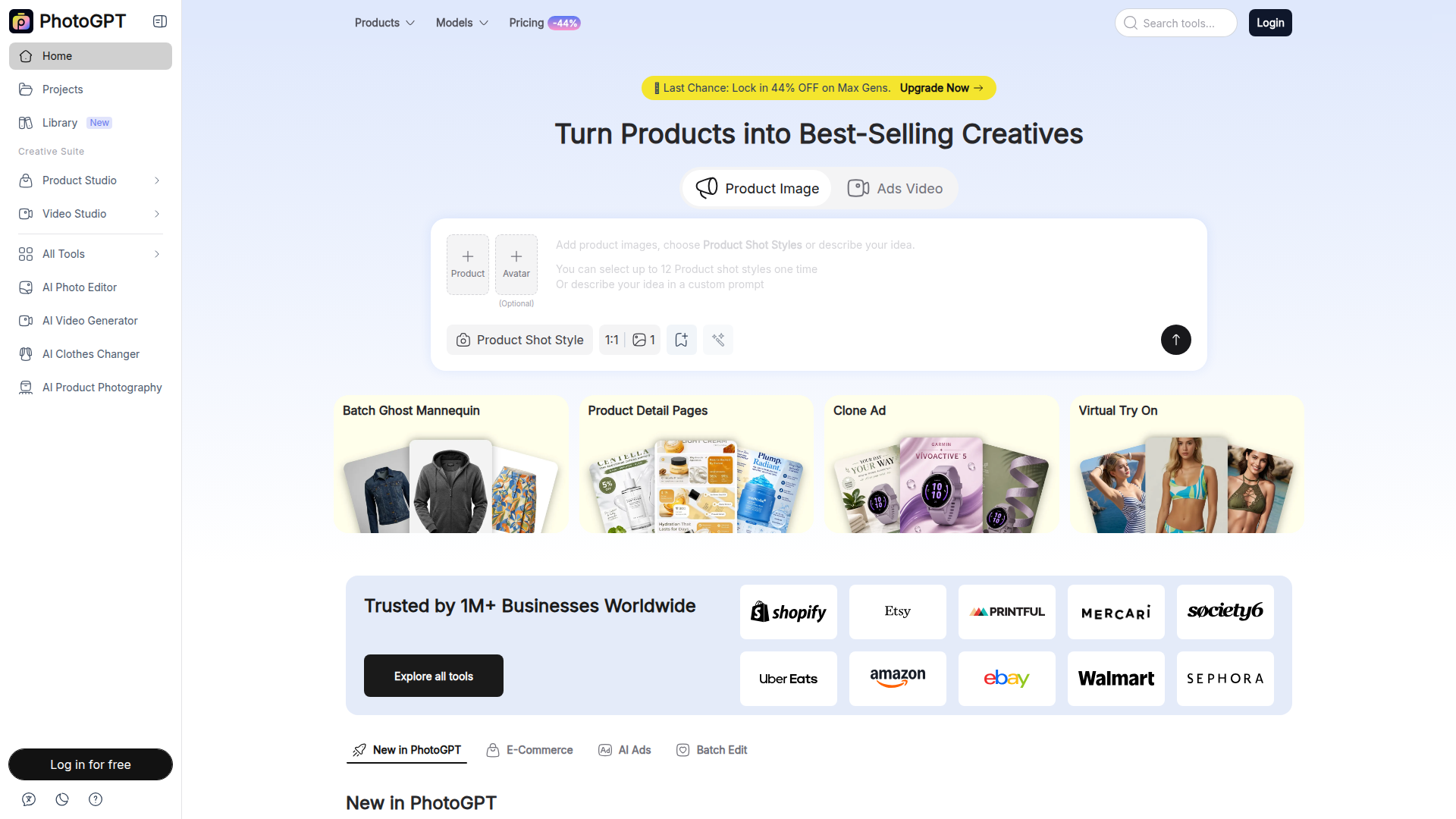
PhotoGPT is an AI-powered platform that allows users to create and edit professional product images, marketing creatives, and videos without needing photography or design skills. It offers a suite of tools for ecommerce sellers, marketers, and content creators, including AI product photography, virtual try-on experiences, ad cloning, and batch editing capabilities. With over 1 million businesses using it, PhotoGPT simplifies the process of generating studio-quality visuals, enhancing product listings, and producing engaging advertising content.

FEATURED
Rallied is an AI-powered technician designed specifically for Managed Service Providers (MSPs) to automate repetitive and time-consuming IT tasks like password resets, account unlocks, user onboarding, and offboarding. Unlike traditional RMM/PSA tools that only suggest actions, Rallied connects directly to your existing stack—including ConnectWise, Autotask, HaloPSA, M365, Entra ID, IT Glue, and more—and executes the fixes autonomously. It triages tickets, interacts with end users, and closes out issues without human intervention. With a rapid deployment of under a week and no implementation fees, Rallied eliminates the need for dedicated AI administrators, freeing your L2 and L3 engineers to focus on high-value projects. It's ideal for growing MSPs struggling with ticket volume, as well as those who've been disappointed by earlier AI tools. Rallied is SOC 2 compliant and offers a 30-day free trial, ensuring a risk-free start to transforming your helpdesk operations.

FEATURED
Beamtrace is a pioneering AI brand visibility tracking platform designed to help businesses monitor and optimize their presence within AI search engines and generative AI outputs. Its primary positioning is as the #1 tool for winning AI visibility, offering a suite of analytics focused on how AI systems see, mention, and recommend brands. The target audience includes marketing teams, agencies, startups, and business owners who need to understand their performance beyond traditional SEO, in the emerging landscape of AI-powered search and conversational answers. Core features revolve around calculating an AI Visibility Score, performing competitor benchmarking, and tracking rank for specific prompts. Content is highly specialized around AI search marketing, with in-depth solutions for platforms like ChatGPT and Perplexity. The user experience is streamlined for professionals, offering trend analysis, side-by-side comparisons, and actionable insights without requiring deep technical expertise. Technically, it aggregates data from leading AI platforms to provide a centralized dashboard for brand intelligence in the age of AI-driven discovery.

FEATURED
OneTwo Resume is an AI-powered career platform designed to help professionals secure interviews and land their dream jobs faster. Its core positioning centers on leveraging advanced artificial intelligence to automate and enhance the traditional resume creation process, dramatically reducing the time from a basic draft to an interview-ready application. The platform targets job seekers across all career stages—from recent graduates to senior executives—who need to create professional, ATS-optimized resumes and supporting documents efficiently. Core features include an intelligent resume builder that uploads and parses existing documents, a powerful AI that rewrites weak bullet points into quantified achievement statements, and a suite of integrated tools for cover letter generation, LinkedIn optimization, and interview preparation. Content features like professionally designed, ATS-tested templates and a unique 'Hiring Power Score' analysis provide immediate, actionable feedback. The user experience is streamlined into a simple three-step process, boasting completion times under five minutes. Technical features like bank-level encryption ensure data security. By offering a comprehensive career toolkit in one subscription, OneTwo Resume differentiates itself from basic resume builders and expensive human writers, delivering enterprise-level quality at an accessible price point.
FEATURED
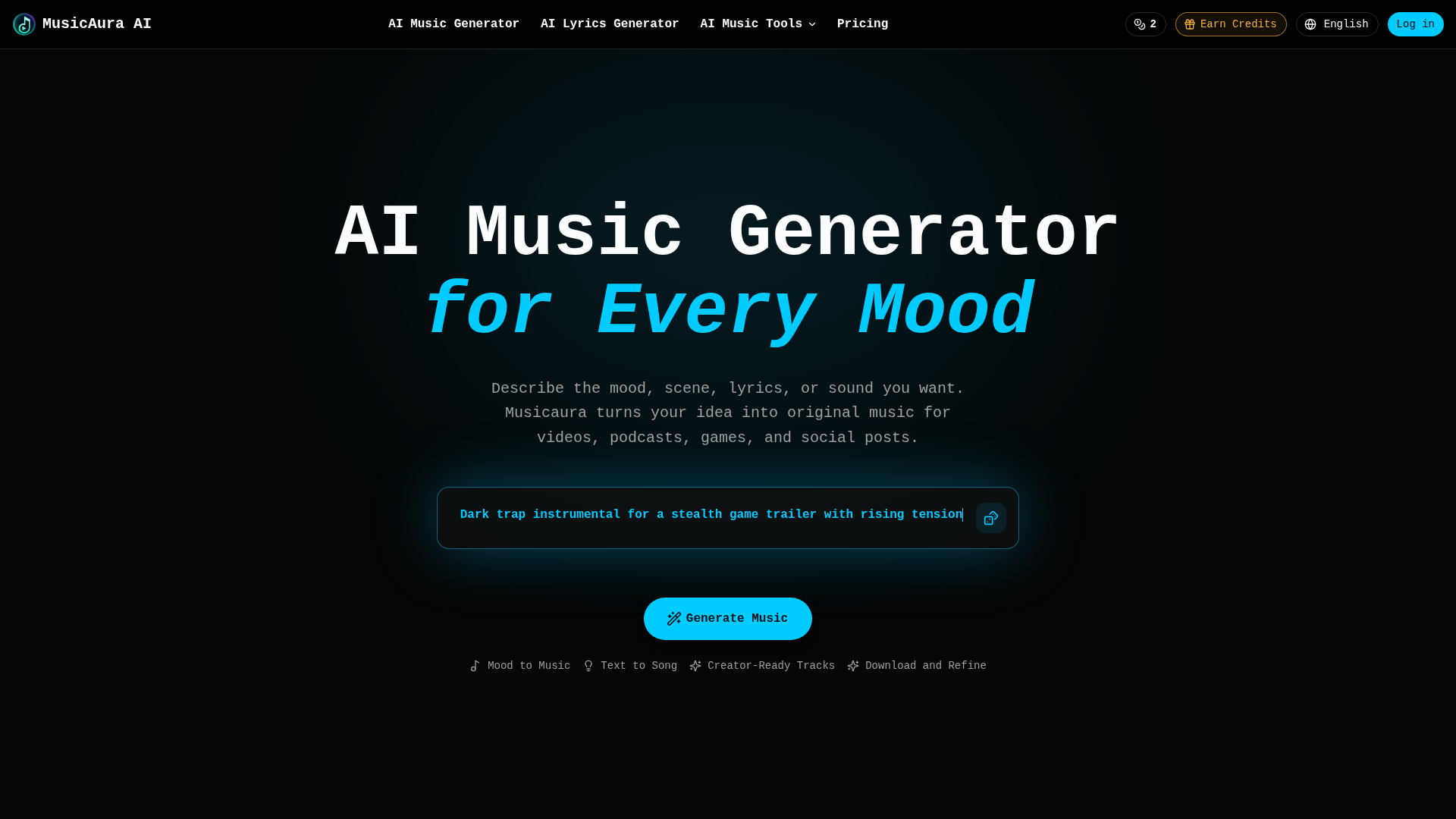
MusicAura AI is a comprehensive, browser-based audio creation platform designed specifically for digital content creators. Its core positioning is as an AI-powered audio workstation that simplifies music production for non-musicians and streamlines workflows for professionals. The platform's target audience includes video editors, podcasters, game developers, social media content creators, and marketing teams who need original, royalty-free music. Core features include an AI Music Generator that creates songs from text prompts describing mood or scenes, an AI Lyrics Generator, a Vocal Remover for isolating tracks, and a Stem Splitter for detailed audio editing. Content features are creator-focused, offering pre-made examples across various genres like pop, rap, and lo-fi. The user experience emphasizes simplicity and integration, allowing users to describe their needs in plain language and generate previews without technical skills. Technical features combine several specialized AI audio tools into a single workspace, enabling generation, editing, and processing without switching applications.

FEATURED
DaVinci positions itself as an all-in-one generative AI platform for visual creation, offering seamless access to cutting-edge models like Sora, Veo, and Flux. Its target audience spans creative professionals, marketers, social media content creators, and businesses seeking high-quality, scalable visual assets. The core features revolve around unified generation and editing of images and videos, integrated within a single workspace. Content features include state-of-the-art AI models for text-to-image, image-to-video, upscaling, and object editing. The user experience is designed to be professional yet accessible, enabling fast iteration and refinement without technical complexity. Technical features boast a credit-based system, priority queues for subscribers, and a mobile app. The platform emphasizes data privacy, commercial usage rights, and trust, aiming to be the go-to suite for end-to-end creative workflows.
FEATURED
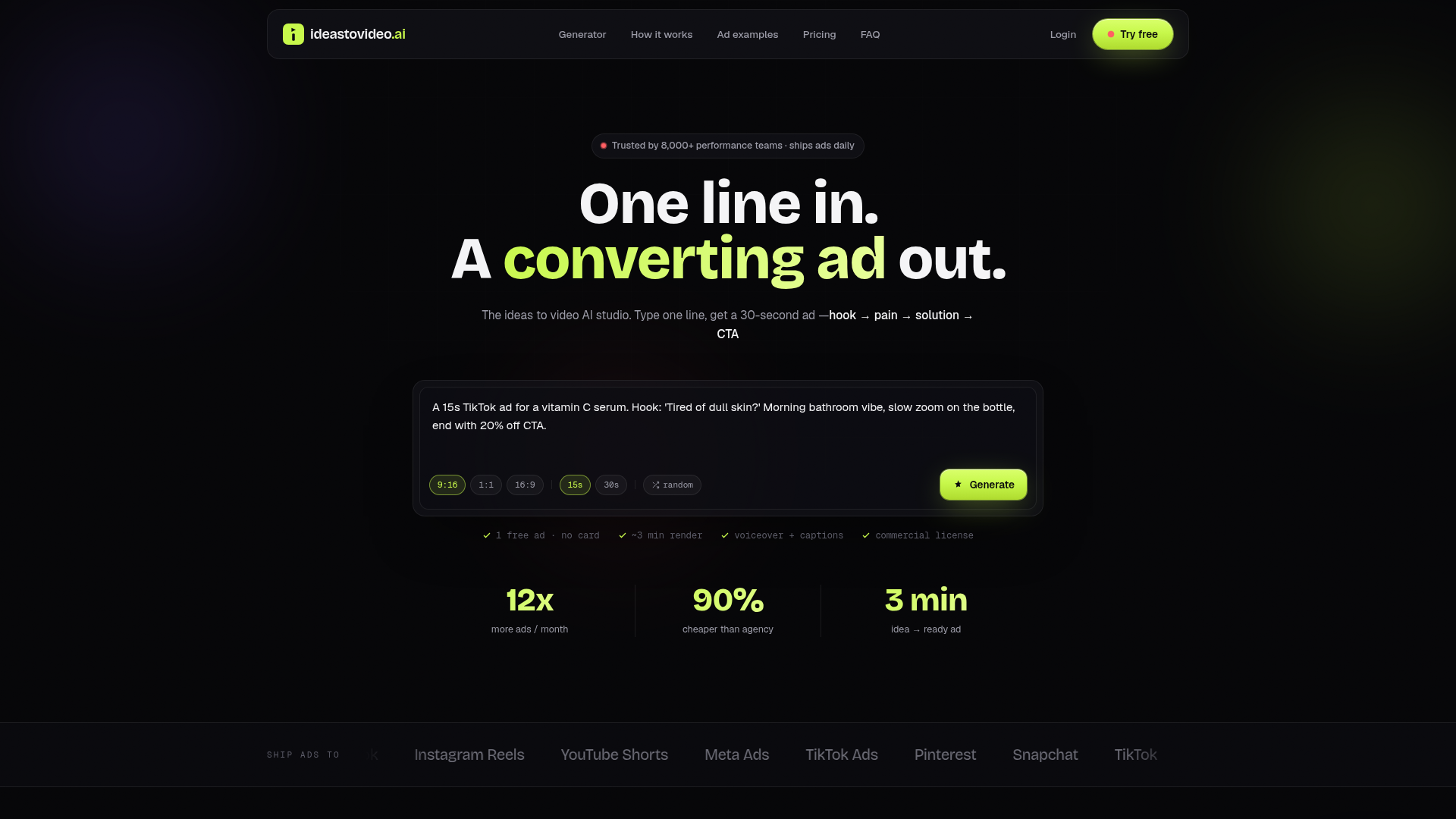
Ideas To Video AI is a revolutionary AI-powered ad studio that transforms simple text prompts into high-converting, ready-to-publish social media video ads in approximately three minutes. Its core positioning is to eliminate the traditional bottlenecks and high costs of ad production—such as agency retainers, lengthy shoots, and multiple revisions—by compressing the entire creative pipeline into a single, intelligent workflow. The platform specifically targets performance marketers, e-commerce brands, agencies, and content creators who need to scale their creative testing on platforms like TikTok, Instagram Reels, YouTube Shorts, and Meta Ads. At its heart is an AI script engine trained on top-performing ad structures (hook, pain, solution, CTA), which automatically generates tailored scripts, matches them with dynamic AI-generated B-roll footage, adds professional voiceovers in over 120 voices, and burns in styled captions. The user experience is streamlined from a one-line prompt to a multi-format export, featuring a Brand Kit for consistent branding and priority rendering for high-volume users. Technologically, it leverages advanced generative AI for video, audio, and text synthesis, offering a commercial license for all outputs and supporting high-volume testing with scalable subscription plans.
FEATURED
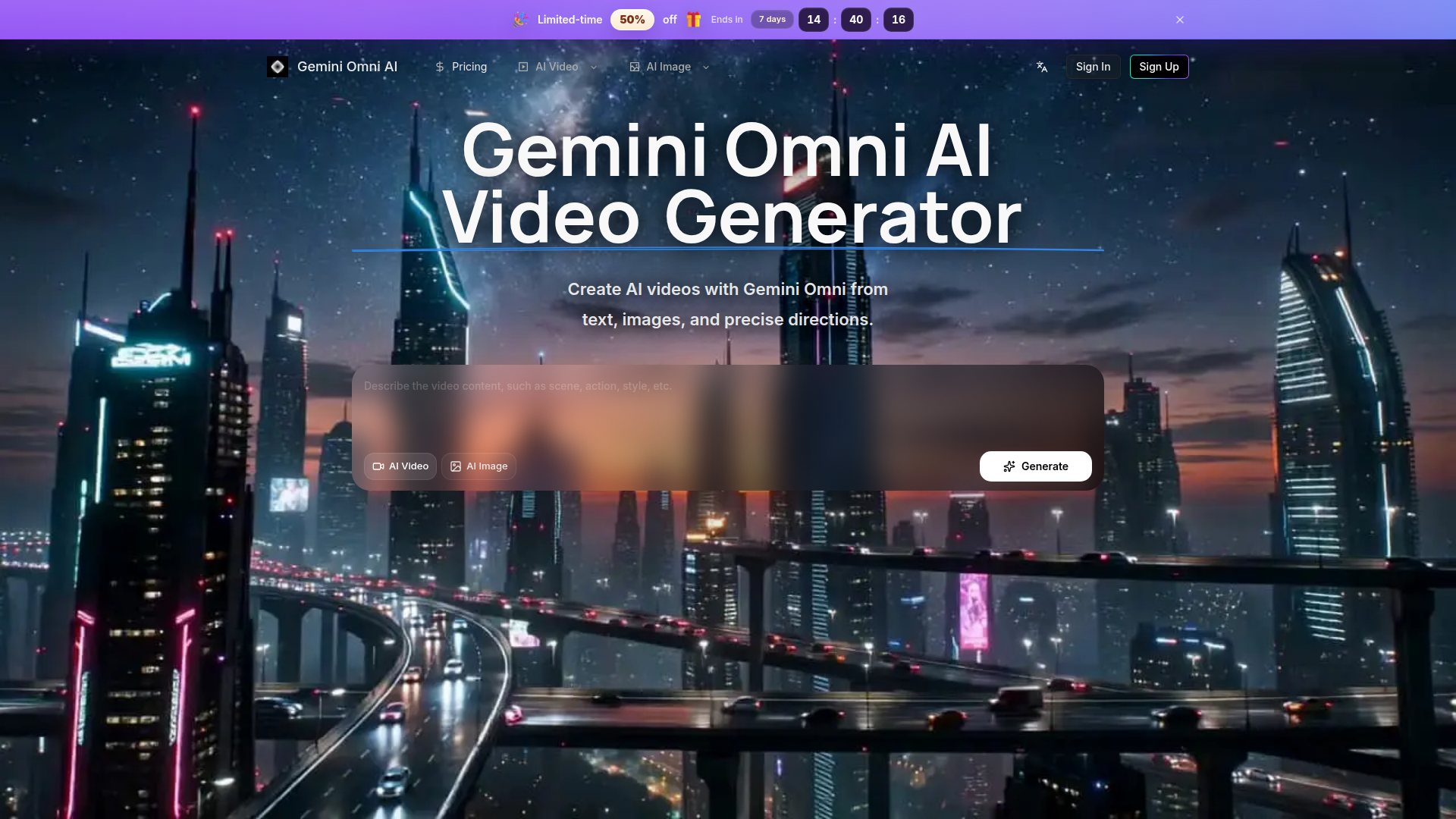
Gemini Omni AI Video Generator is a specialized, streamlined platform focused exclusively on high-quality AI video and image creation powered by models like Gemini Omni. Unlike broad marketplaces, it offers a cohesive workflow for planning, generating, and refining cinematic videos from text prompts, images, and precise references. The target audience includes professional creators, marketers, designers, and e-commerce operators who need efficient production of social clips, product ads, and conceptual scenes. Core features emphasize fine-grained control over camera motion, style, and subject, supported by HD, editing-friendly outputs. Content is enriched with public examples and creator updates for inspiration, while user experience prioritizes continuity—keeping history, credits, and generation tools in one unified interface to eliminate workflow fragmentation.

FEATURED
ChainClarity is a specialized educational and research platform that leverages artificial intelligence to demystify complex cryptocurrency whitepapers. Its core positioning is providing accessible cryptocurrency literacy for all levels of users by breaking down technical documents into clear, concise explanations. The target audience spans from crypto beginners intimidated by dense technical jargon, to investors needing to perform due diligence on new projects, and even builders or researchers needing to quickly grasp a project's essence. Its core features include an ever-growing library of AI-powered explanations for individual tokens or projects, detailed side-by-side comparison tools for understanding project differences, and intuitive categorization by sector (Layer 1, DeFi, NFTs, etc.) for structured exploration.The content is presented in plain English, avoiding hype or price speculation, and focuses on analysis of technology and utility. The user experience is centered on a clean, searchable interface with a main table of projects, community-driven 'Popular This Week' insights, and a newsletter for regular updates on new analyses. Technically, the platform acts as an AI companion ('MeetQai') to automate the process of ingesting and interpreting whitepapers, making advanced crypto research scalable and user-friendly.
FEATURED
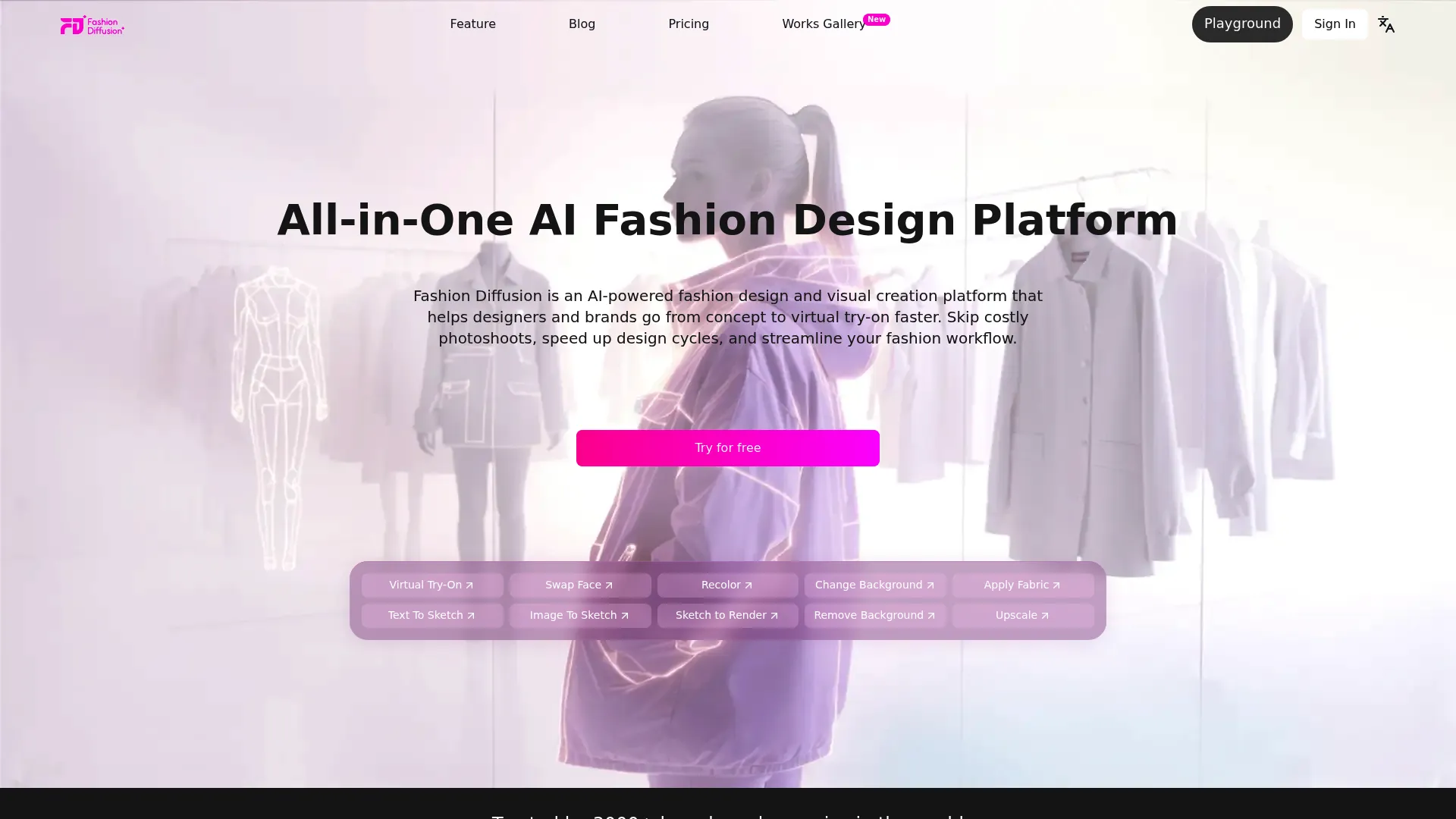
Fashion Diffusion is a comprehensive AI-powered platform revolutionizing the fashion design and visualization industry. Positioned as an all-in-one fashion design generator, it targets fashion designers, brands, e-commerce teams, and content creators. The platform's core features empower users to transform concepts into polished visuals rapidly, offering specialized tools for AI fashion sketching, virtual try-on, and professional image editing. Its content features include a vast gallery of generated works and an educational blog. The user experience is optimized for desktop creation with mobile sign-up bonuses, providing an intuitive workflow from ideation to market-ready imagery. Technologically, it leverages advanced machine learning models for fashion-specific tasks like fabric application and style fusion, streamlining the entire creative and production cycle while significantly reducing costs and time-to-market for new collections.
FEATURED
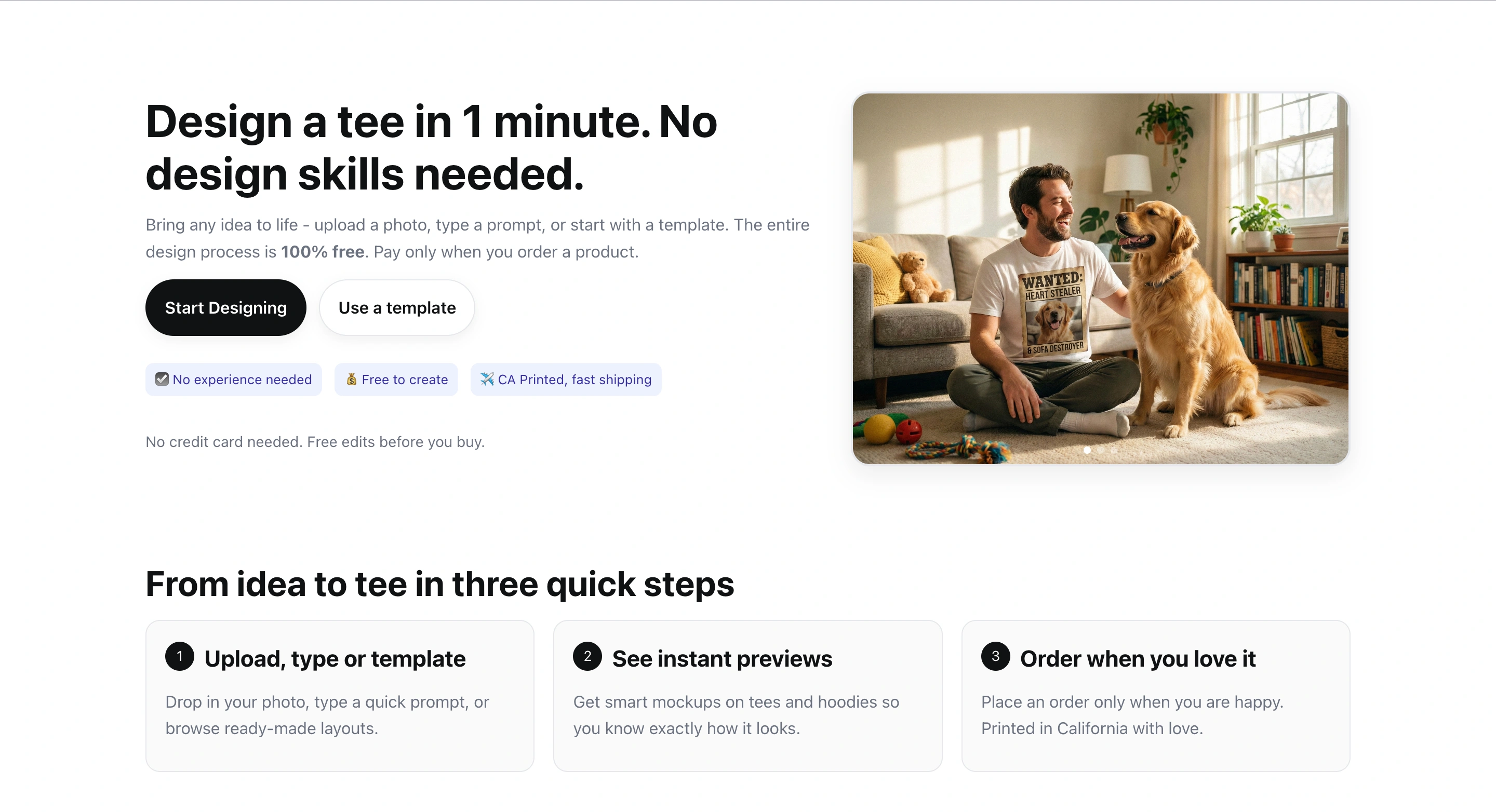
TeeDIY is a platform that allows users to design custom apparel in minutes. It caters to individuals and groups looking for personalized clothing. It offers free design tools, various templates, and user-friendly interfaces. It features a suite of smart tools including magic cleanup, style assist, auto layout, and smart edit. These tools help users create balanced designs with ease. This platform enables users to bring their ideas to life without needing prior design experience. It offers fast shipping within California.
FEATURED
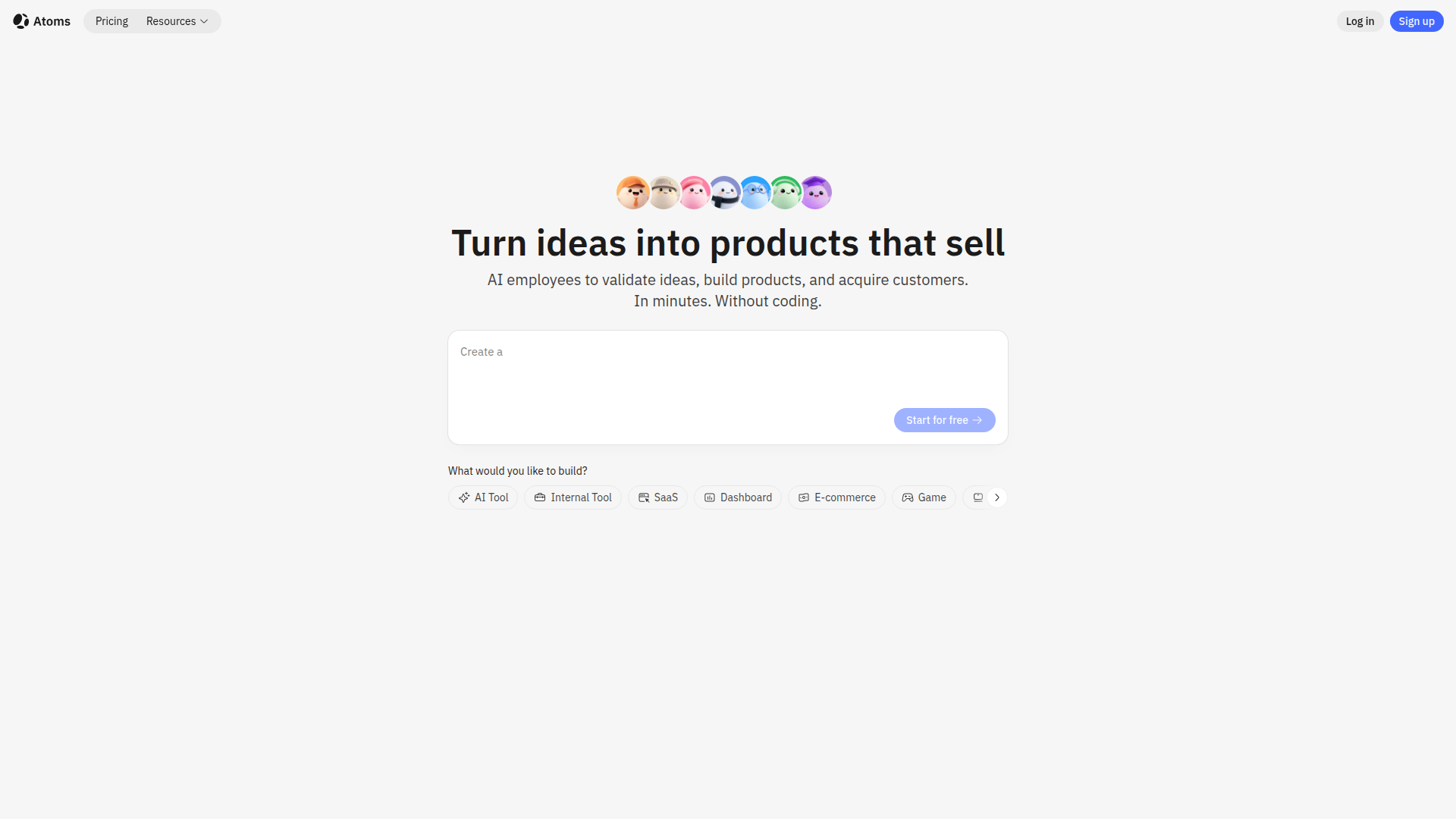
Atoms is an AI-powered platform designed to transform ideas into functional web and mobile applications without requiring any coding knowledge. It leverages a multi-agent AI team, including specialized roles like Product Manager, Engineer, and Data Scientist, to handle every aspect of the development process. Atoms simplifies building SaaS apps, e-commerce platforms, internal tools, and personal projects, offering features like user login, database storage, Stripe payments, and SEO optimization. It provides a user-friendly visual editor, out-of-the-box full-stack backend, instant AI integrations, and one-click deployment, helping users to launch faster, automate operations, and drive revenue while remaining fully in control with code export options.

FEATURED
Pantora is a cutting-edge Answer Engine Optimization (AEO) platform meticulously designed to help local home service professionals, such as plumbers, electricians, HVAC technicians, and roofers, gain prominence. By optimizing their online presence, Pantora ensures these businesses are favorably recommended by AI assistants like ChatGPT and Google AI Overviews. The platform offers AI-optimized websites, continuous visibility tracking, sentiment analysis, and competitor insights, providing comprehensive recommendations for improvement. Pantora simplifies complex SEO and AEO tasks, enabling professionals to attract more customers through AI-driven recommendations. It empowers them to manage their online reputation, enhance visibility, and ultimately, grow their businesses in an evolving digital landscape.
FEATURED
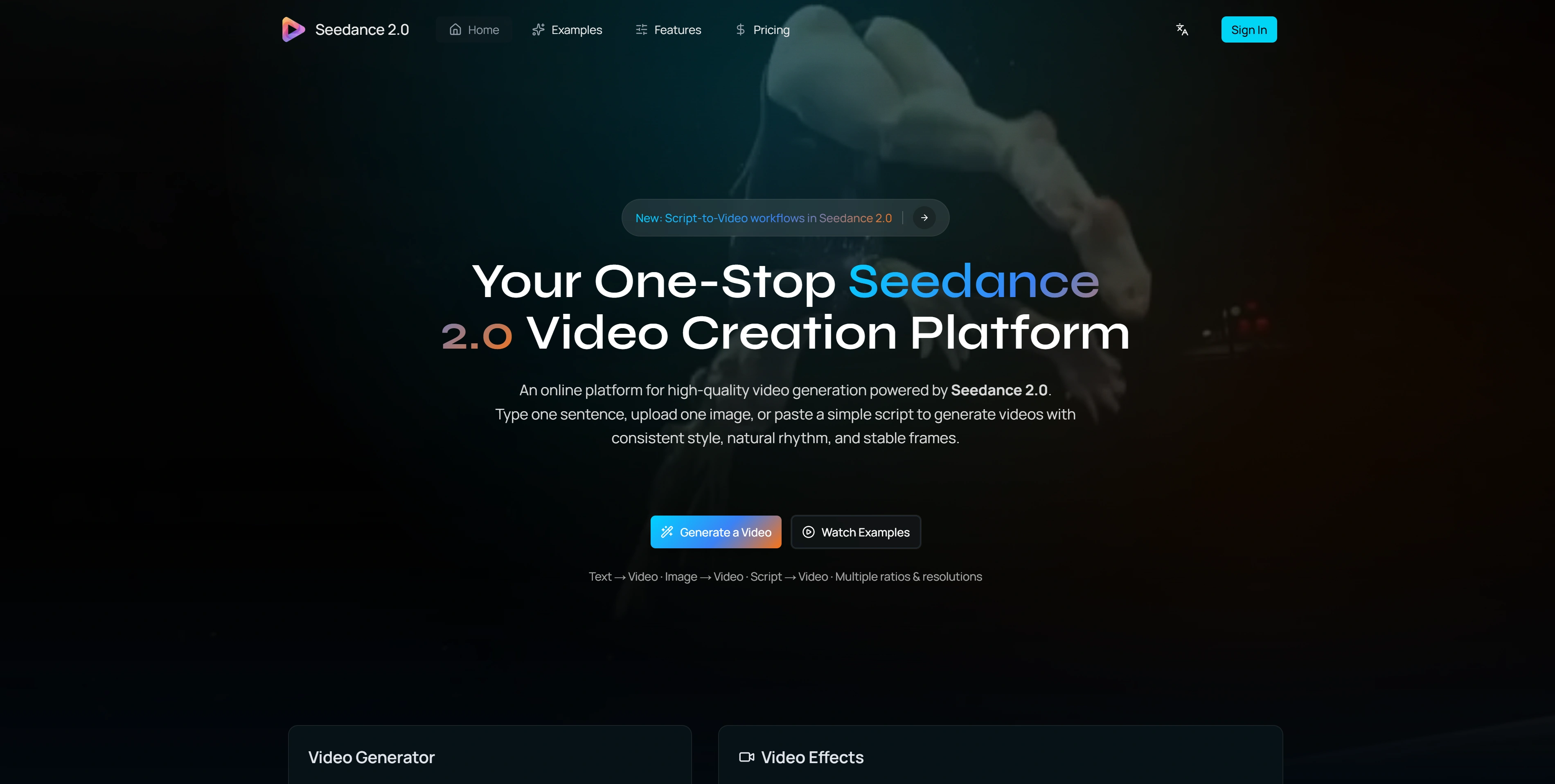
Seedance 2.0 is a cutting-edge AI video generation platform designed for creators and teams. It allows users to generate high-quality, consistent, and visually appealing videos from text prompts, images, or scripts. With a focus on temporal consistency, natural motion, and stable frames, Seedance 2.0 delivers a unique video creation experience. It supports various aspect ratios and resolutions, making it versatile for different platforms. Its advanced features like integrated audio generation and physics-aware motion provide a complete solution for creating marketing videos, social media content, product demos, and more.
FEATURED
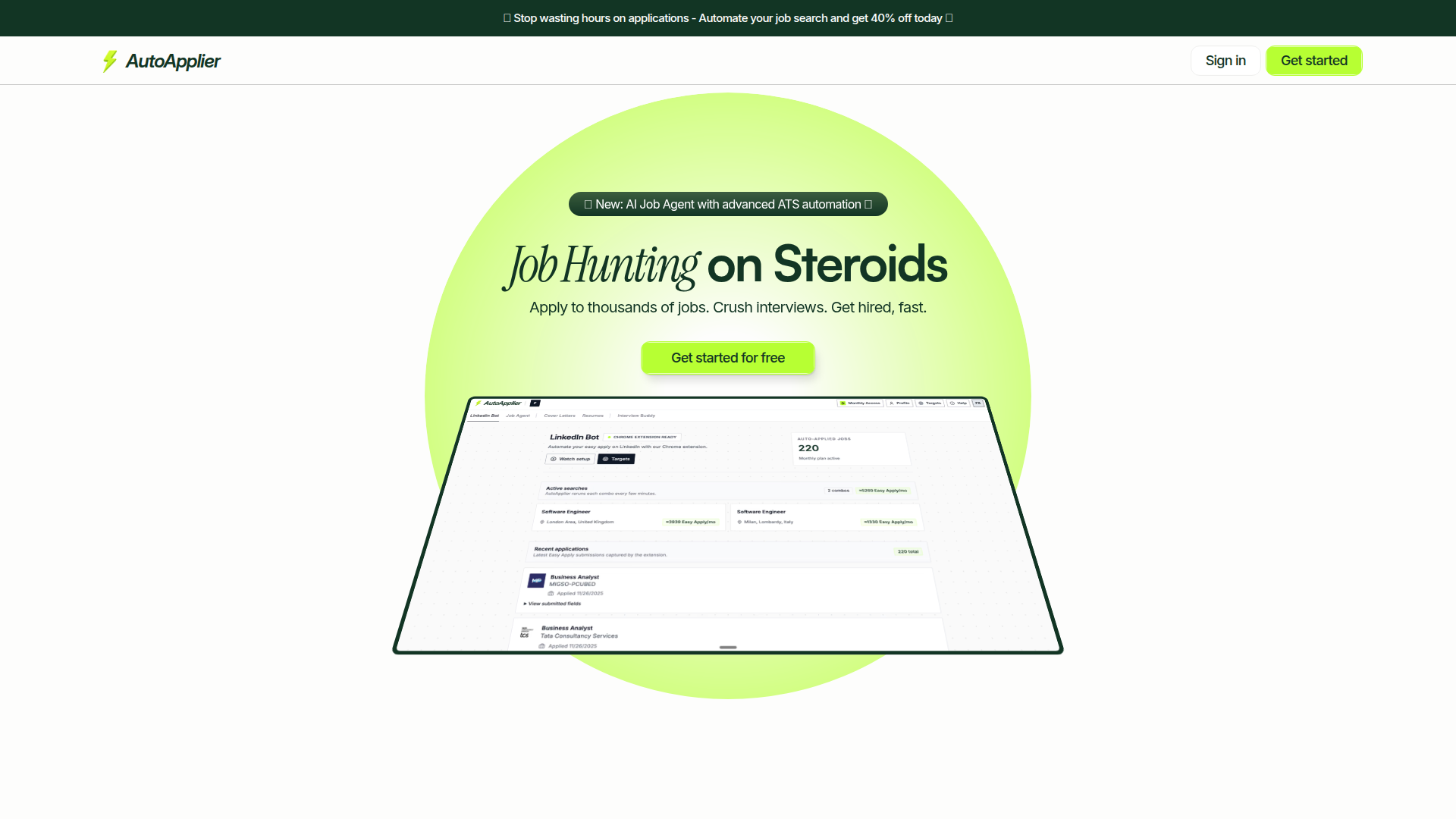
AutoApplier is an AI-powered platform designed to supercharge job seekers' efforts. It provides a suite of tools that automate job application processes, optimize resumes, and generate personalized cover letters. By leveraging AI, AutoApplier helps users save time, apply to thousands of jobs efficiently, and enhance their interview performance. Key features include an AI Job Agent, AI Interview Buddy, LinkedIn automation bot, and resume/cover letter generators. Its focus on sustainable growth ensures continuous improvements and valuable outcomes for users looking to land their dream jobs quickly.
FEATURED
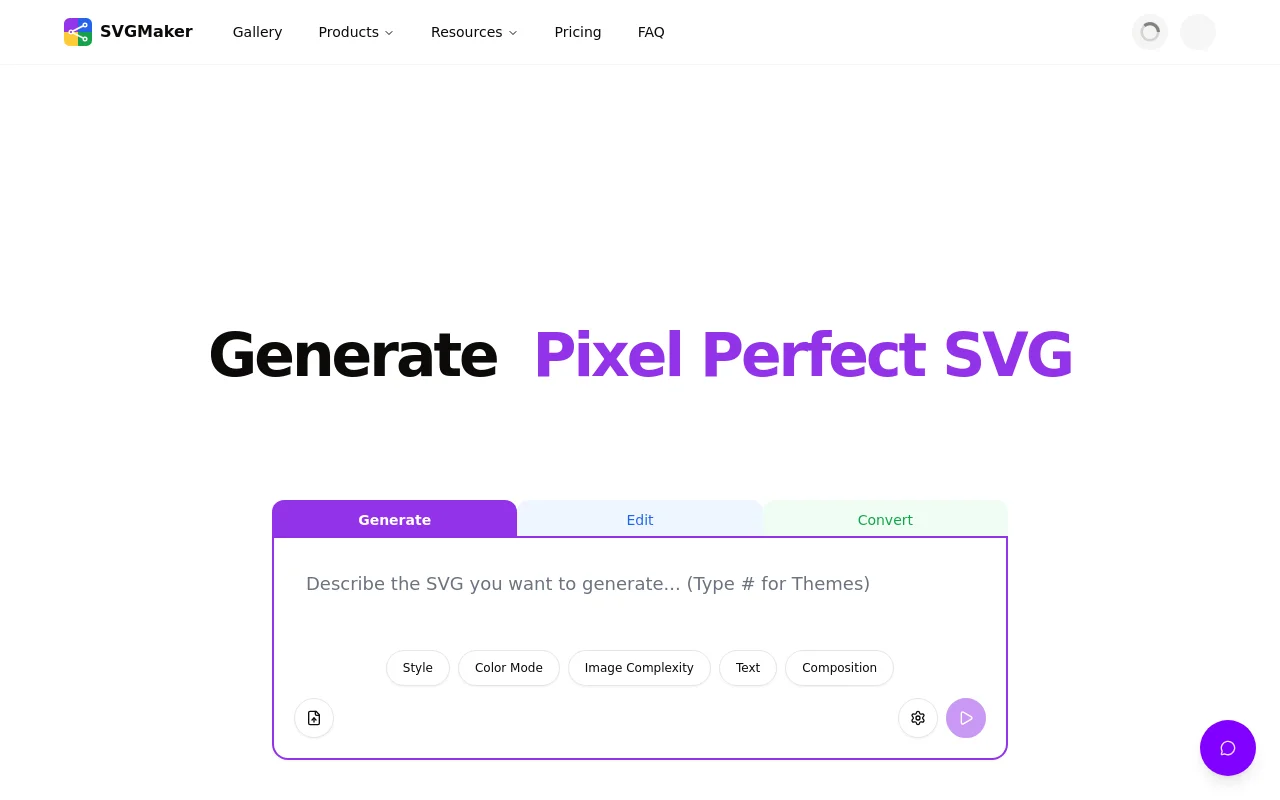
SVGMaker combines the power of artificial intelligence with professional-grade editing tools, making vector graphic creation accessible to everyone from beginners to experienced designers. Whether you're generating SVGs from scratch, converting existing images, or optimizing files for web performance, SVGMaker streamlines your workflow with browser-based convenience and developer-friendly integrations.
FEATURED
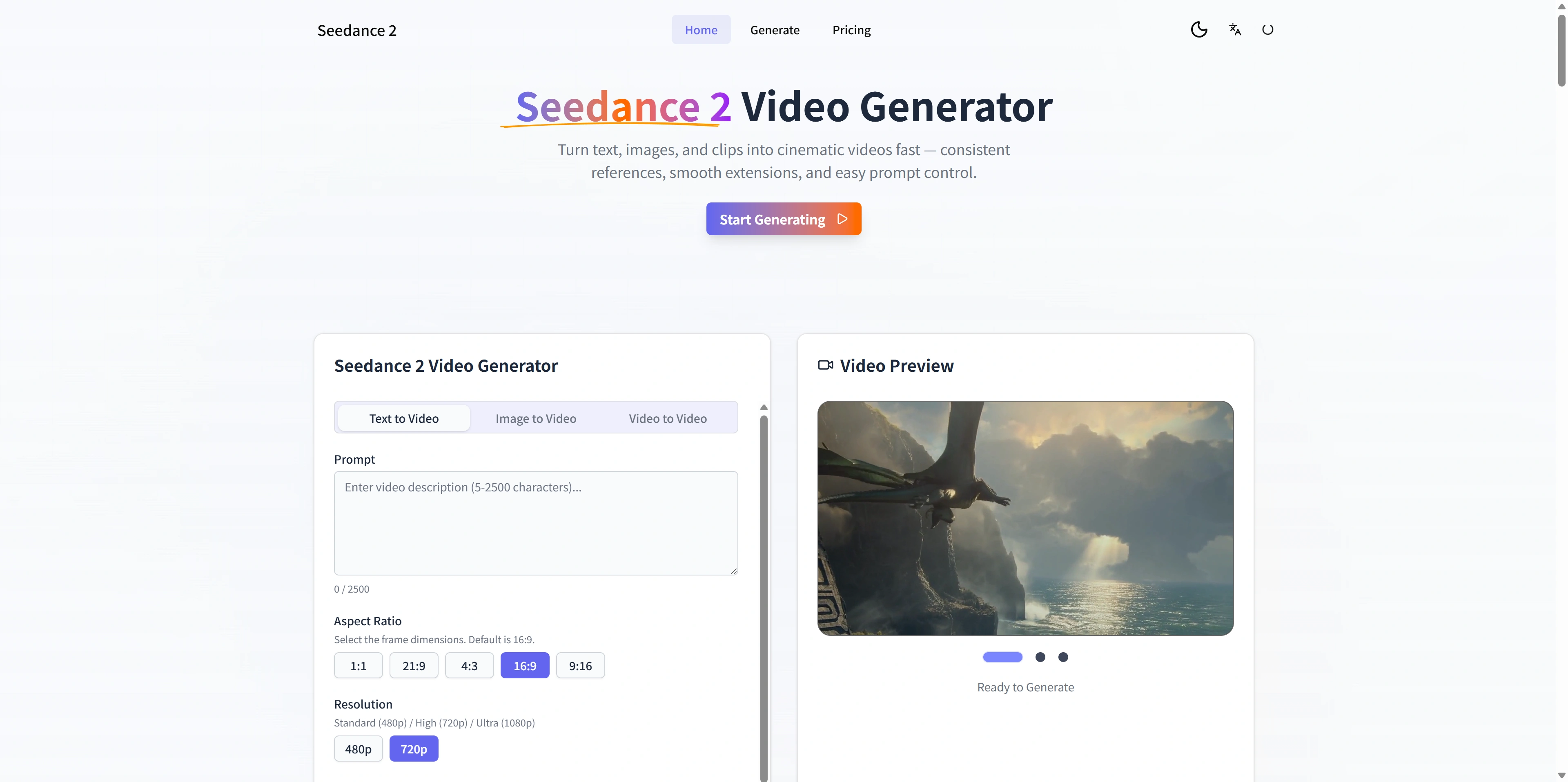
Seedance 2 is an AI-powered video generator designed for creators and teams who need cinematic-quality videos from text, images, and existing footage. It offers multimodal inputs, stable motion, and fast iteration loops, enabling users to move rapidly from concept to publishable video. The platform's reference-first workflow provides greater control and consistency, allowing for smooth extensions and easy prompt adjustments. It is ideal for generating ads, social media content, and product demos with high-definition outputs and quick exports.
FEATURED
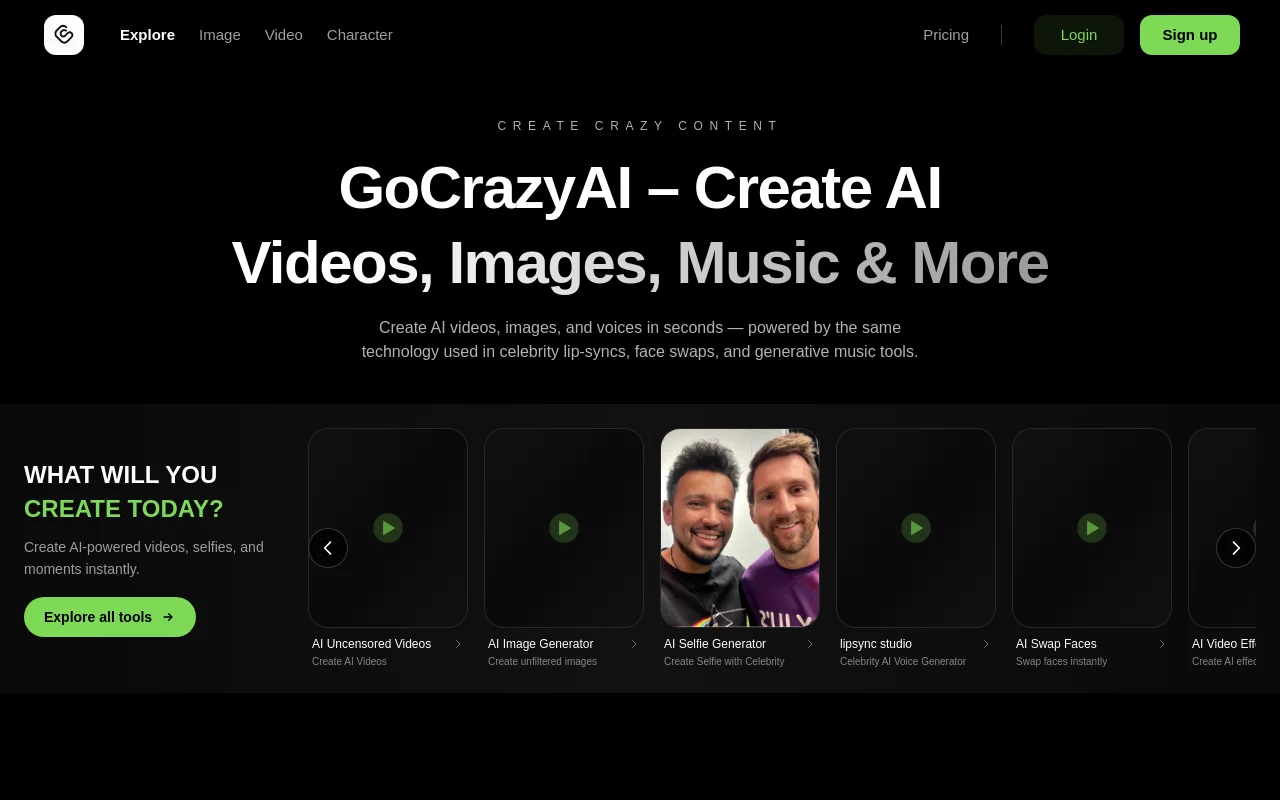
GoCrazyAI is an innovative AI studio providing a suite of tools for creating AI videos, images, and avatars. It stands out by offering unfiltered and uncensored content generation, allowing users full creative freedom. The platform features tools for AI selfie generation, lip-sync videos with celebrities, AI face swaps, and various AI video effects. GoCrazyAI empowers users to produce diverse content, from viral videos to realistic avatars, utilizing next-generation AI models. With a privacy-first approach, user prompts and content are kept private and secure, making it ideal for creators seeking limitless possibilities.
FEATURED
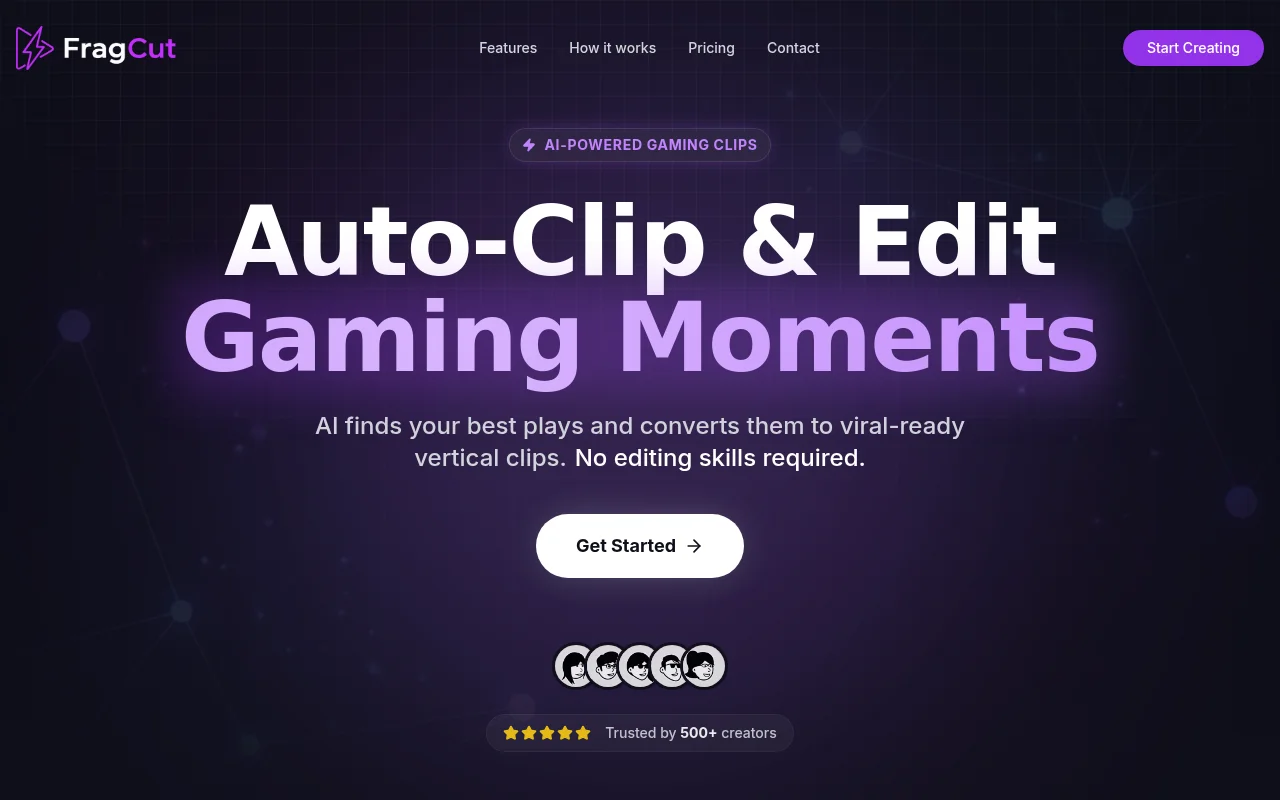
FragCut is an AI-powered gaming clip generator designed to help streamers and content creators quickly transform their long-form VODs into viral-ready short-form content. It automates the process of finding exciting moments, optimizing for vertical video formats, and adding captions, enabling creators to focus on their gameplay. By leveraging cloud processing, FragCut ensures accessibility from any device without the need for software installations. With a trust base of over 500 creators, FragCut provides an efficient solution for turning streams into engaging clips.
FEATURED
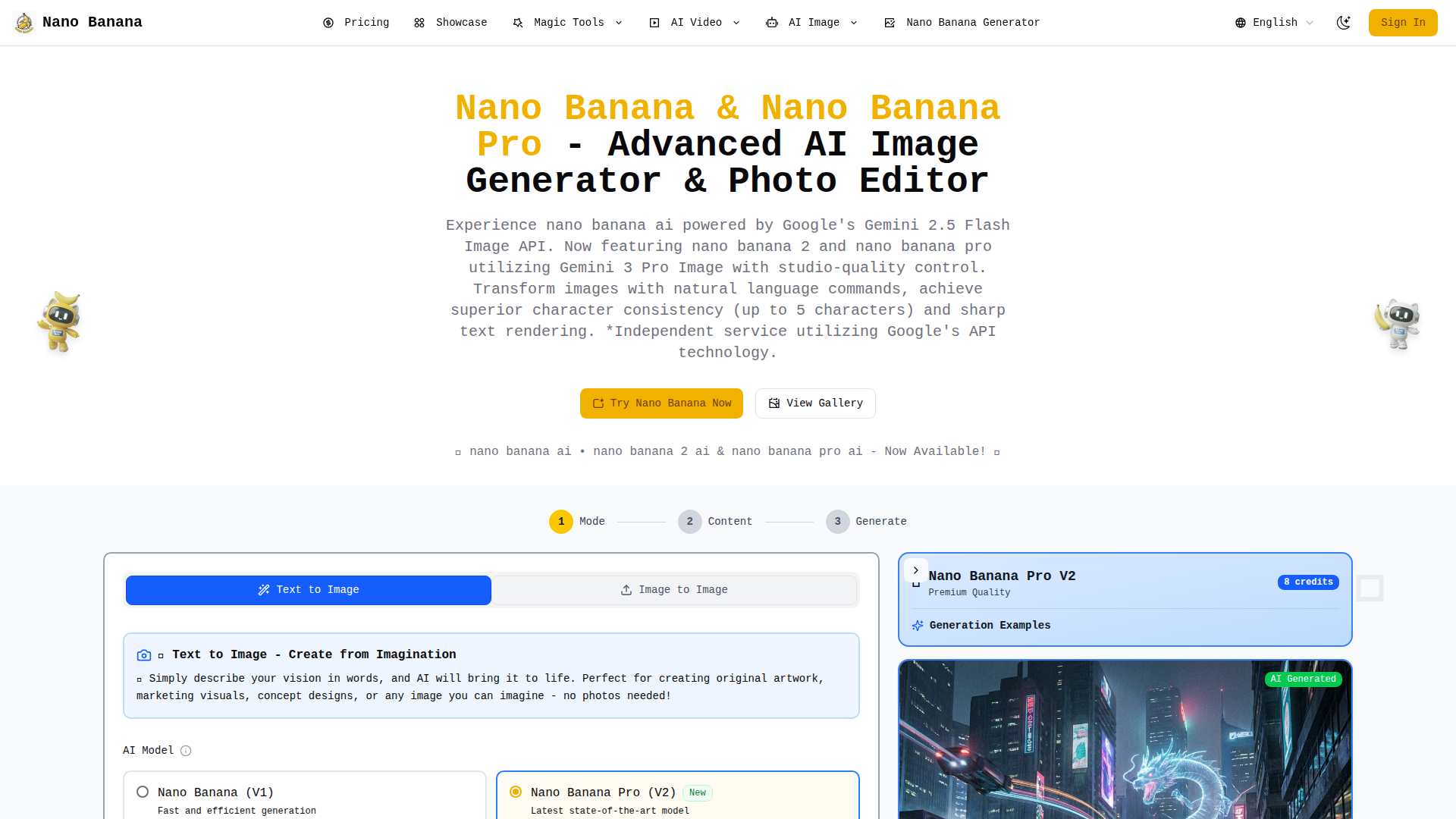
Nano Banana is an innovative AI-powered image generation and editing platform that leverages Google’s cutting-edge Gemini AI models. It offers advanced editing capabilities through natural language prompts, superior character consistency, and sharp text rendering. Featuring Nano Banana, Nano Banana 2, and Nano Banana Pro, this platform provides various options to cater to different user needs and skill levels. Nano Banana empowers users to transform their creative ideas into stunning visuals with studio-quality results. It's an independent service utilizing Google's API technology, making AI accessible to everyone from individual creators to large enterprises.
FEATURED
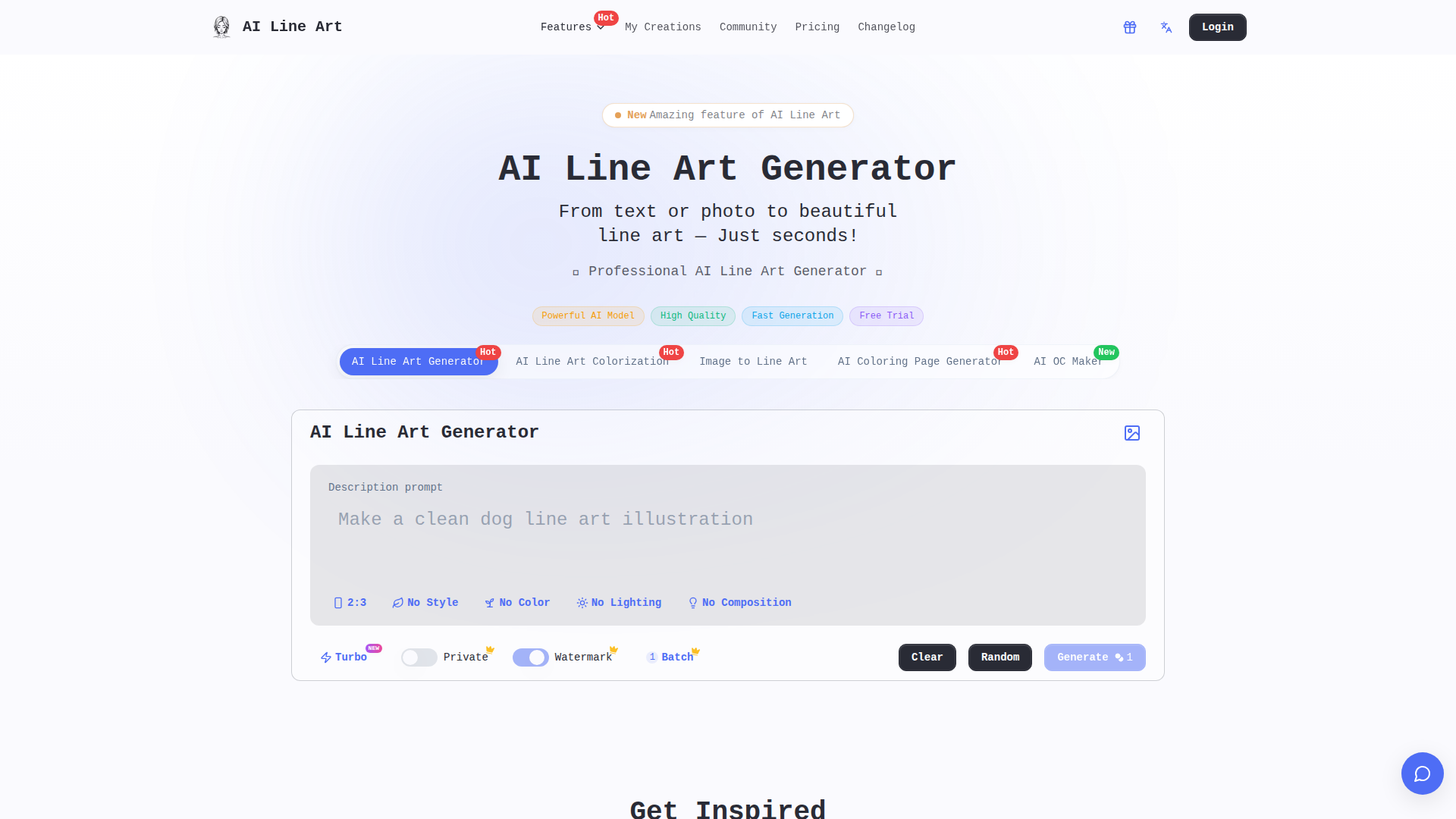
AI Line Art is an AI-powered online tool that facilitates the effortless transformation of photos and text descriptions into stunning line art illustrations. It boasts the capability to generate high-quality line drawings in various styles, making it accessible to both beginners and professionals. With features like one-click generation, multiple art styles, and advanced customization, users can create unique and professional-looking line art for diverse applications, including branding, illustration, tattoo design, and architectural visualization. It provides fast processing and high-resolution export options.
FEATURED
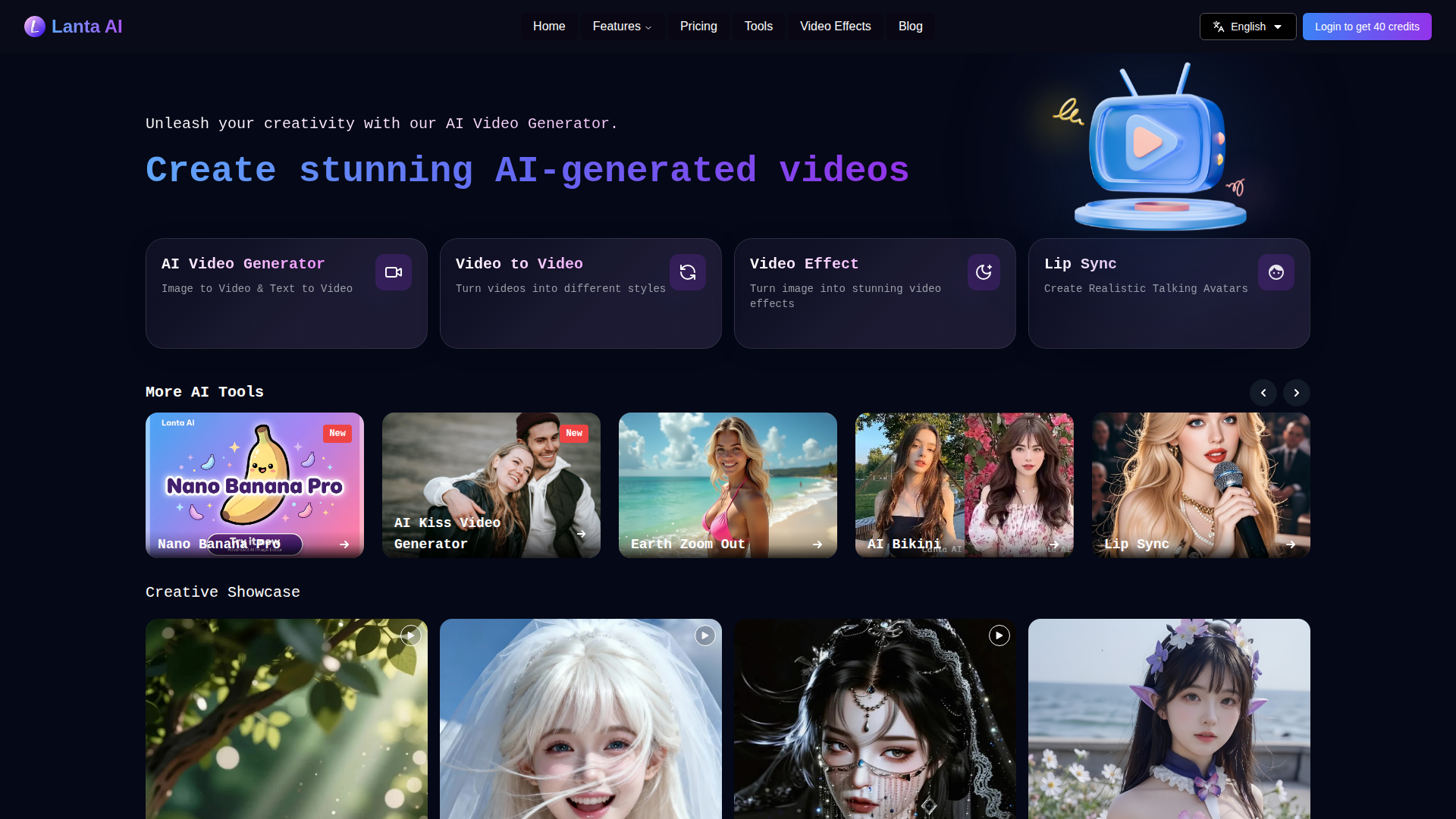
Lanta AI is a versatile online platform that empowers users to generate high-quality AI-generated videos from various inputs, including videos, images, and text. It offers a range of tools for video processing, generation, and editing, allowing users to convert videos into different styles, create videos from text or images, and apply various video effects. The platform features advanced AI models like FramePack, Wan 2.1, and Hunyuan Video. Lanta AI aims to simplify video creation, making it accessible to both beginners and professionals, and offers features like prompt-driven editing and smart repair to make video creation easy.

FEATURED
Jobserver AI is an open-source career aggregator designed to simplify the job search process. It provides a straightforward, user-friendly platform for companies and private entities to post job opportunities globally. Jobserver focuses on interactive job listings and private service listings, ensuring a simplified process for job seekers. It offers a tool designed for job seekers to find opportunities in AI/ML, software engineering, and other tech roles, Jobserver connects talent with opportunities. The platform ensures all job postings are legitimate and regularly monitored, promoting a trustworthy job search experience. Jobserver is dedicated to connecting job seekers with relevant and quality opportunities, enhancing the overall job search process. They can also analyze the match between their CV and employer requirements.
Latest AI Tools
Latest AI tools found by amazing founders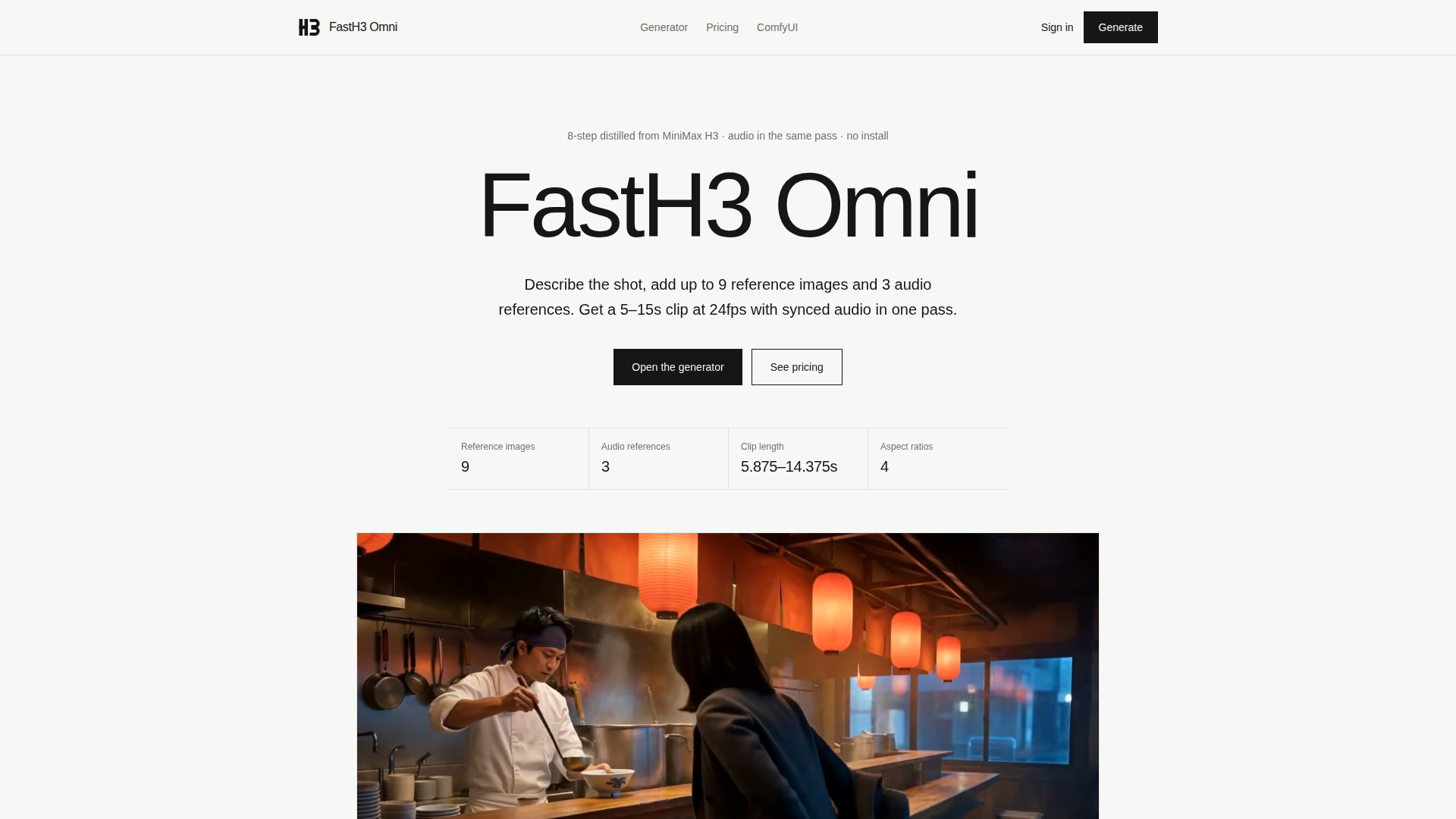
FastH3 Omni is an independent, browser-based reference-to-video AI generator that turns a written prompt — plus up to 9 reference images and 3 audio clips — into a 5–15 second video clip with synced audio in a single generation pass. Built on an open-weight video model distilled from MiniMax H3 Ref2VA down to just 8 denoising steps, it renders picture and sound together at 24 fps, so lips, footsteps and music line up naturally without manual editing or post-production. Website Positioning: FastH3 Omni positions itself as a fast, no-install creative tool for producing short, consistent AI video clips directly in the browser, and is explicitly an independent third-party tool not affiliated with FastVideo, Nuva Lab, or MiniMax. Target Audience: independent creators, video editors, marketers, social media producers, product and character designers, and AI enthusiasts who need quick on-model clips or storyboard-style previews without setting up a local GPU workflow. Core Features: text-to-video and reference-to-video generation, up to 9 reference images, up to 3 audio references (2–15s each), optional first and last frame control, four aspect ratios (16:9, 1:1, 9:16, 4:3), five exact clip lengths from 5.875s to 14.375s, credit-based pricing with automatic refunds for failed runs, and a downloadable MP4 (H.264 + AAC). Content Features: the site provides a full in-page generator form, an input capability table, a FastH3 vs FastH3 Omni comparison, explanations of how each reference type steers the output, output specs and pricing tables, sample clips, and a detailed FAQ. User Experience: the entire workflow — connect, upload, generate, save, done — happens on one page with live preview playback while rendering, and the finished clip is saved to the account for 7 days. Technical Features: 8-step distilled inference, real-time rendering of the first three reference images, single-pass audio-video conditioning, Stripe checkout, and an optional ComfyUI integration, all with no software installation required.
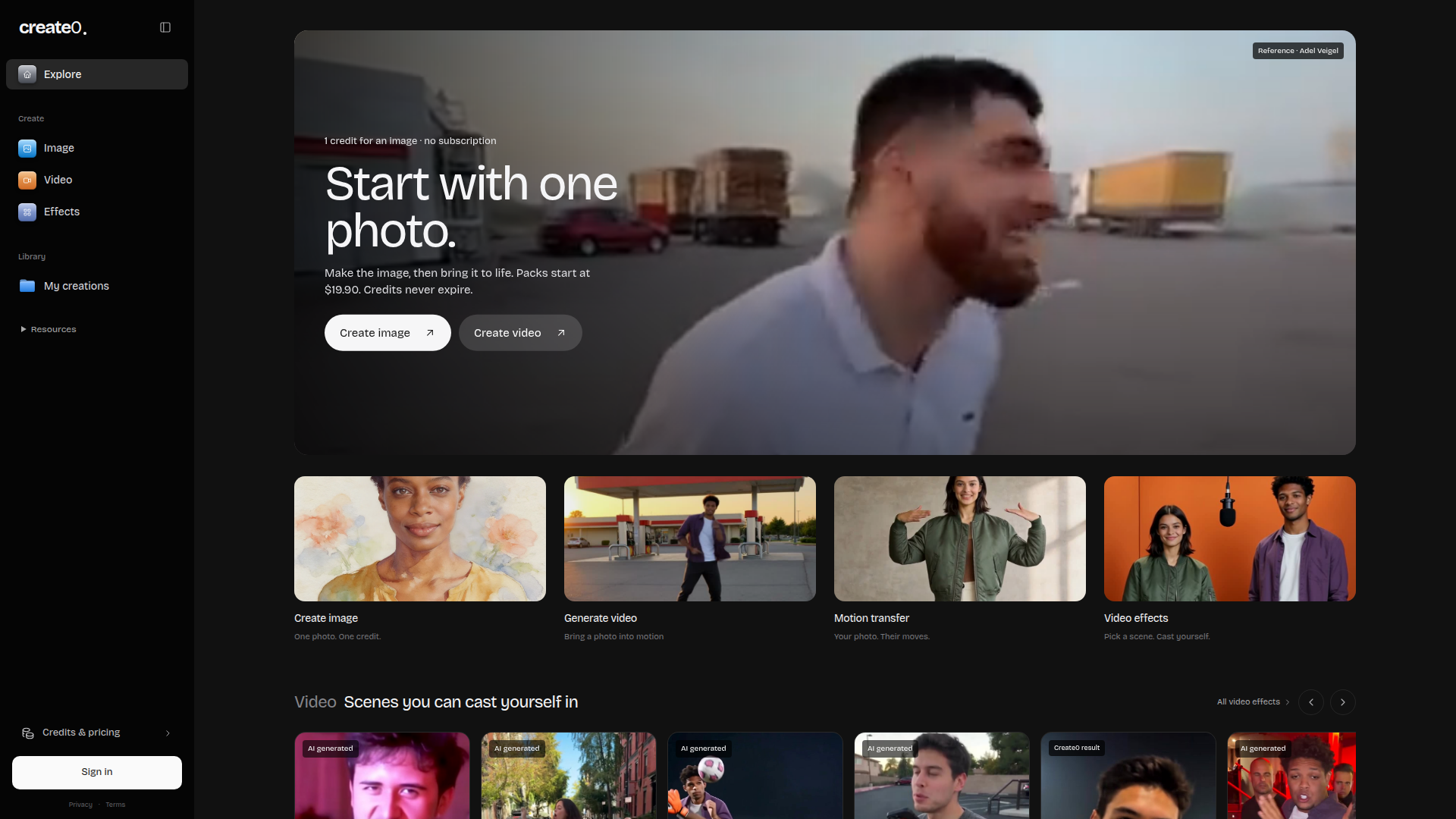
Create0 is an innovative AI-powered platform that transforms a single photo into stunning AI-generated images and dynamic videos. Positioned as a user-friendly tool for both casual creators and professionals, it offers a wide range of ready-made effects, from portrait enhancements to cinematic video scenes. The core feature is the ability to upload one photo and apply various AI effects, such as motion transfer, style transfer, and scene casting. Content features include a vast library of video effects (e.g., dance trends, movie scenes) and photo effects categorized into Portrait, Editorial, Analog, Illustration, and 3D & Pixel. The user experience is streamlined: users buy credits (which never expire) and spend them on any image or video generation. No subscription is required, making it cost-effective for occasional use. Technically, Create0 leverages advanced AI models to generate high-quality outputs, with a focus on realism and creativity. The platform also provides guides, model comparisons, and a gallery of creations for inspiration. Target audience includes social media enthusiasts, content creators, marketers, and anyone looking to create engaging visual content without extensive editing skills. With a pay-per-use credit system starting at $19.90, Create0 offers flexibility and value.
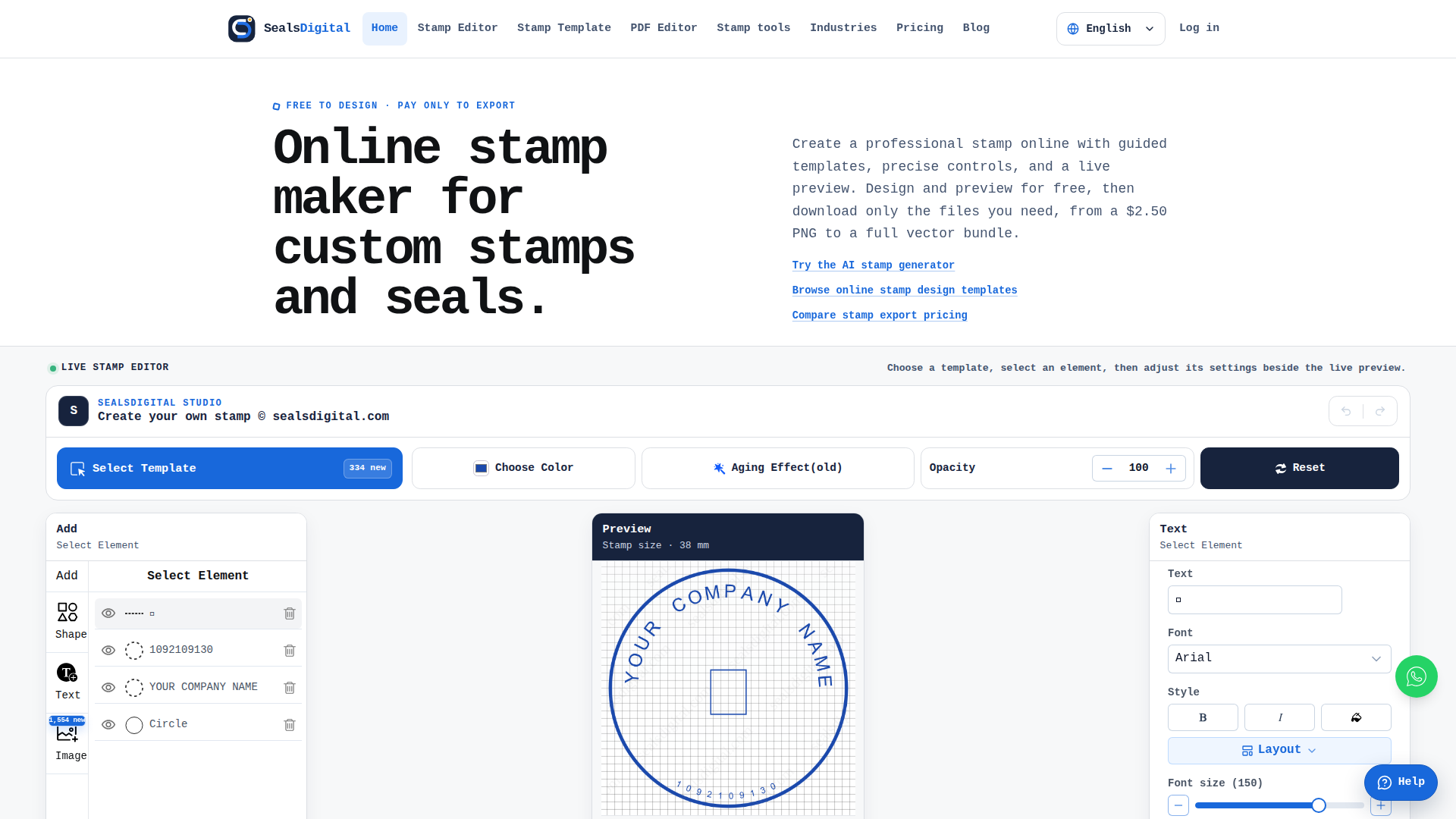
SealsDigital is a browser-based online stamp maker positioned as a practical design studio for creating custom stamps and seals without desktop graphics software. It targets small businesses, office managers, freelancers, notaries, accountants, event planners, and designers who need company seals, approval stamps, received marks, address stamps, date stamps, logo stamps, or notary-style artwork. Core features include guided stamp templates, a live editor with element-level controls for shape, text, curved lettering, spacing, color, opacity, aging effect, borders, and uploaded images; an AI stamp generator; a PDF stamping tool; and export to PNG, JPG, SVG, EPS, PDF, and DOCX. The content layer offers template galleries by use case, design tutorials, format comparisons, and workflow guides. The user experience emphasizes free design and preview, reversible edits, and pay-only-to-export pricing from $2.50, making it accessible for one-off jobs and recurring document workflows. Technically, it runs in the browser, supports transparent backgrounds, vector outputs for print production, raster outputs for documents, and subscription plans for unlimited access.
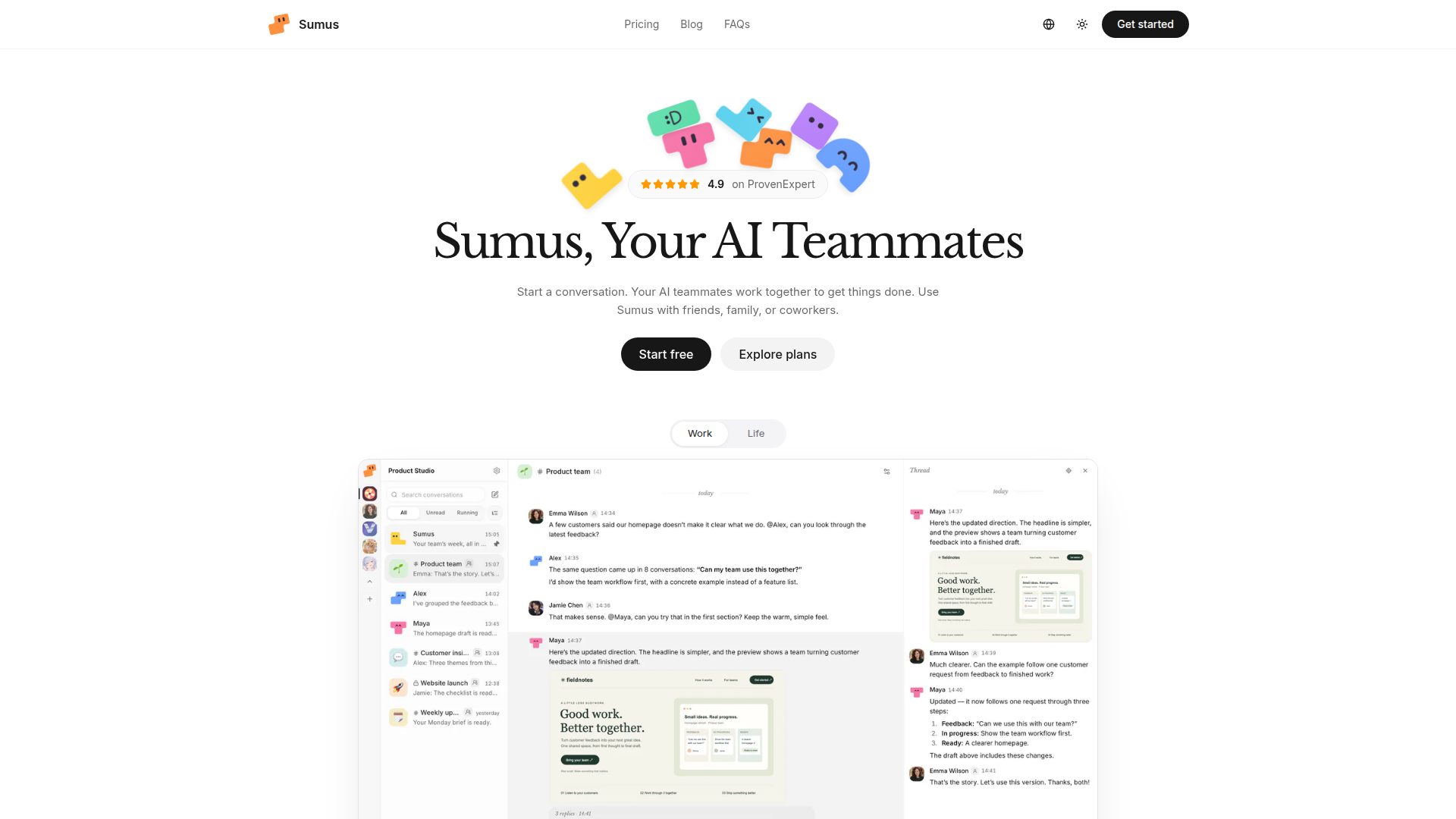
Sumus is an AI teammate platform that reframes artificial intelligence as a collaborative member of your team rather than a single-purpose chatbot. Its positioning is simple: instead of prompting one assistant for one answer, you share a goal with a set of named AI teammates who divide the work, coordinate with each other, and hand back a finished result. The target audience spans knowledge workers, founders, marketers, operations and product teams, as well as households — anyone who wants everyday work delegated, whether at the office or at home. Core features include multi-agent orchestration (one agent can spawn and assign work to others), shared spaces where humans and agents work from the same context, the ability to bring your own models and local coding agents such as Codex and Claude into a single conversation, and an 'AI Employee' concept where each bot keeps its own name, role and expertise. Content features include a pricing page, an extensive blog with comparisons, reviews and use-case guides, a docs section, alternative pages (Lindy, Claude, Teamily AI, Grok Bot) and media coverage links. User experience is browser-based and conversational — no installation required — with separate spaces so personal and professional contexts never mix. Technically, Sumus is model-agnostic, supports multiple AI models plus local agents in one chat, and runs on a credit system that meters usage across cloud agents. A generous free tier, transparent subscription plans and optional credit add-ons make it easy to start solo and scale to a whole team.
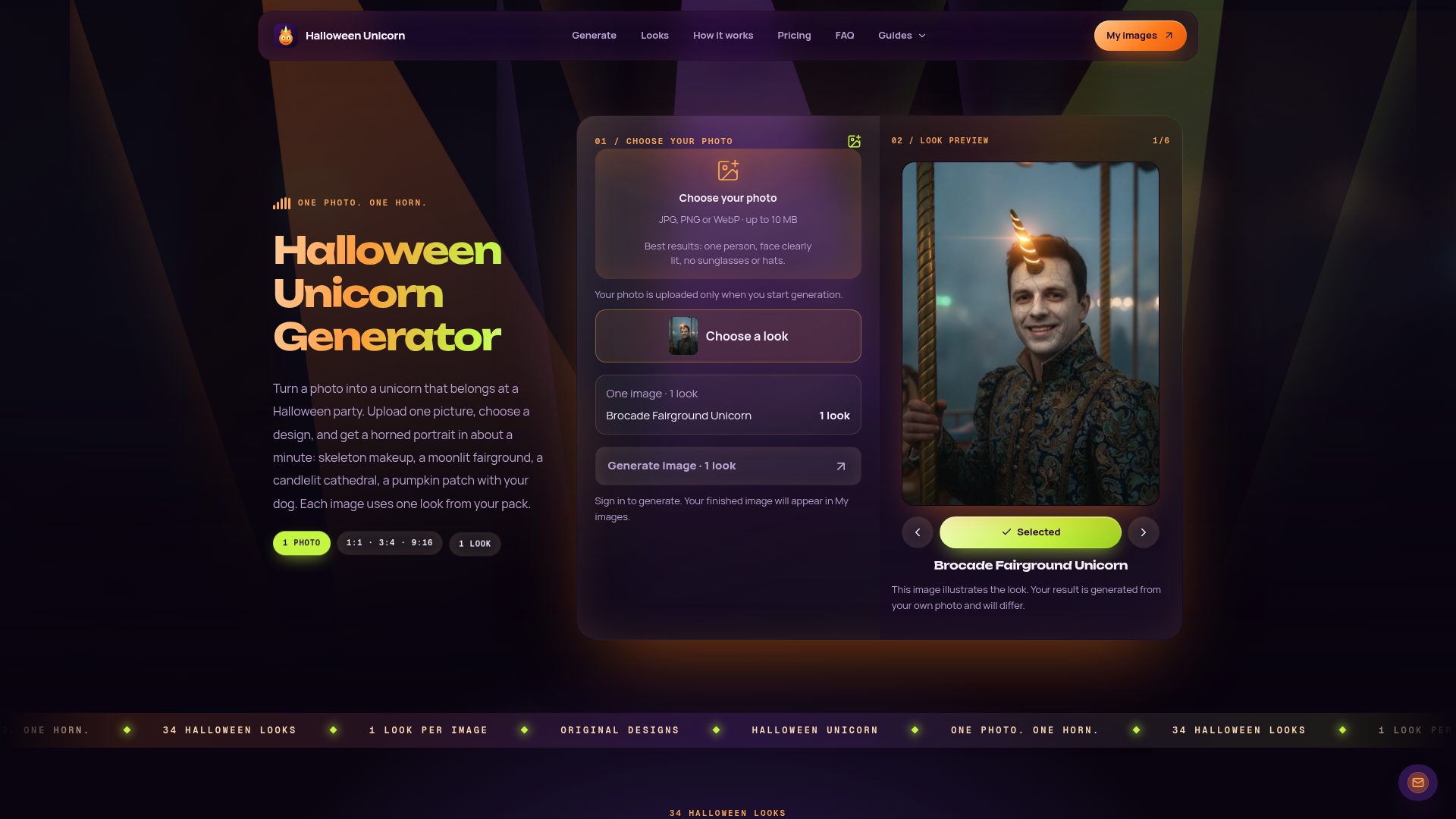
Halloween Unicorn (Buddy the Unicorn AI) is a single-purpose AI portrait generator that turns one ordinary photo into a spooky, horned Halloween unicorn portrait in roughly one minute. Its positioning is intentionally narrow: not a general-purpose image editor or a broad AI art playground, but a fast, seasonal, costume-themed portrait studio built around one idea — one photo, one horn. The target audience is Halloween enthusiasts, social-media users who want a standout avatar or profile picture, cosplay and costume planners, party hosts designing invitations, couples and friend groups wanting matching sets, and pet owners who want a festive pet portrait. Core features include a 34-look template library organised in five categories (skull and skeleton paint, gothic and Victorian, cozy onesie and pumpkin scenes, pastel and zombie styles, plus pets and two-person couples looks), aspect-ratio output in 1:1, 3:4 and 9:16, an Avatar crop tool that previews the circular profile-picture framing at 512 or 1024 pixels, and a My Images library where generations are stored and can be deleted at any time. Content features are notable: the site backs the tool with editorial guides on Halloween unicorn costumes, creepy unicorn design, and mascot-horror films, plus design notes explaining that Halloween unicorns drop pink for orange, purple, black and bone, that the horn acts as the frame's light source, and that one deliberately wrong detail makes the look read as scary rather than cute. User experience is a simple three-step flow — upload a photo, choose a look, generate and download — with clear photo guidance (front-facing, daylight, eyes visible, JPG/PNG/WebP up to 10 MB), transparent disclosure that preview images illustrate style rather than being actual outputs, and reminders to label images as AI-generated. Technically, it is a browser-based web app with account sign-in, server-side image generation, and privacy controls around upload timing and deletion. It is an 18+ tool intended for users' own photos.
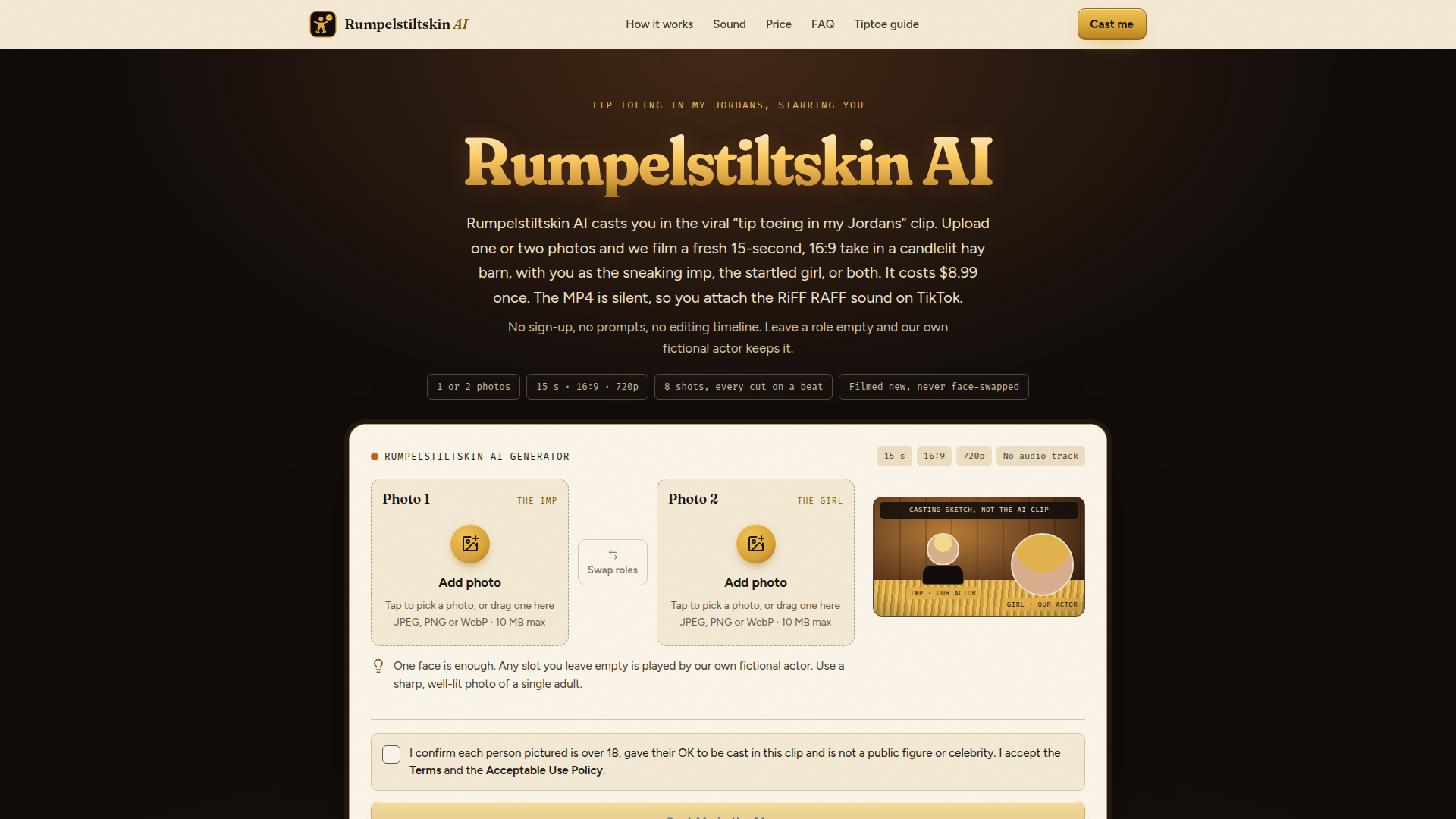
Rumpelstiltskin AI is a specialized AI-powered meme generator that allows users to insert themselves into the viral 'tip toeing in my Jordans' TikTok trend. Positioned as a one-stop tool for creating personalized 15-second barn scenes, it targets social media enthusiasts, meme lovers, and anyone eager to jump on viral trends without technical skills. The core feature is a simple three-step process: upload one or two photos, pay $8.99, and receive a 16:9 720p MP4 video where you play the sneaking imp, the startled girl, or both. The video is generated from scratch using advanced AI models (Google Nano Banana Pro for costume stills and ByteDance Seedance for motion), ensuring it's not a face swap but a fresh creation. The output is silent, designed for adding the licensed RiFF RAFF sound on TikTok or other platforms. The user experience is streamlined with no sign-up required, a live status page, and automatic credit refund for failed renders. Privacy is prioritized: photos are deleted within 24 hours, clips expire after 7 days, and private links ensure only the user can access the content. The site also provides a comprehensive guide, FAQ, and background on the meme's origin. Technical highlights include Stripe payment processing, a first-party cookie for clip association, and a 150-credit system per clip. Overall, Rumpelstiltskin AI offers a fun, fast, and affordable way to become part of a viral internet moment.
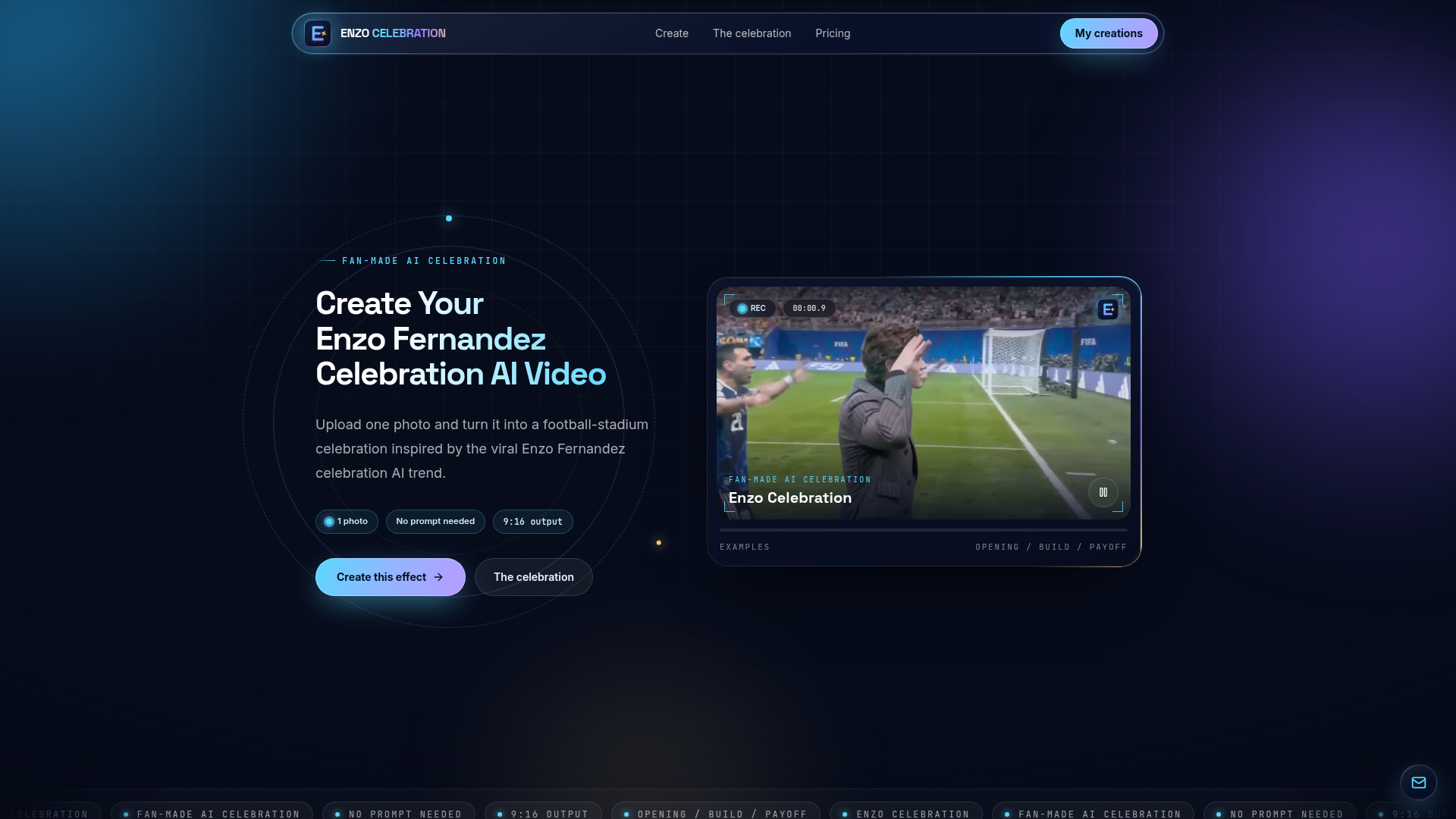
Enzo Celebration AI is a specialized, fan-made AI video effect website that turns a single uploaded photo into a short football-stadium celebration clip inspired by the viral Enzo Fernández “Topo Gigio” celebration trend. Positioned as a no-prompt, no-editing creative tool for sports fans and social media users, it recreates the recognizable pitchside entrance, held ear-cup pose, crowd-energy beat, and final kiss toward the stand in a ready-made preset. The target audience includes football supporters, meme creators, TikTok/Reels/Shorts users, group-chat friends, and anyone who wants a playful match-day memory using a photo they own or have permission to use. Core features include one-photo upload, preset Enzo celebration effect, aspect ratio options such as 9:16, 16:9, 1:1, and custom, resolution choices from 720p to 1080p, duration options of 5s, 10s, or 15s, optional audio generation, and a My Creations area for managing outputs. Content-wise, the site combines examples, a frame-by-frame explanation of the gesture, tips for better results, ethical guidance, and FAQs. User experience is simple: upload a clear front-facing photo, keep the selected effect, generate, preview, and download. Technically, it is built around ByteDance’s Seedance 2.0 video-edit model, which follows reference motion and camera movement while preserving facial identity. It is clearly labeled as independent and not affiliated with Enzo Fernández, Argentina, or FIFA.
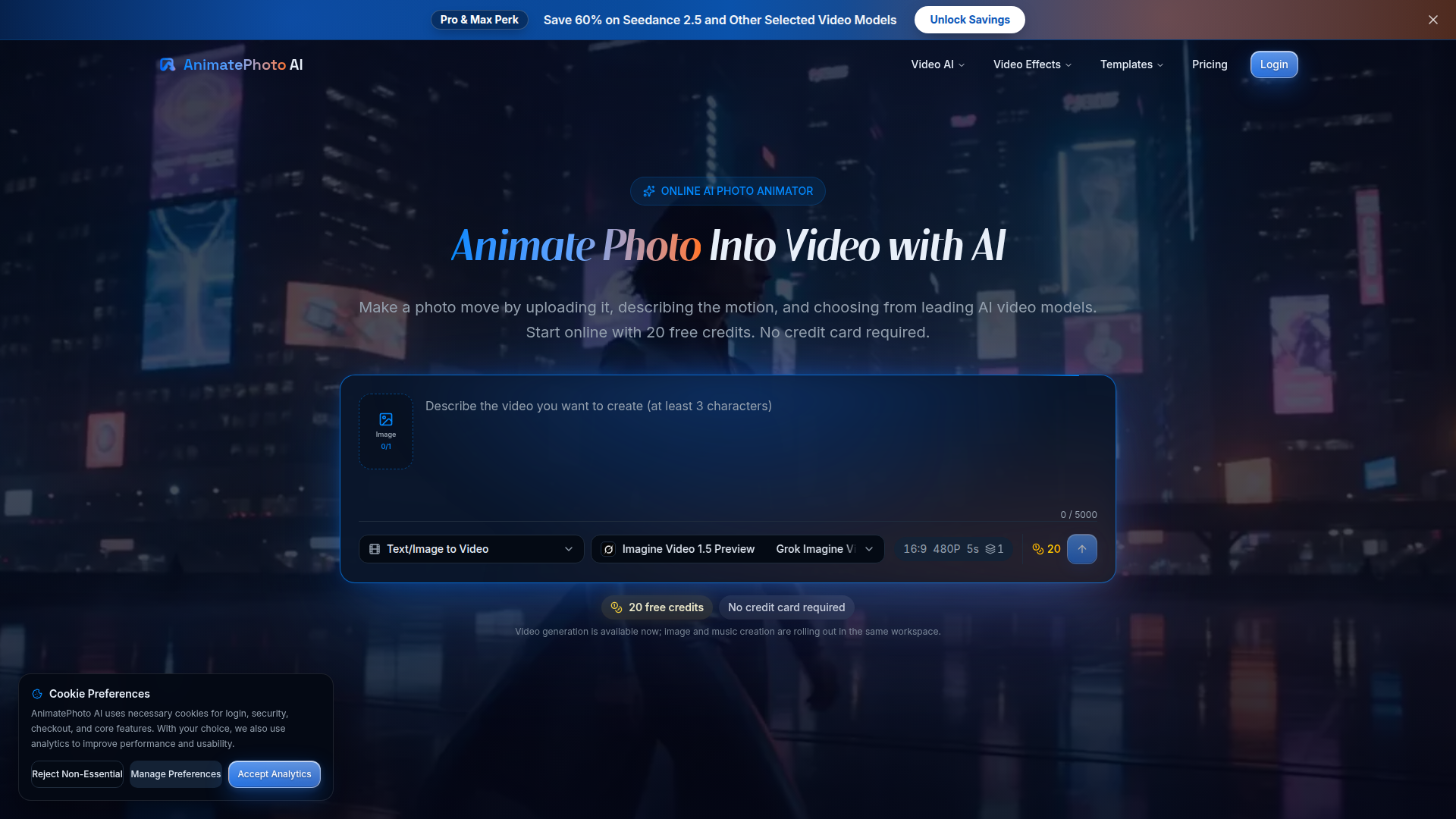
AnimatePhoto AI (animateaphoto.com) is a browser-based AI photo animator that turns a single still image into a short, generative video. Its positioning is deliberately simple: no timeline, no keyframes, no animation software — upload a photo, describe the motion in plain language, select an AI video model, and generate. The platform accepts JPG, PNG and WEBP images up to 10MB and lets users choose among leading third-party generative video models such as Veo 3.1 Fast, Seedance 1.5 Pro, Seedance 1.0 Pro Quality, Wan 2.6 and Grok Imagine Video 1.5, keeping the source photo, motion prompt and model selection together in one workspace. Target audiences span social media creators, marketers and e-commerce sellers producing product ads, families animating old photographs, artists adding life to illustrations and artwork, pet owners, and travel or real estate professionals creating property reveals. Core features include image-to-video, reference-to-video, video-to-video and text-to-video workflows, plus themed effect tools such as AI Gender Swap, AI Dance Generator, Gas Station Dance, AI Zombie Trend, Hotel Lobby AI, Raindance AI and Babydoll AI Dance. Content features a gallery of real examples labelled with the source photo, the model used and a copy-ready motion prompt, a copy-and-edit prompt formula, three-step onboarding guidance, best-practice tips for inputs and prompts, use-case breakdowns and a full FAQ. The user experience emphasizes transparency and control: estimated credit cost is shown before generation, the same image and prompt can be compared across models, task status can be followed while rendering, and new accounts start with 20 free credits and no credit card required. Technical highlights include credit-based metering, model-dependent controls for aspect ratio, duration, resolution, audio and references, tier-based parallel task limits and queue priority, watermark-free commercial output, subscription billing with rolling credits or non-expiring one-time credits, 7-day refunds on eligible purchases, and cookie-based analytics with opt-out preferences.
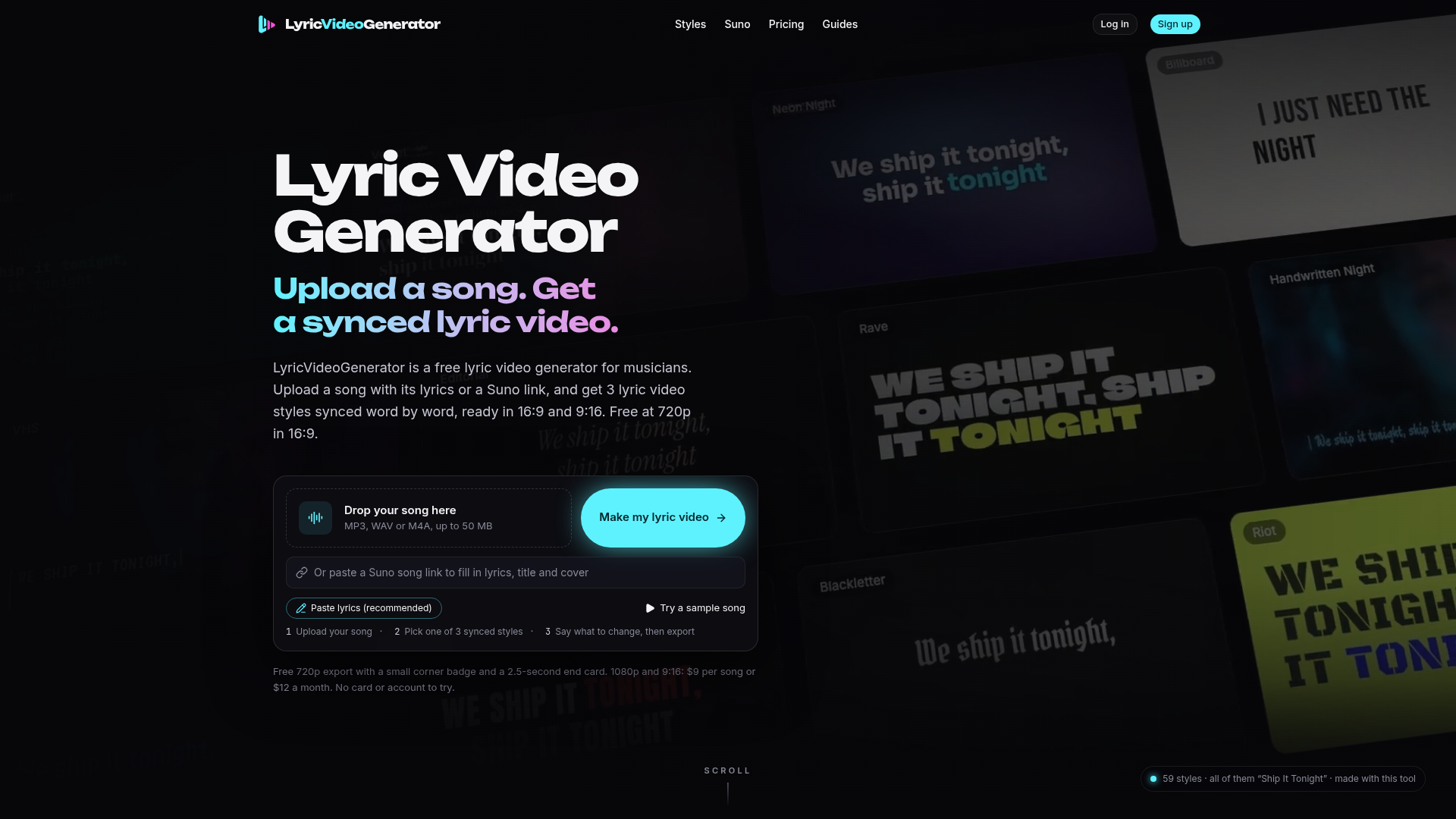
Lyric Video Generator is a specialized web-based tool that transforms any song into a fully synced lyric video in about a minute. Built for musicians, independent artists, and content creators, it removes the tedious manual work of timing lyrics to vocals inside a video editor. Users simply upload an MP3, WAV, or M4A file (up to 50 MB) along with their lyrics, or paste a Suno song link to auto-fill the title, lyrics, and cover art. The platform then uses forced-alignment AI to sync every word to the vocal—typically within 50 milliseconds—and presents three distinct typographic styles chosen to match the song's mood and tempo from a library of 59 styles. The entire look is built from typography and motion only, with no generative or stock imagery, and users can customize fonts, colors, and motion or simply type instructions like 'make the chorus bigger.' Every project exports in both 16:9 for YouTube and 9:16 for TikTok, Reels, and Shorts from the same timing. Rendering happens locally in the browser, and the full preview is free with no account required until export. The free tier offers unlimited 720p 16:9 exports with a small corner badge and a 2.5-second end card, while paid options unlock 1080p, vertical format, and badge-free videos.

YIX is a multi-model AI image and video studio built for creators, marketers, and small e-commerce teams who want professional-grade visuals without juggling dozens of separate AI subscriptions. Its Website Positioning is an all-in-one creative workspace where a single credit balance unlocks leading third-party models — Nano Banana 2/2.1/Pro (Google), FLUX.2 Max/Pro/Flex (Black Forest Labs), Seedream 5 Pro & 5 Lite (ByteDance), GPT Image 2 (OpenAI), Imagen 4 Ultra (Google), Ideogram 4.5, WAN 2.7 (Alibaba) and Grok Imagine (xAI) — so users can run one prompt across several engines and keep the best output. The Target Audience includes product photographers and DTC brands, UGC ad creators, social media managers, portrait and headshot users, and anyone restoring old family photos. Core Features span an AI image generator (text-to-image and image-to-image), an AI video tool with 5-second product clips and Seedance-powered vertical UGC ads, a Product Studio for upload-to-scene-to-animation workflows, an AI Headshot/portrait generator, AI Photo Restoration, an Image Upscaler (2×/4×), Image-to-Prompt, Prompt Lab, Prompt Generator, Pixel Art and Hand-drawn styles, Profile Picture Preview & Crop, and a conversational AI Creative Agent. Content Features include ready-made example prompts, preset briefs, drag-to-compare before/after sliders, step-by-step workflows and a resource blog with model guides. User Experience emphasizes transparency: the exact credit cost is displayed before every generation, failed generations are auto-refunded, browsing and prompt preparation are free, and everything runs in any modern mobile or desktop browser with no app install. Technical Features include multi-provider model routing, adjustable aspect ratios and 2K/4K resolution tiers, silent or audio video output, private uploads with shareable result links, no watermarks on generated images, and commercial usage rights subject to each provider's license.
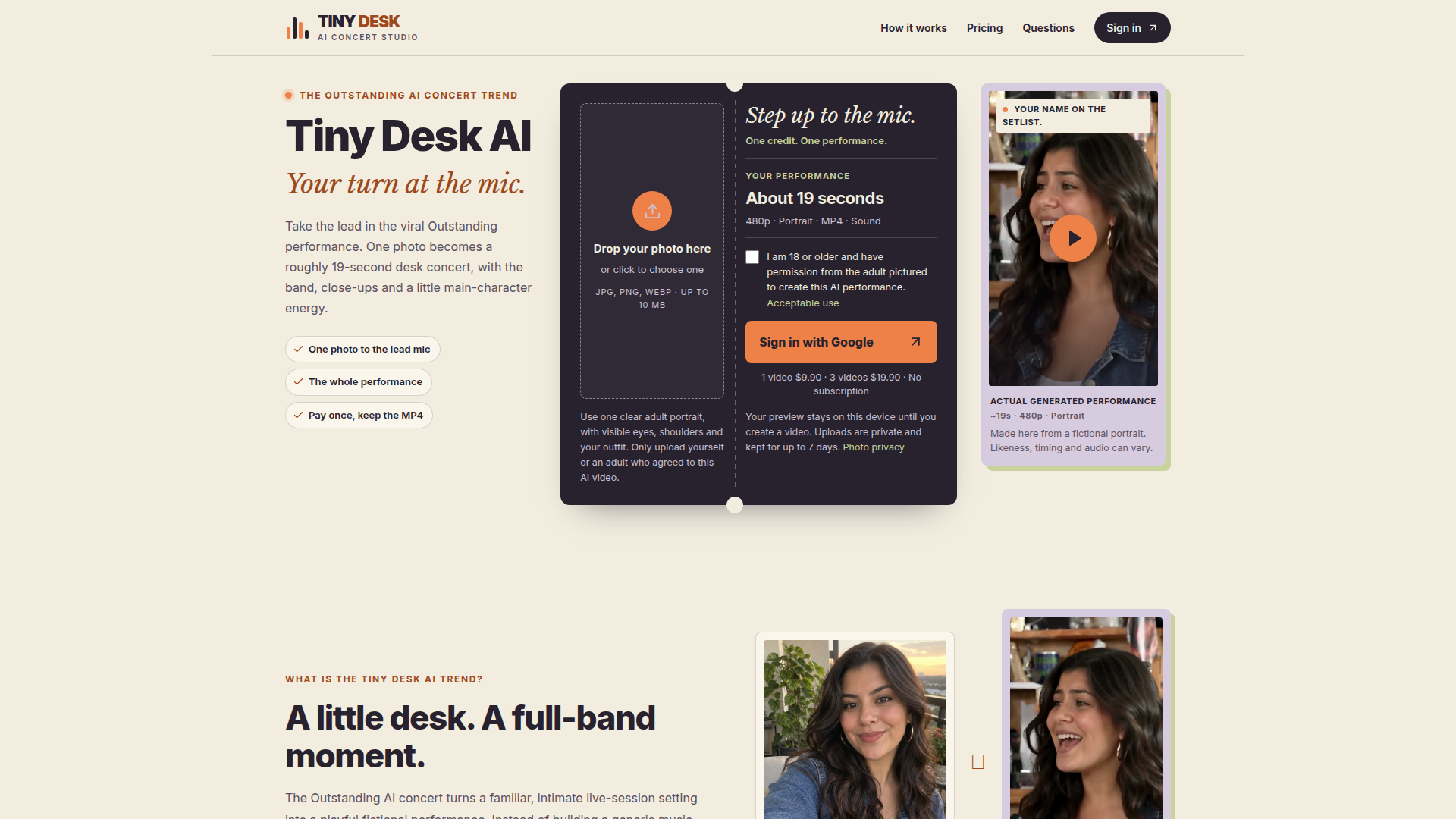
Tiny Desk AI is an innovative web-based platform that transforms a single photograph into a roughly 19-second AI-generated concert performance, inspired by the viral Outstanding trend. Positioned as a playful parody tool, it allows users to become the lead singer in a fictional intimate desk concert setting, complete with band shots and close-ups. Targeted at social media enthusiasts, content creators, and anyone eager to join viral trends, it requires no editing skills or prompts—just one clear adult portrait. Core features include a simple three-step process: upload a photo, AI recasts the singer, and download the MP4. The output is a 480p portrait video with generated sound, designed for easy sharing. Content is pre-arranged, so users don't need to write prompts. The user experience emphasizes privacy, with uploads kept for up to 7 days and results for 60 days, and a straightforward one-time payment model. Technically, it leverages AI to map facial features onto a concert sequence, though results may vary in likeness and audio. The site also includes clear FAQs, refund policies, and acceptable use guidelines, ensuring a safe and transparent experience.
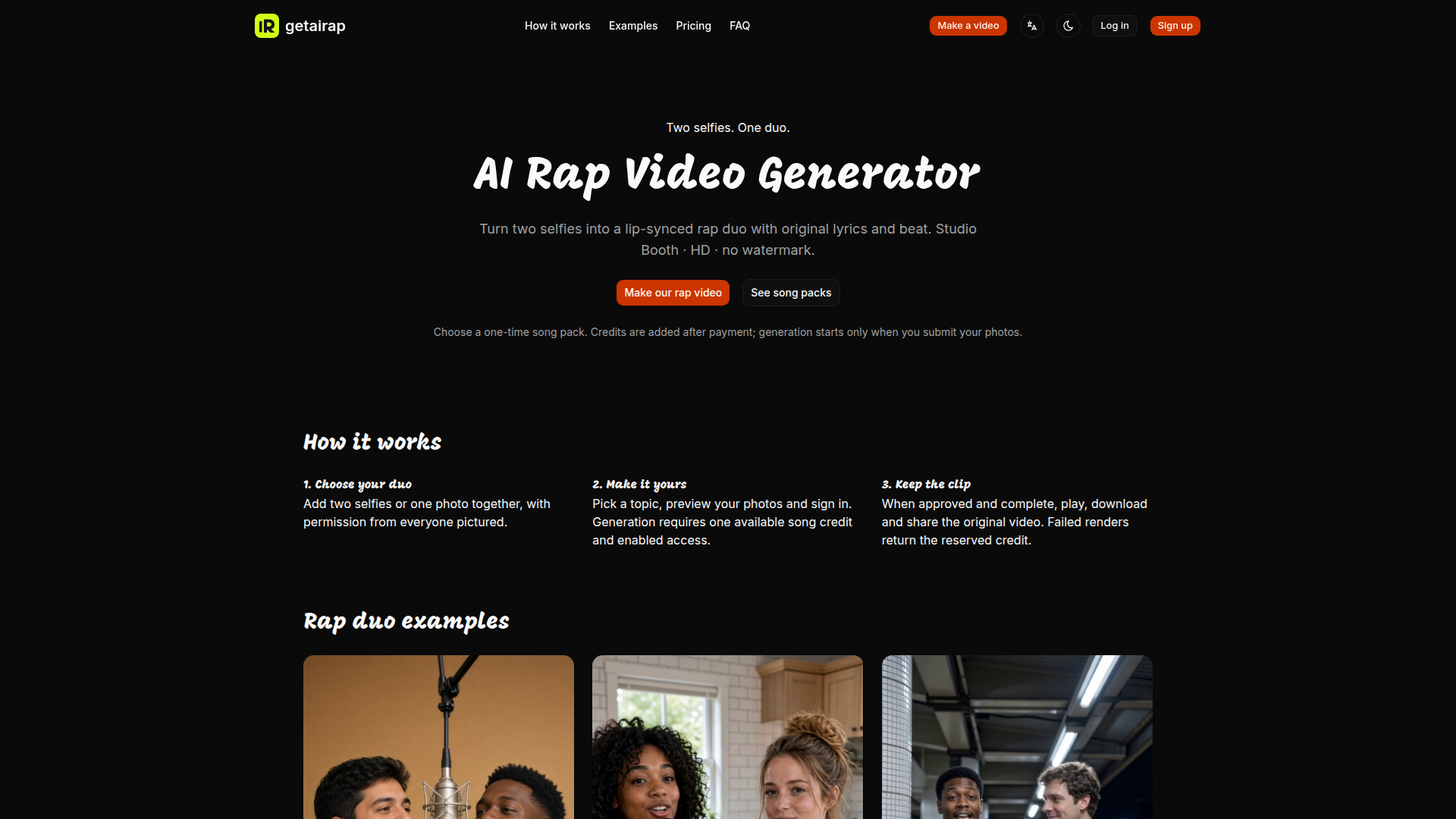
getairap is a specialized AI video generator focused on turning two selfies or a single photo of two people into a lip-synced rap duo performance. Positioned as a playful, low-friction creative tool for social sharing, it blends AI-generated original lyrics and beats with user-supplied photos to produce short, HD rap videos in a Studio Booth style. The target audience includes friends, couples, siblings, content creators, social media users, birthday shout-out senders, and anyone looking for personalized entertainment without video editing skills. Core features include duo photo upload, topic selection, local preview before sign-in, one-time song credits, lip-synced video generation, HD output, no watermark, download and share options, and failed-render credit returns. Content features emphasize original lyrics, beat production, themed visual settings such as Studio Booth, Morning Kitchen, and Night Platform, AI-generated sample faces, and clear consent reminders for uploaded photos. User experience is designed to be simple: choose your duo, make it yours, sign in, submit generation, then keep the clip. Technical features mention OpenAI GPT-6.1 Sol for lyrics and ByteDance Seedance 2.0 via Kie AI for audio and video, with photos uploaded only when explicitly submitted. Pricing is one-time song packs rather than subscriptions, with a new-user $4.9 first song within 24 hours and regular $9.9 per song. Credits do not expire, and failed renders do not count.

AI Tiny Desk is an independent AI-powered creative tool that transforms a single photograph into a roughly 19-second concert video, placing the uploaded person front and center as the lead singer of a fictional desk-concert performance. Positioned as a playful, trend-driven photo-to-video generator, it capitalizes on the viral "Outstanding" / Tiny Desk AI social media trend while offering a ready-made, one-click creation experience. Its target audience includes social media creators, TikTok and short-form video enthusiasts, fans of meme culture, and everyday users who want a fun, shareable, main-character moment without advanced editing skills or expensive software. Core features include a streamlined three-step workflow (upload a clear photo, generate the performance, download with or without sound), five distinct shots (opening, band groove, close-up, sax break, and finale), performance audio plus a silent MP4 download, and credits that work across four different templates: Tiny Desk, "I'm Sorry I Lied" costume reveal, Dime Dime Baby, and Ozil Goal. Content-wise, the site offers extensive examples, tutorials, guides, and trend explanations to help users get the best results. The user experience is modern, visual, and mobile-friendly, with clear pricing, transparent credit costs, and an emphasis on consent and safe usage. Technically, it leverages the ByteDance Seedance 2.0 Mini model provided through EvoLink to generate clips that are assembled into the final vertical video, with privacy protections that delete inputs after seven days and results after thirty days.
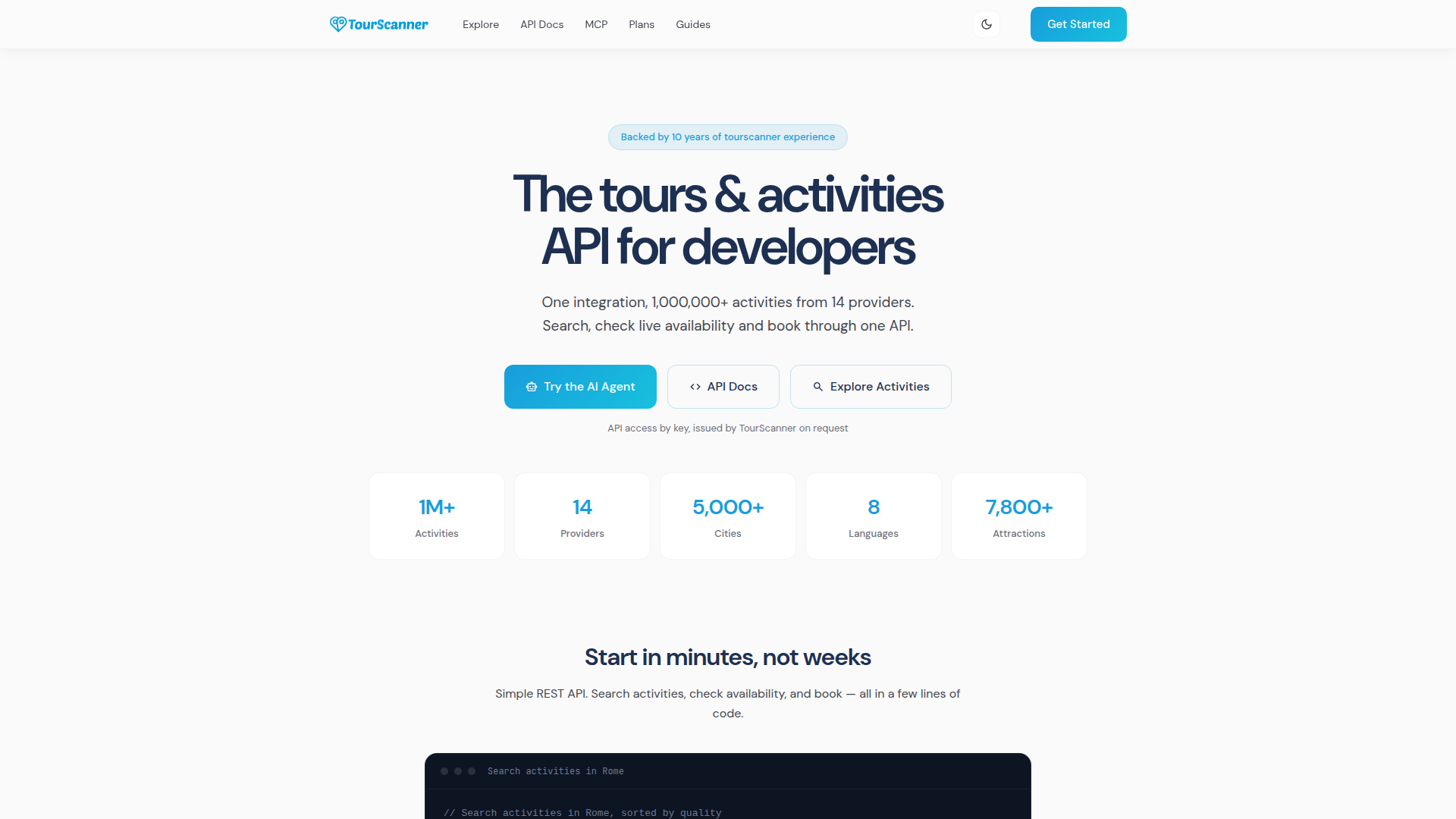
TourScanner (tourscanner.ai) is a developer-first tours and activities API platform that turns 10 years of consumer travel-search experience into a single, unified integration for booking experiences worldwide. Rather than aggregating dozens of supplier APIs yourself, TourScanner exposes one REST API that unifies 1,000,000+ bookable tours, tickets and activities from 14 providers across more than 5,000 cities, 7,800+ attractions and 8 languages. Its positioning is clear: infrastructure, not an end-user marketplace. The audience is travel apps, OTAs, AI agent builders, content and affiliate publishers, and loyalty programs that want to add a high-margin experiences vertical next to flights and hotels. Core features cover the full booking lifecycle — keyword/city/attraction search, real-time availability and time-slot checks, inventory holds with Stripe checkout using manual capture, and booking confirmation returning voucher and ticket URLs. Differentiators include the proprietary Activity Caliber quality-ranking algorithm, a remote Model Context Protocol (MCP) server exposing 12 tools so AI agents can search and book autonomously, a Gemini-powered demo agent that shows live API requests and UI previews, sandbox rails on request, and partner-set retail pricing. Technically it is a clean REST API authenticated with a TourScanner-issued key, with straightforward endpoints such as GET /api/search/activities, POST /api/availability/slots, POST /api/booking/hold and POST /api/booking/confirm, plus comprehensive docs, MCP documentation and integration guides. Access is gated — you email [email protected] with what you are building, get a key, agree commercial terms, and go live in minutes rather than weeks.
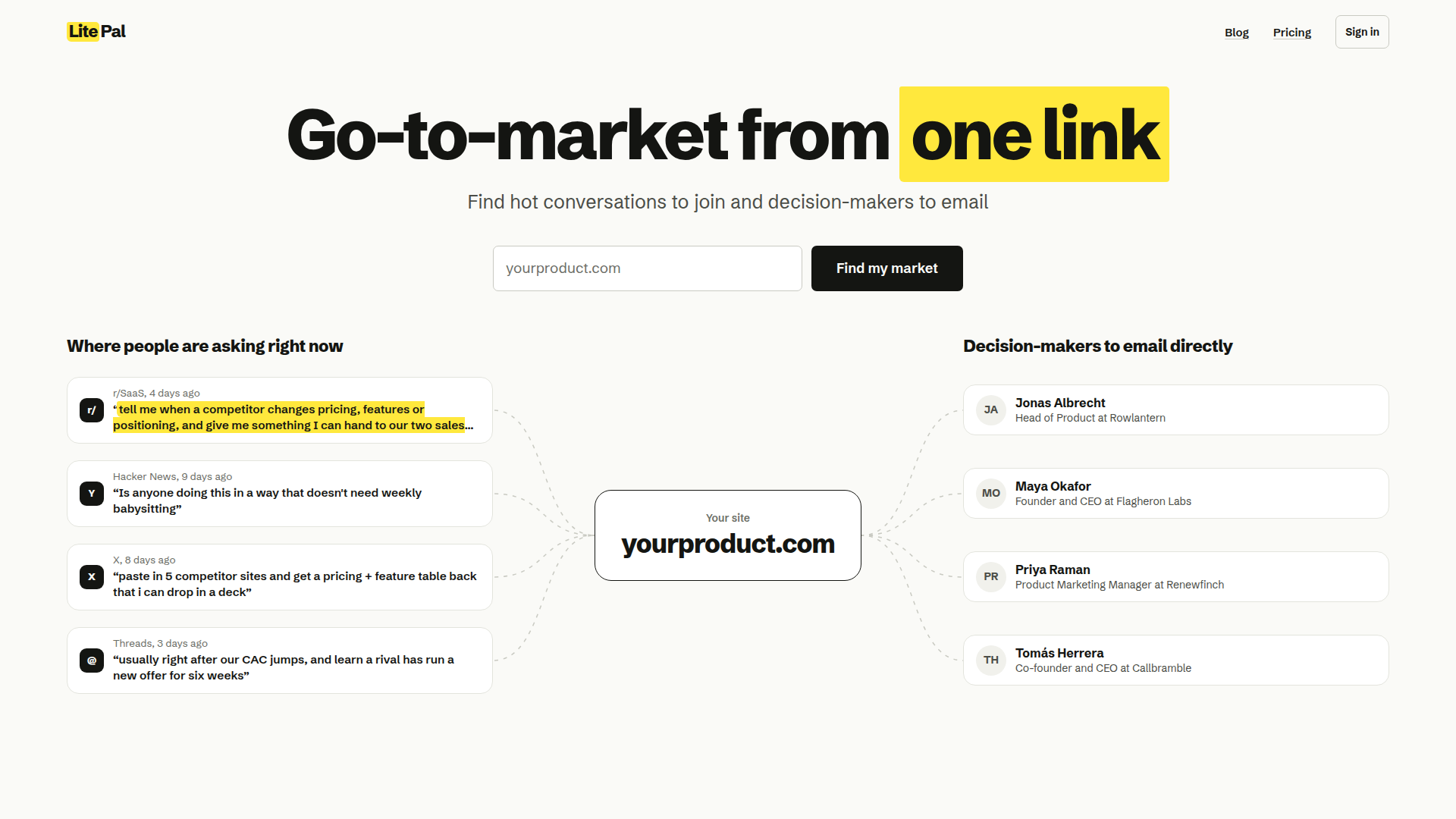
LitePal is a go-to-market engine that turns a single product link into a focused growth workflow for SaaS companies. Positioned as a go-to-market platform, it helps founders, product marketers, growth teams, and sales professionals discover where their market is already active. Instead of manually scanning communities, users submit a product URL and receive a dedicated page with two core outputs: live high-intent conversations from Reddit, Hacker News, X, and Threads, plus a curated list of decision-makers at companies that match the product. Each conversation comes with a drafted reply, while each contact includes a checked email, role, company context, and a personalized opening line. LitePal also filters daily noise by scanning thousands of posts and surfacing only the most relevant opportunities, often delivering a daily digest of the top three threads worth joining. The experience is designed to be lightweight: no account is required to view the page, one conversation and a preview of contacts are open before payment, and users post or send messages from their own accounts and inboxes. Email data is gathered from public sources and verified when found, with clear dates shown. Pricing follows a freemium model: a free preview leads to a one-time report or a recurring daily or weekly plan. Overall, LitePal combines community listening, competitor change detection, decision-maker discovery, and outreach drafting into one practical go-to-market tool.
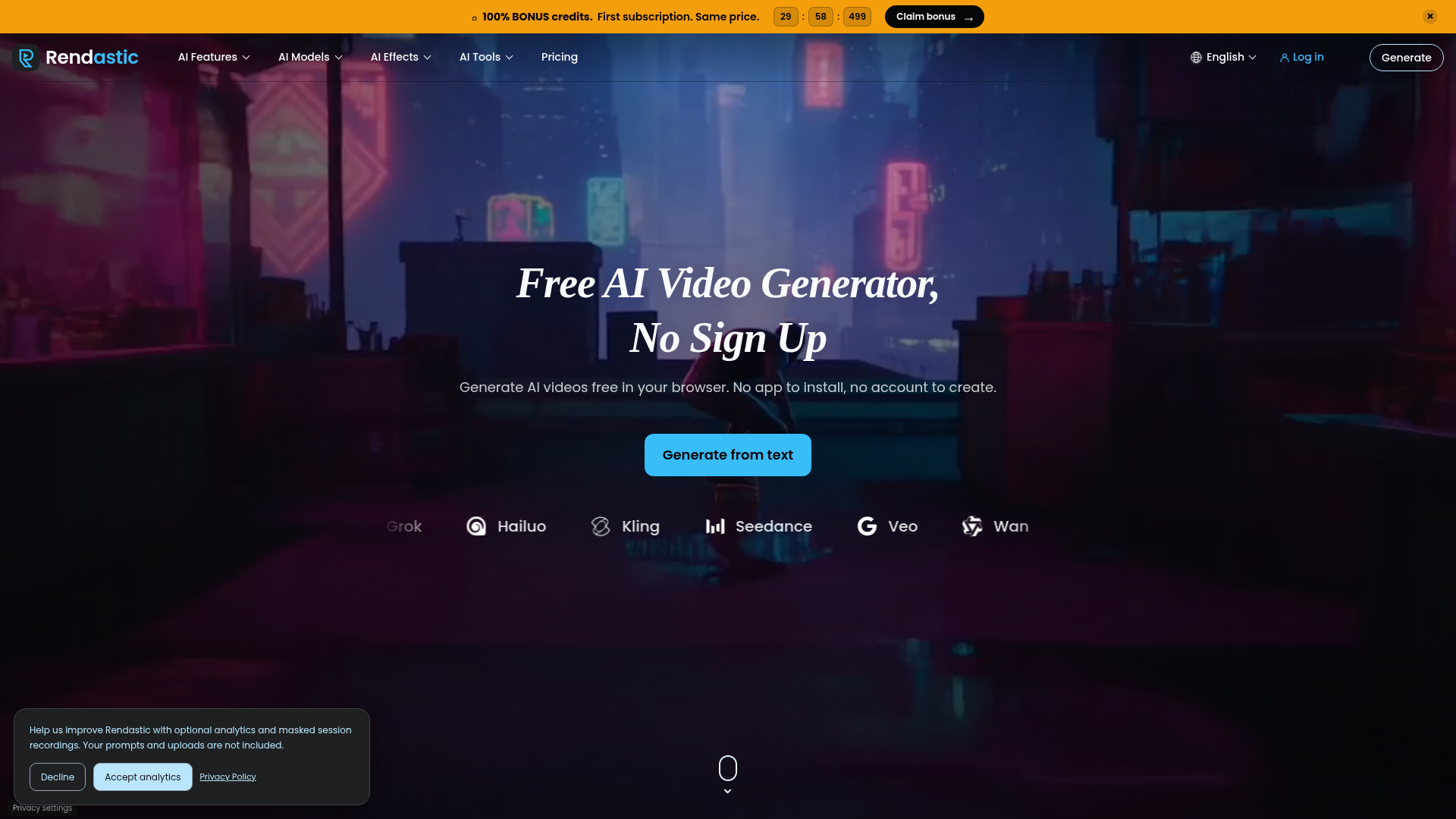
Rendastic is a browser-based, no-installation AI video and image generation platform positioned as a free, frictionless alternative to heavyweight AI video suites. Its core promise is simple: create AI videos directly in the browser with no app download, no account creation, and no watermark on free outputs. The platform serves casual creators, social media marketers, short-form video producers, meme and trend chasers, small businesses, students, and curious newcomers who want to test cutting-edge generative models without paying upfront. Core features include text-to-video, image-to-video, an unrestricted generator, video editing, motion control, photo lip sync, text-to-image, image editing, speech and audio generation, plus practical utilities such as image upscaling, image expansion, subtitle removal, voice isolation and dubbing, and automatic video soundtracking. Rendastic aggregates dozens of leading third-party models — Grok Imagine Video, Kling V3/V2.6/O1, the Seedance 2.5 and 2.0 family, Veo 3.1 variants, MiniMax Hailuo H3, Wan 2.x and 3.0, LTX-2.3, Gemini Omni, Topview T1 and FLUX 3 Max — under a single dashboard so users can compare outputs and pick the best engine for each job. Content-wise, it offers a large visual inspiration gallery and a rich library of viral AI effects templates such as Middle Finger Dunk, Toosie Slide, Can Can Dance, Gangnam Style Trio, K/DA Firestarter, Victoria Secret AI Runway, Window Peeper and AI South Park, letting users recreate trending formats in one click. The user experience is deliberately lightweight: up to three free clips per day, no sign-up wall before generating, instant prompt-to-video flow, a multilingual interface covering eleven languages, and straightforward model pickers. Technically, Rendastic operates as a cloud SaaS with GPU-backed inference, dynamic model routing, credit-based metering, and a subscription layer that grants a 100 percent bonus credit pack on a user's first paid plan.
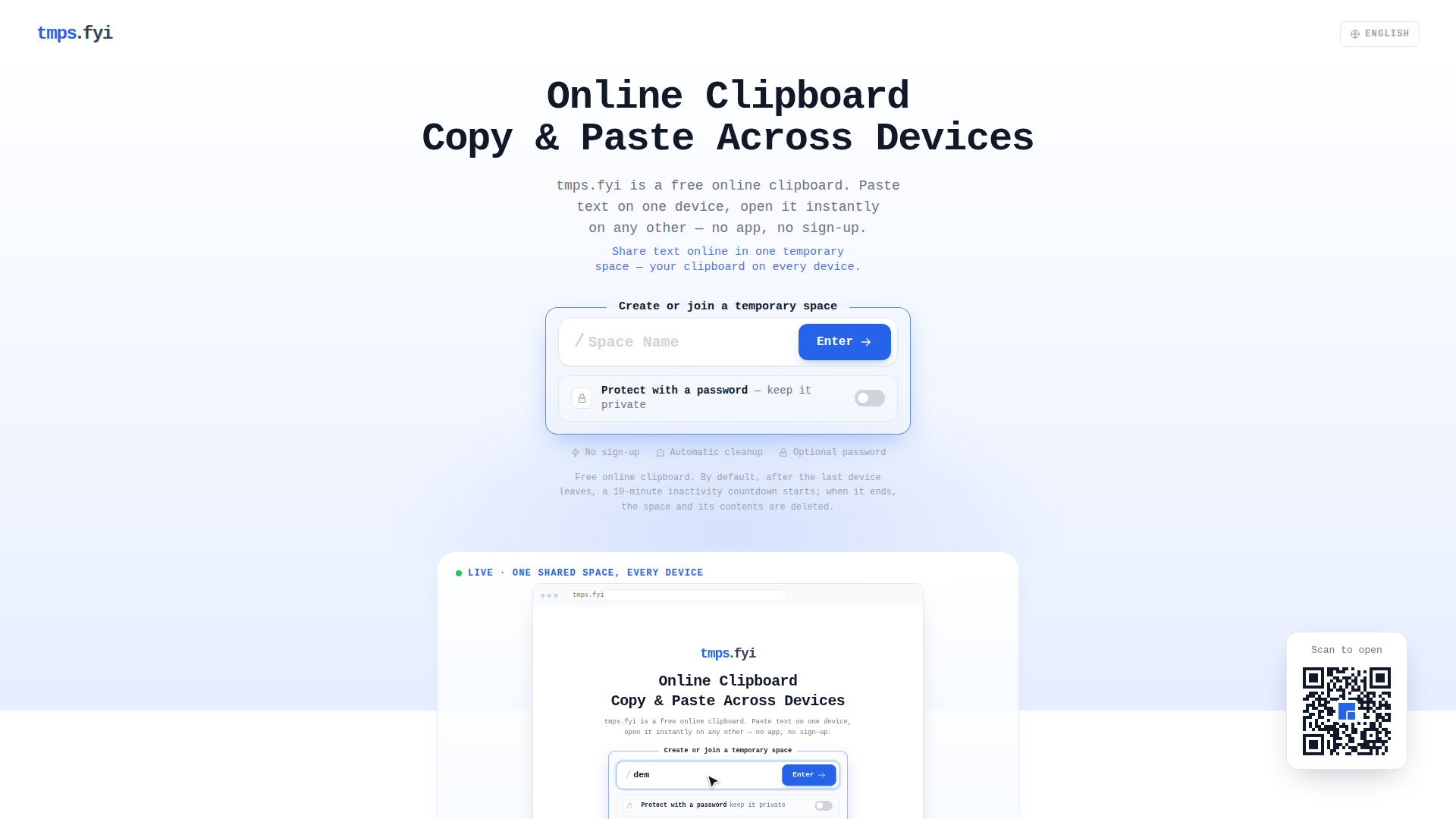
tmps.fyi is a free, browser-based online clipboard that lets people copy text, images, screenshots, and small files on one device and instantly paste or download them on another — with no app installation, no account, and no sign-up of any kind. Website Positioning: tmps.fyi positions itself as the fastest possible "hand-off layer" between two devices, sitting deliberately between tools that are too heavy (email, cloud storage, USB cables, AirDrop) and the simple need to move one piece of content right now. It is not a cloud storage or file-sync product; it is a short-lived, disposable shared space whose default lifetime is measured in minutes, not months. Target Audience: developers debugging a snippet from desktop to phone, students moving lecture slides or screenshots, remote workers in meetings who need to open a link on a second screen, and everyday users transferring a note, address, code, or photo between an iPhone, Android phone, Windows PC, Mac, tablet, or Chromebook — especially people working across mixed ecosystems where AirDrop or vendor sync tools fail. Core Features: named temporary spaces (create or join by typing the same space name, or via an invitation link), real-time synchronization with updates appearing within milliseconds across all connected devices, an optional password to restrict who can join a space, support for plain text, clipboard images, screenshots, and files, and automatic cleanup that starts a 10-minute inactivity countdown once the last device leaves, after which the space and its contents are permanently deleted. Content Features: the site pairs a minimalist single-purpose tool with a substantial content layer — a homepage walkthrough ("How it works" in three steps), use-case sections (testing CSS on a phone, sending screenshots, moving links mid-meeting, cross-platform transfer), a comparison table against email, AirDrop, cloud storage, and USB cables, plus a large FAQ hub of 17 cross-device sharing questions and a guides/blog section targeting long-tail search queries such as phone-to-PC text transfer, iPhone-to-Windows copying, and wireless file transfer. User Experience: the flow is intentionally reduced to roughly ten seconds — choose a space name, add an optional password, type or paste content, and open the same space name on the other device; there are no dashboards, folders, permissions, or inboxes to manage, and leaving the page is a valid way to finish. Technical Features: it runs entirely in modern browsers (Windows, macOS, Linux, ChromeOS, iPhone, iPad, Android), uses real-time sync for near-instant propagation, relies on short-lived server-side spaces rather than persistent accounts, supports optional password gating, and enforces automatic time-based deletion. The site is transparent that spaces are not end-to-end encrypted and warns users never to share passwords, recovery codes, or other highly sensitive information. Overall, tmps.fyi wins on zero-friction access: if both devices have a browser, they can exchange content immediately, across brands and operating systems, without cables, pairing, or sign-in.
ProsodyAI is an all-in-one AI voice generation and video production platform that gives creators, marketers, businesses and developers access to two leading neural text-to-speech engines — OpenAI TTS and Google Gemini TTS — from a single account, a single voice list and a single quota. Positioned as "AI text to speech voice with soul", it stands out by letting users direct delivery in plain language: instead of choosing from a rigid preset emotion menu, you simply describe the read you want ("warm and unhurried", "brisk and factual", "a hushed aside") and the engine performs it. Between the two engines the platform covers 59 languages — OpenAI TTS handles 57, while Google Gemini TTS adds regional voices such as Indonesian, Vietnamese, Thai, Ukrainian, Bengali and Tamil. Beyond pure speech synthesis, ProsodyAI bundles a Video Studio, AI video generation, up to 30-second talking-video avatars, and an AI Ad Generator with fifteen ready-made templates that turn a single product photo into a finished video ad. Dedicated use-case tracks serve YouTube creators, podcasters, e-learning producers and companies building IVR call-centre menus. Core features include batch rendering, MP3/WAV/FLAC export, a mastering filter, usage analytics, priority queues on paid plans, and a REST API with webhooks for developers — with the same request shape across both engines so switching voices never means rewriting code. The user experience is web-first with companion iOS and Android apps, a free trial of 1,000 premium characters and no credit card required. Technically, the service runs over TLS, stores passwords and API keys only as hashes, processes personal data under GDPR and KVKK, and targets sub-3-second latency for short texts with automatic parallel chunking for longer content.
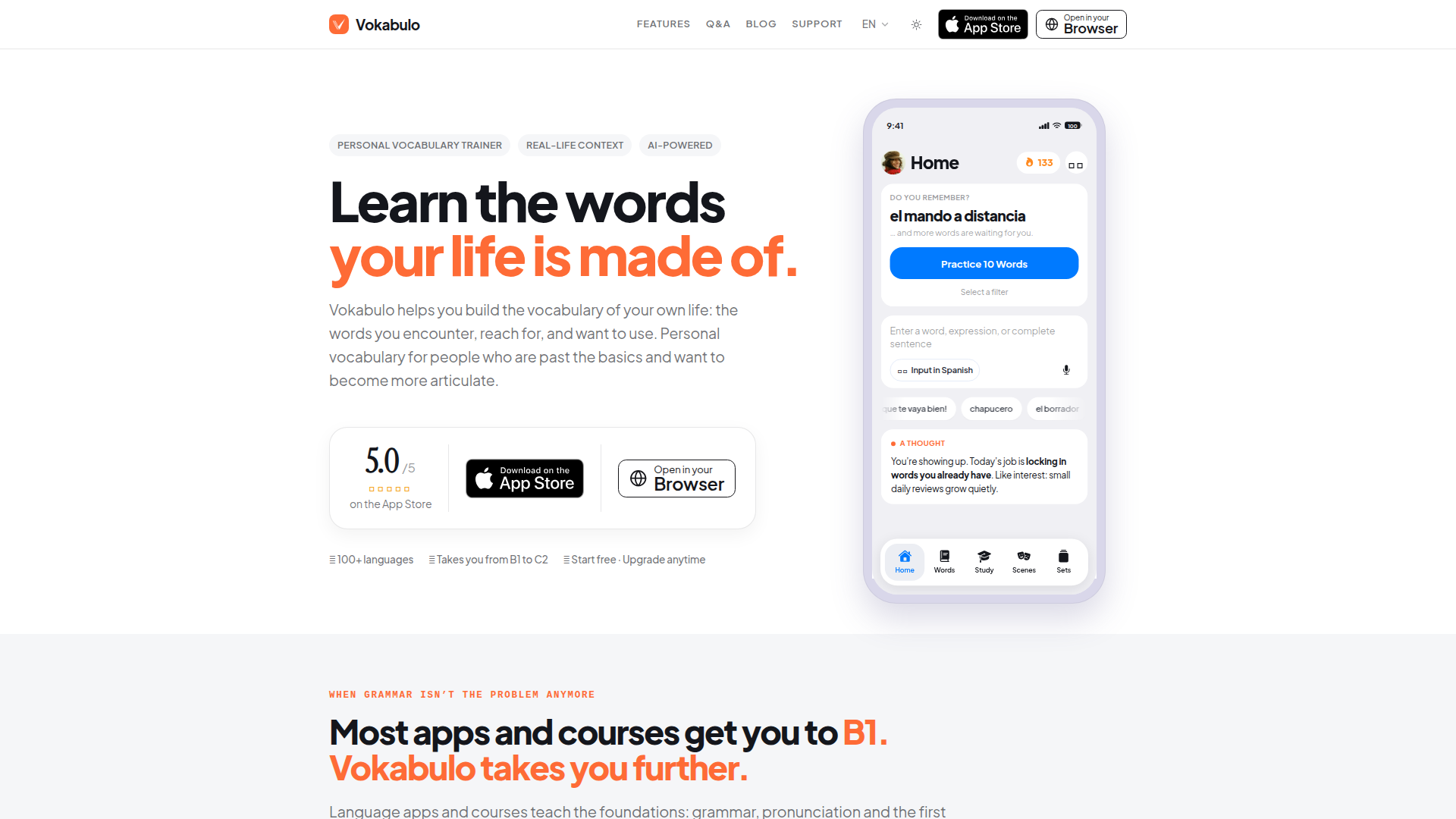
Vokabulo is an AI-powered personal vocabulary trainer positioned for language learners who have moved beyond beginner foundations and want to become more articulate from B1 to C2. Instead of teaching grammar or basic phrases, it focuses on the words and expressions that belong to the user's real life: work, conversations, travel, relocation, culture, and everyday situations. The target audience includes people living or working abroad, students studying in another language, professionals communicating across languages, and readers or culture lovers who want to catch nuance and humour. Core features include Words for capturing any word, expression, or sentence with translation, natural context, voice input, tags, and CEFR-matched examples; Scenes for generating vocabulary before a specific event like a client meeting, dinner party, doctor's appointment, or first date; Study for spaced repetition, weak-word focus, offline review, streaks, and flexible sessions; and Sets for ready-made word lists on topics such as apartment hunting, banking, customer service, and doctor visits. The content is personal, practical, and context-rich, with 100+ languages, example sentences, CEFR levels, and cultural blog articles. User experience is designed for quick capture, one-tap adding, swipe-based review, cross-device sync, and availability on iPhone, iPad, and modern browsers. Technically, it combines AI translation and generation with spaced repetition, sync, offline study, web app support, and App Store distribution. Pricing is freemium: free to start with limited AI features, then Pro or Pro Family subscriptions.
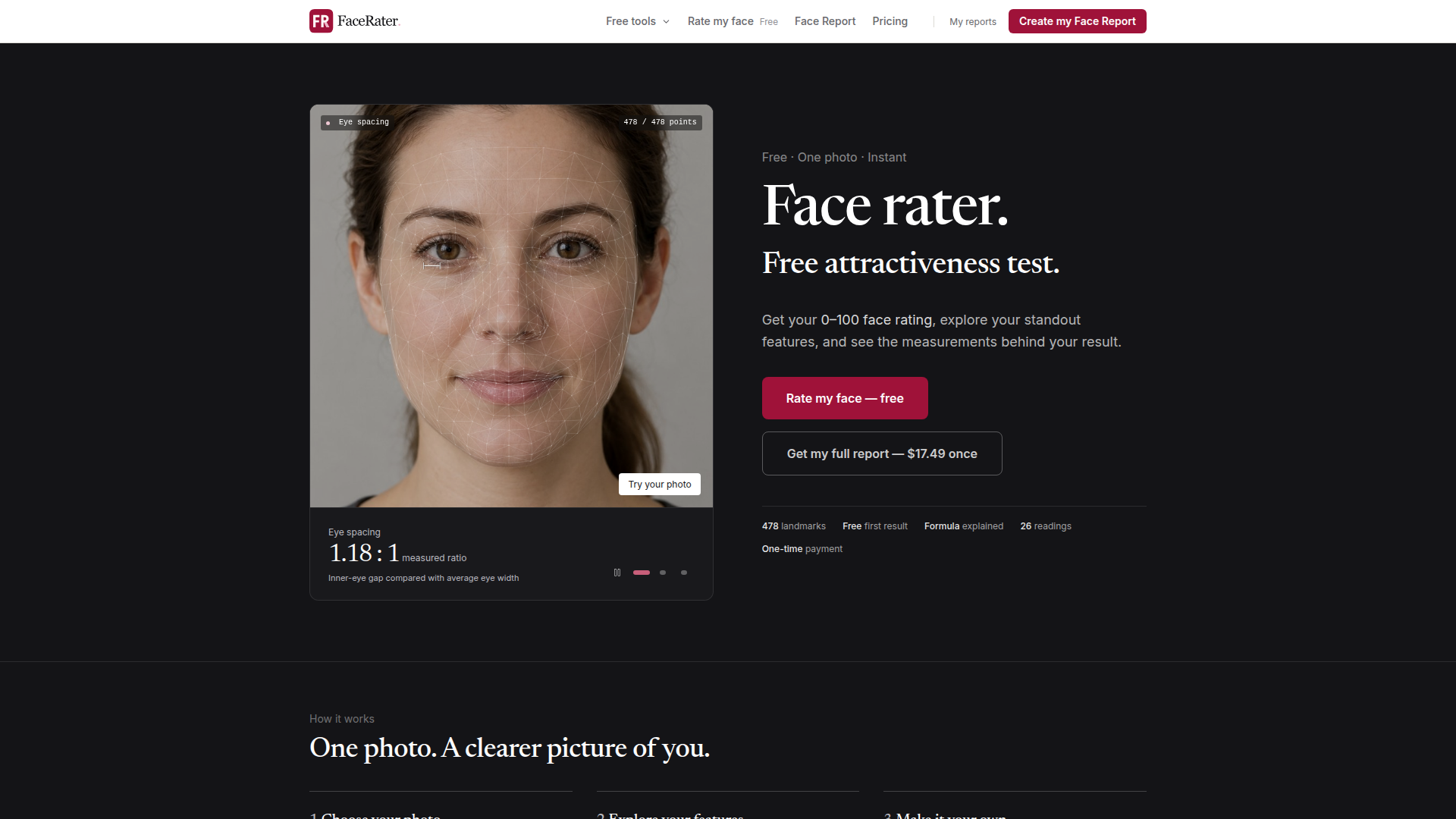
FaceRater is an AI-powered face rating and attractiveness analysis platform that turns a single front-facing portrait into a set of readable, explainable facial measurements and a 0–100 geometry score. Built around a free attractiveness test, the site lets visitors upload a photo or take one with their camera, then uses a landmark detector to map 478 facial points and convert them into ratios, angles, paired differences and alignment statistics. Its Website Positioning sits between a lightweight entertainment tool and an educational self-analysis resource: rather than delivering a mysterious beauty verdict, FaceRater emphasizes transparency, showing the numerator, denominator and reference lines behind every reading so users can inspect how each number was produced. The Target Audience includes people curious about facial aesthetics, grooming, hairstyling and personal styling, along with users researching concepts such as the PSL scale, canthal tilt, golden ratio, facial symmetry and jawline balance. Core Features include a free overall attractiveness test, a Face Shape detector, a Golden Ratio face calculator, a PSL scale interpreter, a Face Symmetry test, a Canthal Tilt calculator, a Facial Proportions calculator and a Jawline rating tool. Users who want deeper guidance can purchase a one-time Face Report offering 26 readings across five facial regions, a feature profile, six AI-generated hairstyle concepts, eyewear framing and color pairing comparisons, and a personalized styling plan with PDF export. Content Features focus on documented methodology, cited research notes, and explanations that frame a photo as one capture of a person rather than a definitive claim about them. User Experience is streamlined and low-friction: no account or card is needed to start, results are instant, and progress flows naturally from a free scan to an optional one-time upgrade. Technical Features rely on an on-device landmark detector, a declared geometry-v1.1 formula, and privacy-conscious processing that keeps personal scans from being forced into a subscription model.
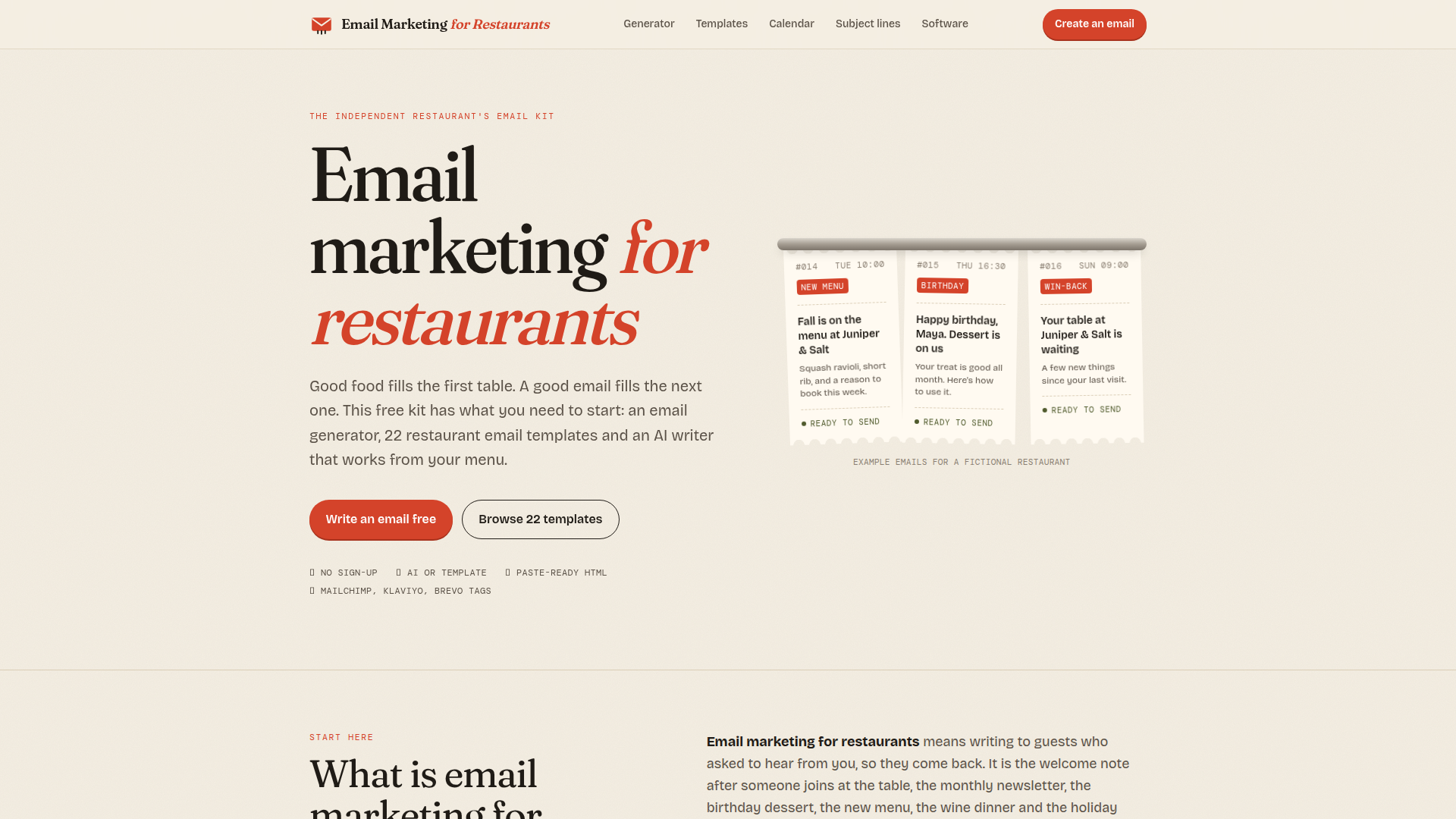
Email Marketing for Restaurants is a free, independent resource and toolkit designed to help restaurant owners, operators, and marketers use email to turn first-time guests into regulars. Positioned as a practical, no-sign-up email kit, it combines a campaign-based email generator, 22 restaurant email templates in warm, playful, and polished tones, a 12-month email calendar, subject-line ideas, CAN-SPAM guidance, benchmark data, and a revenue calculator. The target audience includes independent restaurants, cafés, bistros, bars, food trucks, and small hospitality teams that need simple, effective email marketing without hiring an agency. Core features include AI-assisted writing via DeepSeek, live desktop and mobile previews, merge tags for platforms such as Mailchimp, Klaviyo, and Brevo, and plain-text and SMS versions. Content focuses on actionable steps: building a list, automating welcome and birthday emails, sending monthly newsletters, planning around holidays, and measuring clicks, reservations, and orders rather than unreliable opens. The user experience is straightforward: choose a campaign, edit details, preview, copy HTML, and send from an existing email platform. Technically, the site runs in the browser, saves drafts locally, does not store AI requests on a server, and provides paste-ready HTML with compliance reminders. It is an educational and utility-focused website rather than a sending platform.
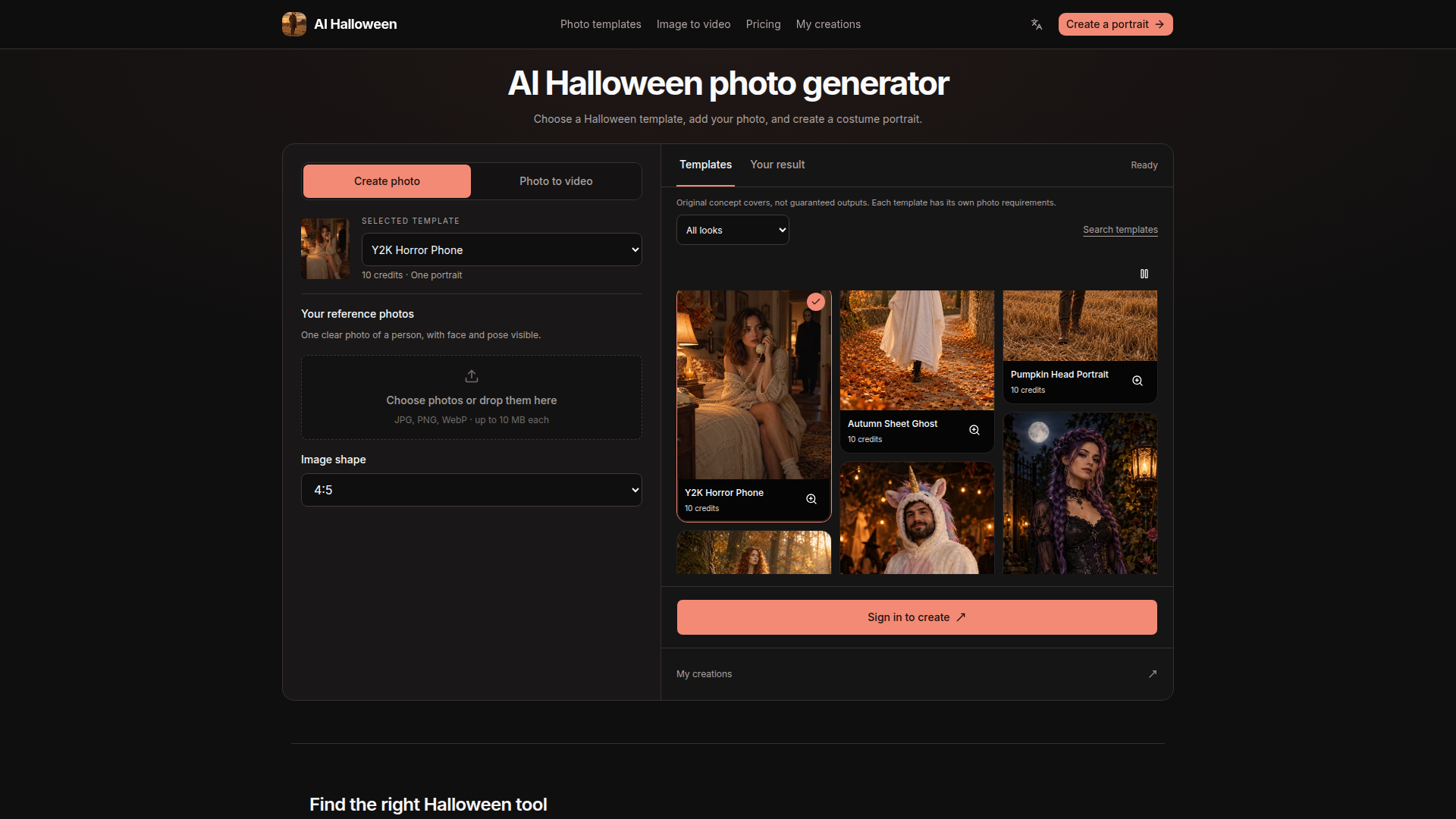
AI Halloween is a specialized AI photo and video generation website positioned as a seasonal Halloween portrait studio. It targets people who want spooky, cinematic, or playful Halloween images without learning prompt engineering, including social media users, couples, pet owners, party hosts, and families preparing for October events. Its core features include template-based portrait generation, dedicated categories for solo portraits, matching pairs, and pets, an image-to-video workflow, and a personal creations history. Content features include themed templates such as Cinematic Zombie, Velvet Vampire, Pumpkin Head Portrait, Sheet Ghost Pet, Witchy Pet, and Y2K Horror Phone, each with sample covers, photo requirements, and credit costs. The user experience is designed around three simple steps: choose a template, upload a JPG, PNG, or WebP image up to 10 MB, and generate a portrait; users can then review and download results. The platform uses account credits for generation, offers a sign-in flow, and provides privacy and terms pages. Technically, it sends reference images to an AI service for generation, supports image and video tasks, tracks generation history, and shows credit costs before submissions. While identity preservation is a goal rather than a guarantee, AI Halloween makes Halloween-themed AI creation accessible, browser-based, and template-driven.
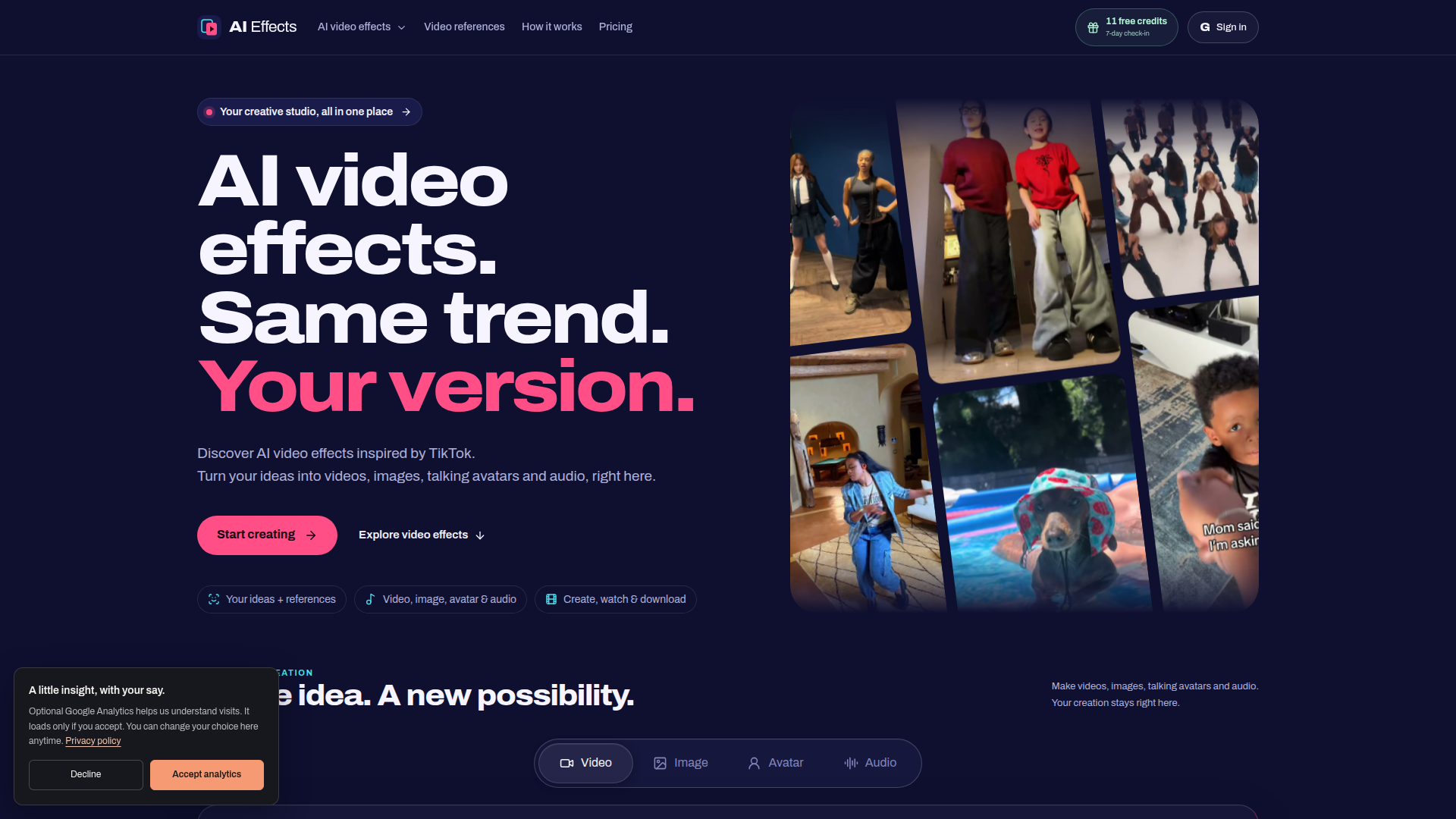
AI Effects is a TikTok-inspired AI video effects studio that lets users turn personal photos into trending short-form videos, images, talking avatars, and audio. Positioned as an independent creative project rather than an official TikTok product, it combines a curated trend archive with dedicated generation tools. The target audience includes TikTok and Reels creators, casual social media users, meme and dance trend fans, small businesses, and anyone who wants to insert themselves into popular video formats without advanced editing skills. Core features include 11 template-based effects such as AI Video Transitions, Baby Podcast, Roadster AI, Zombie Trend, BULIN 47, Ozil Goal Video, Glitch Makeup, Te He Perdido Entre la Gente, Supalonely AI Dance, Ghost Filter Prank, and Jean Phil. The site offers a free archive of 30 credited creator references, source videos, and previews so users can study the original trend before generating. The available Supalonely AI Dance workflow accepts one full-body person photo and an optional background image, then produces an approximately 15-second 720p MP4 with matching slowed music included. User experience is streamlined: explore references, choose an effect, upload photos, pay via guest checkout where available, track progress, and download results. Technical features include AI video, image, avatar, and audio generation in one studio, credit-based generation estimates, aspect ratio and duration controls, optional sound, upload limits around 32 MB, and privacy-focused result handling. Pricing is primarily per video, with the Supalonely tool listed at US$9.99 per complete video, plus promotional free credits and a 7-day check-in bonus. The site is design-forward, visual, and focused on making trend participation accessible, with clear creator credits and guidance on photo quality, sound, and sharing.
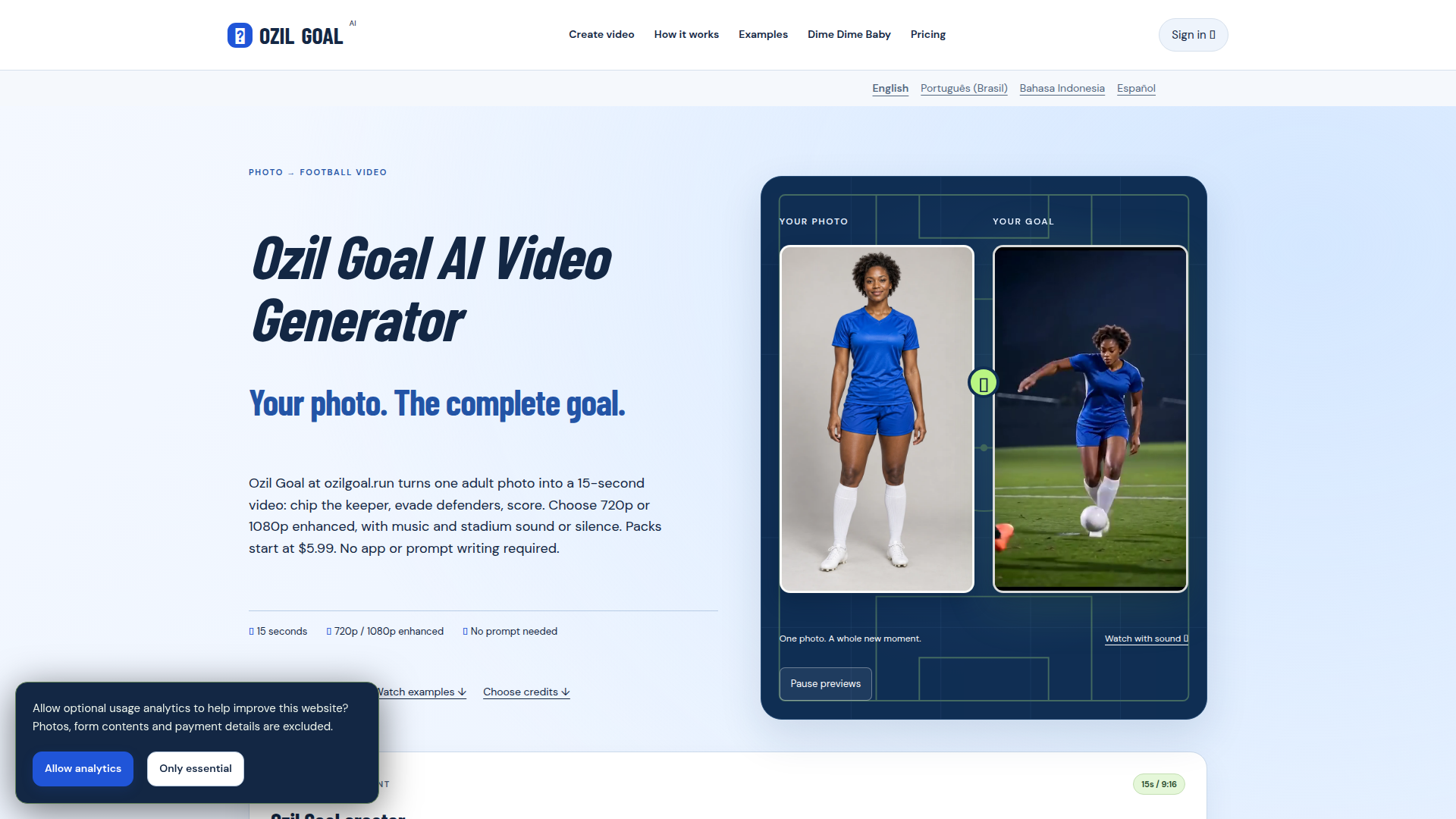
Ozil Goal AI is a browser-based AI video generator that transforms a single photo of an adult into a 15-second football highlight clip. Positioned as a lightweight entertainment and social-content tool rather than a professional video editor, it removes the need for filming, acting, prompt writing or editing skills: the user uploads one JPG, PNG or WebP image (max 5 MB), confirms they are 18+ and have permission to use the photo, and the service's prepared motion template renders a keeper chip, a recovery, two defensive evasions and a final shot. Its target audience is football fans, social-media creators, meme makers and casual users who want a shareable 'Ozil goal' trend clip in vertical 9:16 format without owning editing software such as CapCut. Core features include two templates — the football finish and the silent, landscape-framed 'Dime Dime Baby' dance — 720p enhanced export for 1 credit or 1080p enhanced for 2 credits, an optional original soundtrack ('One More Touch') with AI crowd and ball ambience, no added website watermark, a downloadable MP4 plus a downloadable original Mini file, a 'My creations' account area, and multi-language support in English, Portuguese (Brazil), Indonesian and Spanish. The user experience is a single-page flow: add photo, pick template, choose export quality and music, tick the consent box, sign in and keep the tab open while the browser prepares the enhanced MP4. Technical features include credit-based rendering, automatic credit return on confirmed technical failure, a seven-day visual-defect review policy with one redo and a possible allocated refund, and privacy-conscious optional analytics that exclude photos, form contents and payment details. Pricing follows a simple one-time purchase model with no subscription — $5.99 for 1 credit, $14.99 for 3 credits and $39.99 for 10 credits — and credits never expire.
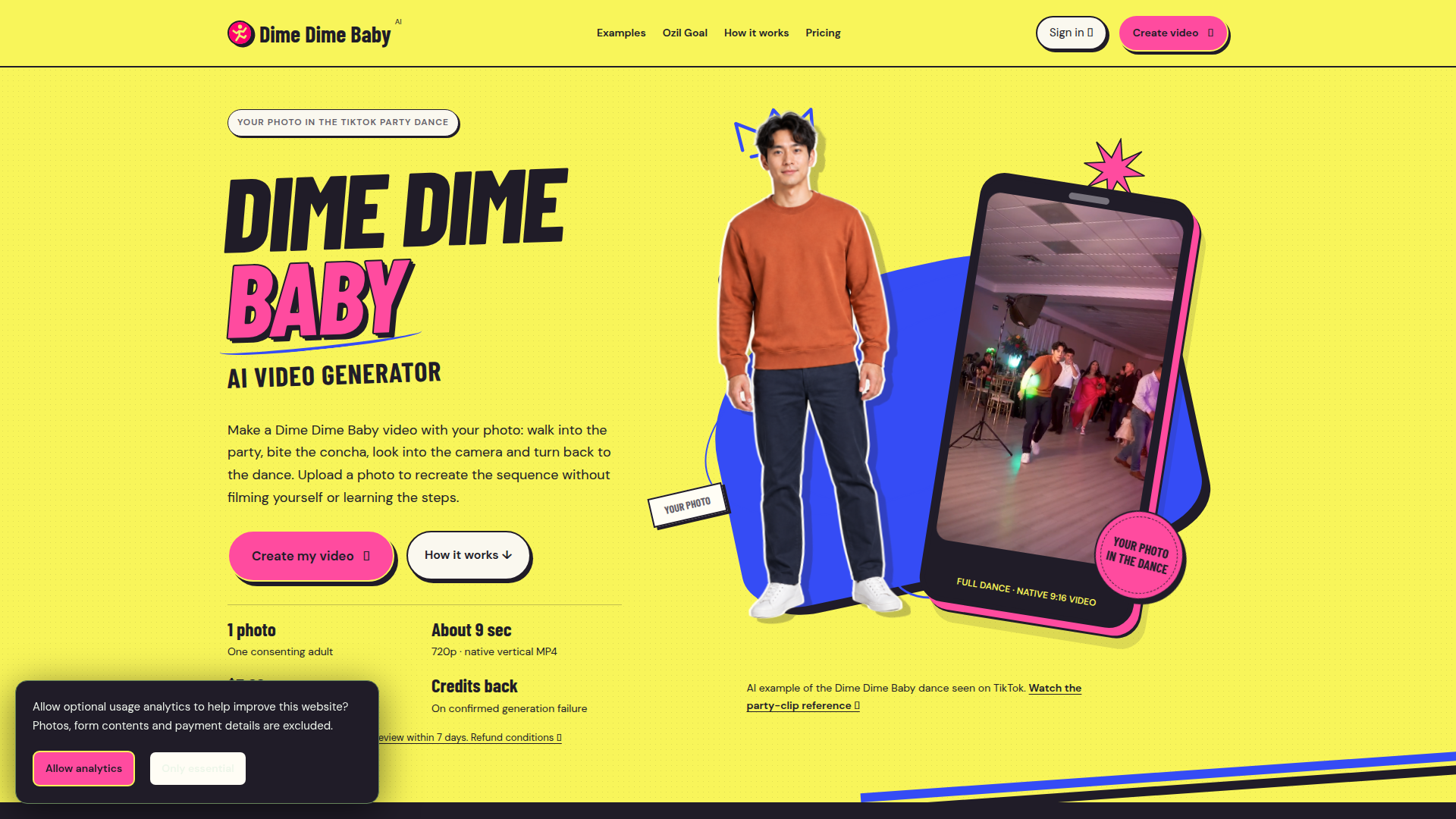
DimeDimeBaby.info is a browser-based AI video generator built around one very specific viral TikTok trend: the Dime Dime Baby / BbY WOW party dance. Instead of editing templates or filming yourself, you upload a single front-facing photo of one consenting adult (JPG, PNG or WebP, up to 5 MB) and the site animates that person into the full concha-bite sequence — walking toward the camera through the party, swaying to the groove, biting a Mexican sweet bread, pausing with a straight-faced look into the lens, and turning back to the dance. The motion reference is pre-set, so no prompt writing, choreography or filming is needed, and the output is produced natively in vertical 9:16 (720 × 1280) as a silent MP4 of roughly nine seconds, ready to save to a phone and pair with the BbY WOW sound inside TikTok or Reels. Website Positioning: a niche, single-purpose creative tool for trend-chasers, meme-makers and social creators who want to ride a fast-moving TikTok dance without CapCut editing skills or on-camera time. Target Audience: TikTok/Reels/Shorts creators, meme accounts, friends making group-content jokes, and casual users curious about the "guy eating bread" AI edits. Core Features: photo-to-dance generation, a second preset (Ozil Goal, a 15-second football approach-and-finish clip), standard 720p and 1080p-enhanced exports, optional original demo music and stadium sound for the football preset, an account area with "My creations", preview-before-download flow, and an 18+ consent confirmation for animating another adult's photo. Content Features: a rich guide library (full tutorial, sound-sync guide, BBY WOW guy explainer, trend history, CapCut template comparison, best-generator comparison), motion-by-motion timing breakdowns, side-by-side photo/video example showcases, and transparent policy pages covering privacy, terms, acceptable use and refunds. User Experience: a clean, single-scroll layout with a numbered three-step workflow, in-page preview panel, credit-pack picker and a large FAQ, plus no added watermark and no recurring charges. Technical Features: cloud AI video generation in the browser, native vertical recomposition from a wide reference, credit-based task queue with automatic credit return on confirmed technical failure, 7-day visual-defect review window, input media scheduled for deletion after 7 days and outputs after 30 days, optional privacy-respecting analytics, and PayPal checkout. Pricing is deliberately simple: a one-time $5.99 single credit pack (one standard video), a recommended $14.99 trio pack (three standards or one enhanced), and a $39.99 squad pack (ten standards or five enhanced), with credits that never expire and no subscription.
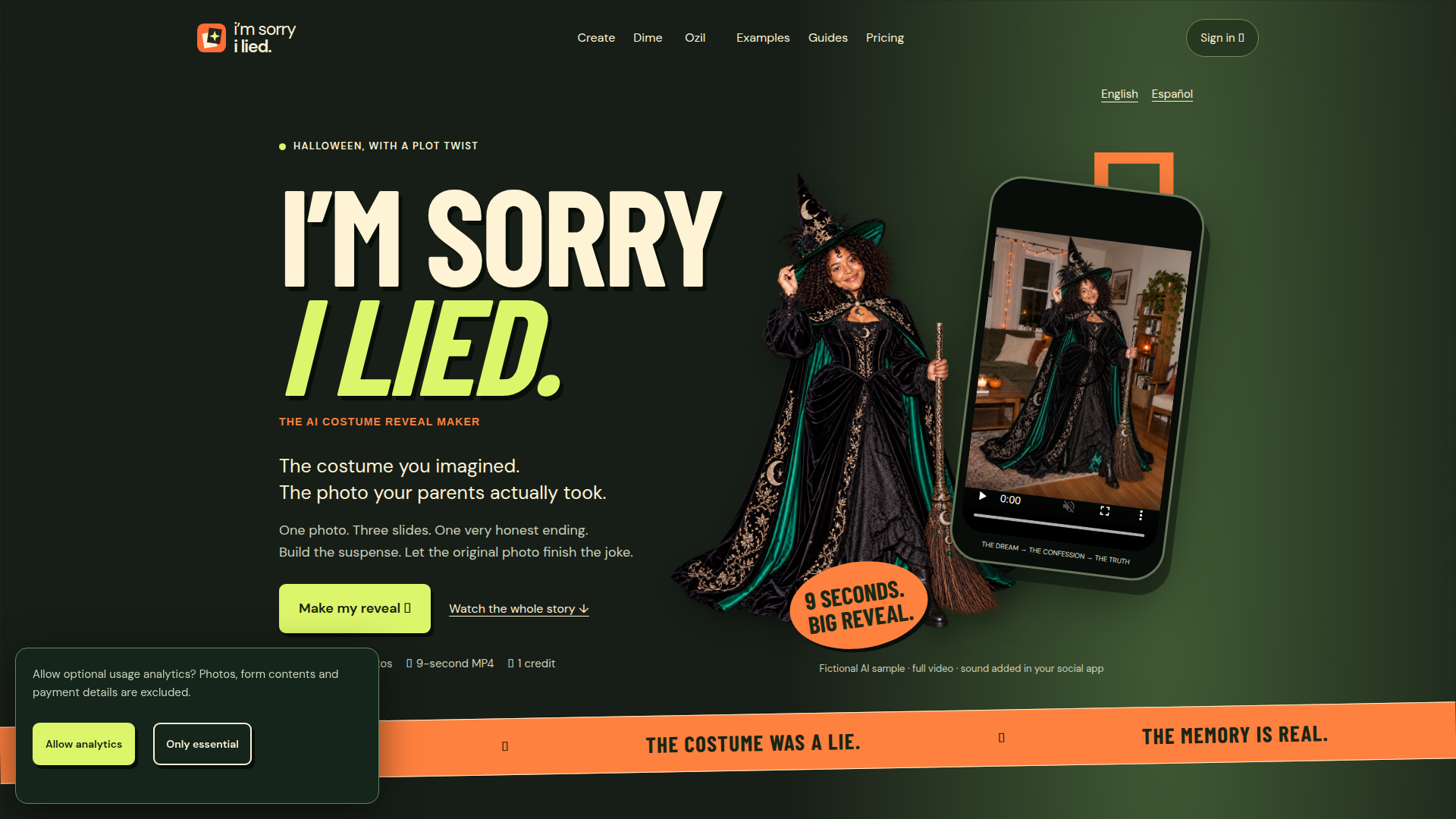
I'm Sorry I Lied (imsorryilied.xyz) is a browser-based creative studio built around the viral "I'm Sorry I Lied" costume-reveal format that swept social media during Halloween season. Website Positioning: it positions itself as a specialized, single-purpose AI costume reveal maker rather than a general image editor — a tool that turns one childhood Halloween photograph into a three-slide, plot-twist video with an honest punchline. Target Audience: nostalgia-driven social media users aged 18 and over, parents who want to recreate their own or their children's Halloween memories, TikTok and Reels creators chasing trending audio formats, and casual users who own exactly one grainy costume photo and want a laugh. Core Features: photo upload (JPG, PNG or WebP, up to 5 MB); an AI costume upgrade that preserves the subject's face, age, pose and background while replacing the outfit; four preset costume energies (wizard, witch, vampire, astronaut); a three-part narrative structure (The Dream → The Confession → The Truth); editable captions that can be rewritten and re-exported without spending another credit; and export of three captioned images plus a 9-second silent MP4 at 720 × 1280. The platform also hosts two sibling templates on the same credit balance — the Dime Dime Baby character video and the Ozil Goal football finish — plus a downloadable fictional sample so users can judge the output quality before paying. Content Features: a large editorial layer of guide pages answering questions about the trend's origin, the best prompts, CapCut alternatives, music, free options, and Halloween-specific tips, alongside an Examples gallery with witch, astronaut and vampire sample videos. User Experience: the flow is deliberately frictionless — upload, describe, generate — with clear consent language, transparent credit costs, and an explicit note that confirmed generation failures return credits. Technical Features: account-gated private storage, browser-based MP4 encoding with a graceful image-only fallback on incompatible mobile devices, English and Spanish localisation, age and permission attestations, and credit-based metering that separates site balances from those of other websites. Refunds and privacy are handled through dedicated policy pages, and the site openly declares independence from TikTok, CapCut, and any club or player.
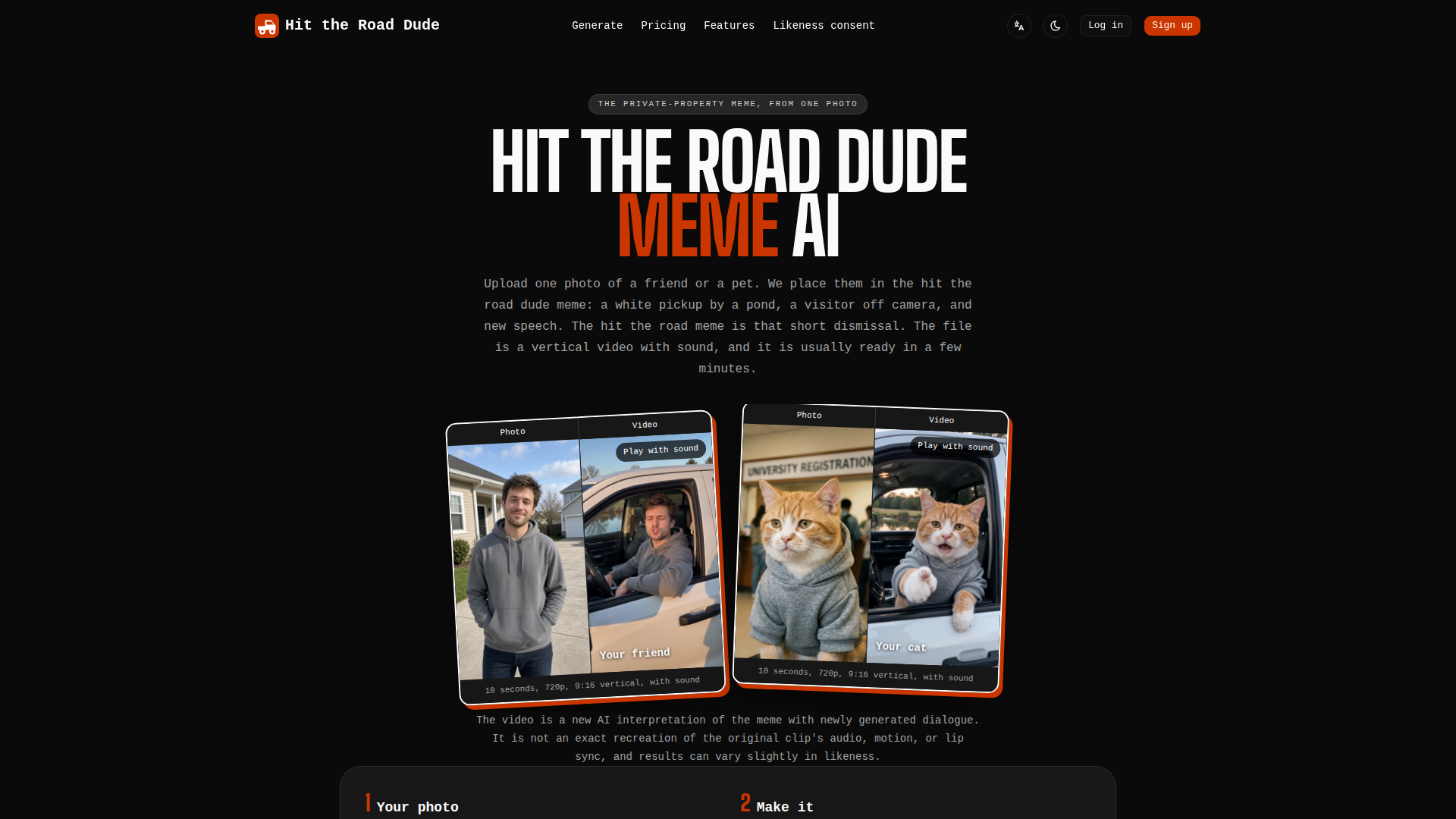
Hit the Road Dude is a specialized AI meme video generator focused on the viral 'hit the road dude' private-property meme. Its positioning is narrow but clear: instead of a general-purpose video editor, it turns a single uploaded photo into a personalized, short vertical clip that recreates the meme's familiar setup—a white pickup by a rural pond, an off-camera visitor, and the dismissive 'hit the road, dude' punchline. Target users include social media users who want a quick reaction video for group chats, TikTok, Reels, or WhatsApp; pet owners who want their cat or dog to play the driver; and meme fans who enjoy AI-generated humor. Core features include one-photo upload, AI face and fur reference, new AI-generated speech and sound, 10-second 9:16 720p MP4 output, and a simple credit-based purchase model with no subscription. Content features include how-to guides, meme meaning pages, a pet meme generator, and likeness-consent information. User experience is intentionally simple: add one clear photo, sign in with Google or email, buy a pack, and download the finished MP4. Technical features rely on generative video and speech synthesis; results can vary in likeness, and the site explicitly states the clip is not the original recording. Privacy is addressed with private photo storage and deletion within 30 days. The service emphasizes ethical use: users should have permission, avoid celebrities, public figures, and minors, and label shared videos as AI-generated.
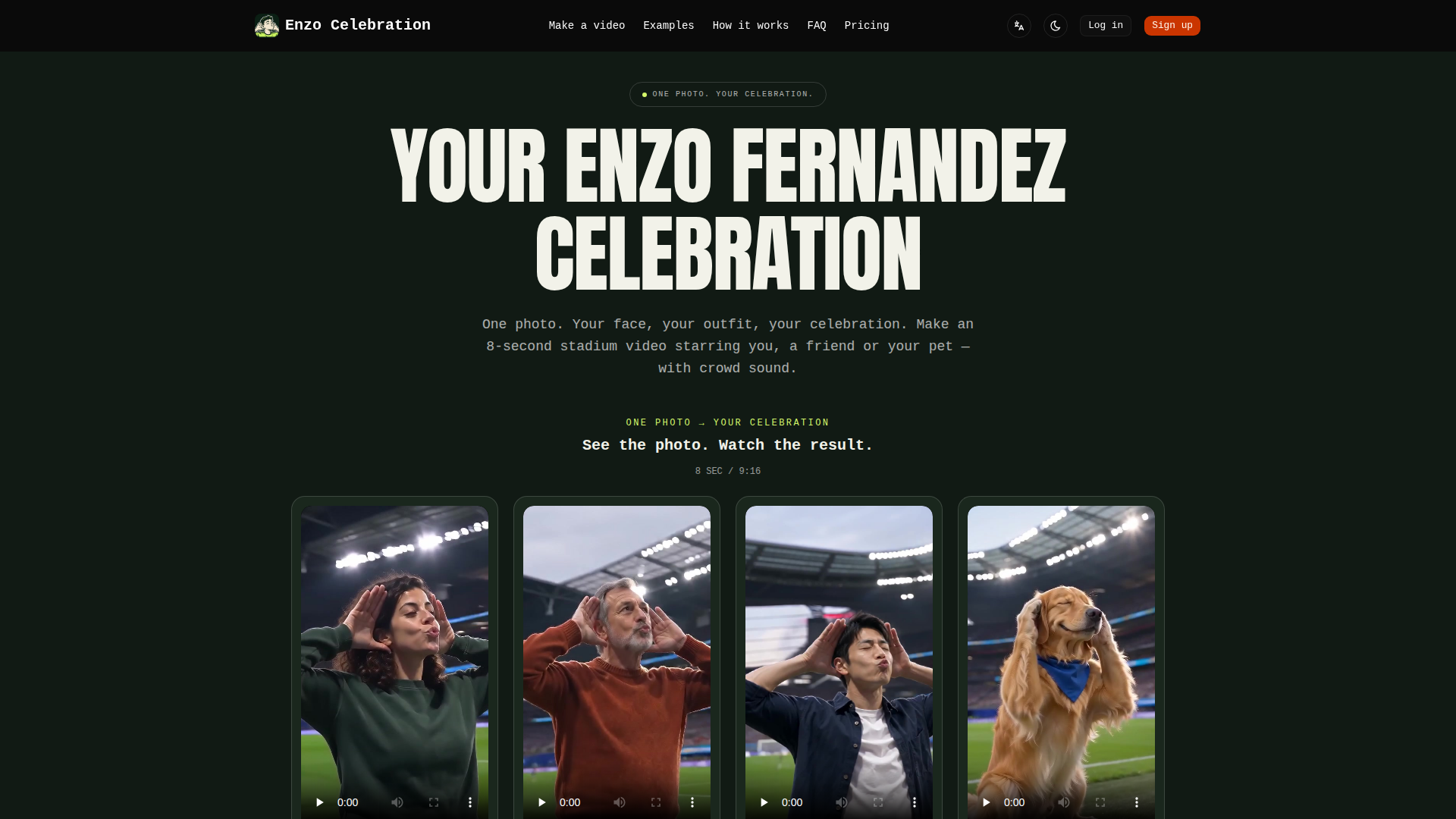
Enzo Celebration is a niche AI video tool that transforms a single photo into an 8-second stadium celebration video. Positioned as an independent fan-made effect inspired by the iconic hands-behind-the-ears football celebration, it lets users star themselves, a friend, or a pet in a fictional stadium scene without needing real match footage. Target audiences include football fans, social media creators, pet owners, and anyone looking for a quick, personalized viral-style video. Core features include one-photo input, automatic animation of a touchline walk, the Topo Gigio pose, a brief pout, and an arms-raised finish, plus generated crowd sound. The output is a 9:16 vertical MP4 at 720p, ready for TikTok, Instagram Reels, or YouTube Shorts. User experience is streamlined: choose a clear JPEG, PNG, or WebP photo, sign in, spend one credit, and receive an email when rendering completes. Content features include sample videos, photo tips, step-by-step guides, FAQs, and transparent disclaimers that results vary. Technical features include browser-side photo selection before upload, credit-based rendering, automatic credit return for failed renders, and cloud AI generation. Pricing is one-time purchase with no subscription, offering Single ($6.90), Pair ($9.90), and Squad ($19.90) packs. The site is not affiliated with Enzo Fernandez, any club, or broadcaster, emphasizing ethical use of photos.
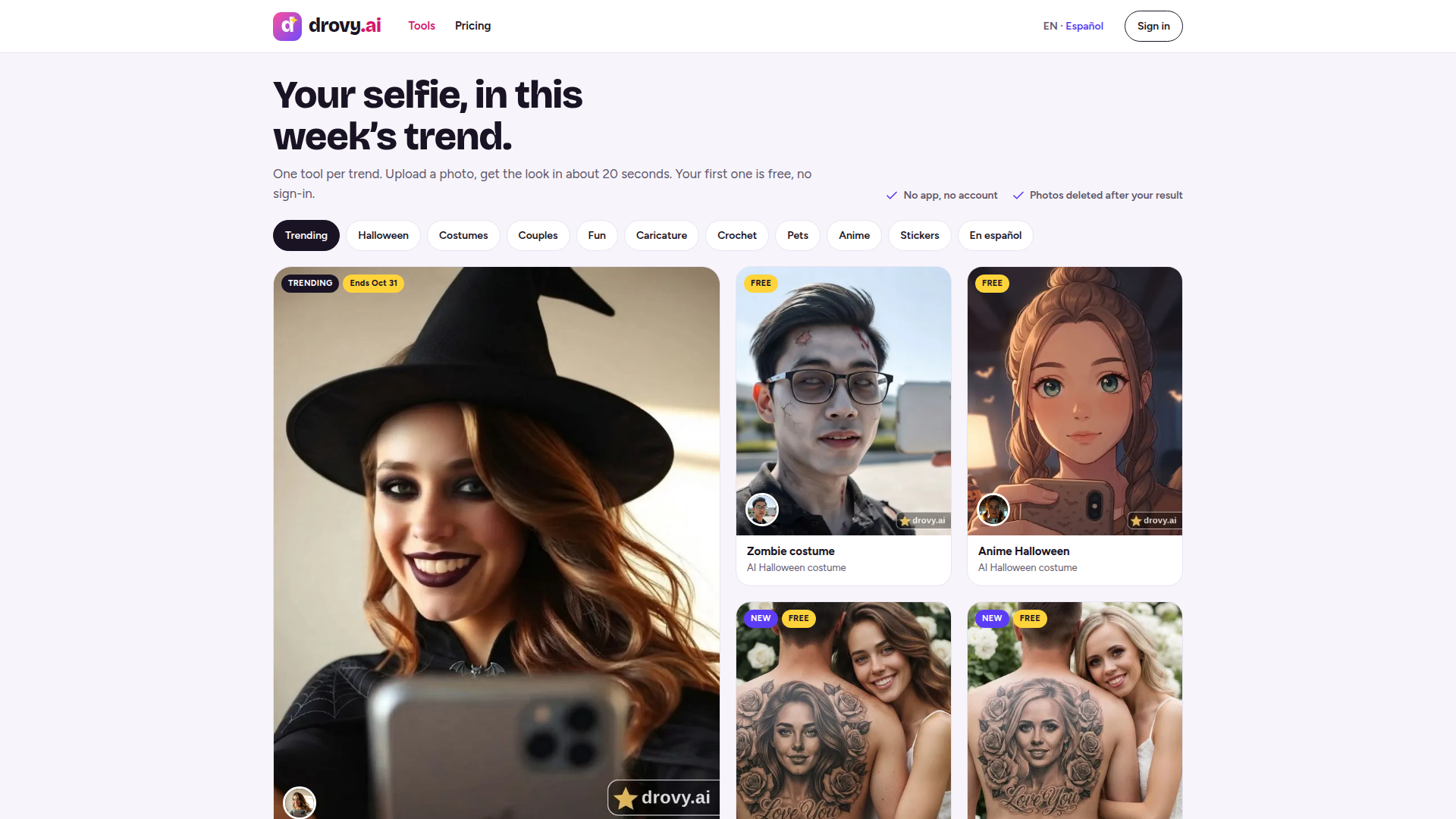
drovy.ai is an AI-powered selfie transformation platform designed for viral social media trends. Positioned as a fast, no-app, no-account tool, it lets users upload a single selfie, couple photo, group shot, or pet photo and receive a trend-specific AI-generated look in about 20 seconds. Each trend—such as AI Halloween costumes, zombie looks, anime lookalikes, couple back tattoos, caricatures, crochet filters, star eye stickers, and more—has its own dedicated page and tool. The target audience includes TikTok, Instagram, and social media users who want to join trending photo formats without editing skills, as well as couples, friends, pet owners, anime fans, and Halloween enthusiasts. Core features include one-tool-per-trend simplicity, free first image per tool per day with a small watermark, photo uploads in JPG, PNG, or HEIC up to 8 MB, and no sign-in requirement for the first image. Content is organized around trending, Halloween, costumes, couples, fun, caricature, crochet, pets, anime, and stickers categories, with Spanish language support. User experience emphasizes speed, privacy, and low friction: photos are deleted after processing, credits can remove watermarks, and sign-in is only needed to access purchased credits via Google or email code. Technical features include AI image generation, invisible SynthID marking, Stripe-powered secure checkout with Apple Pay, Google Pay, and cards, and a credit system where 5 credits equal one image without watermark. The site is not affiliated with CapCut or TikTok, and it invites users to suggest new trends by sending TikTok links.
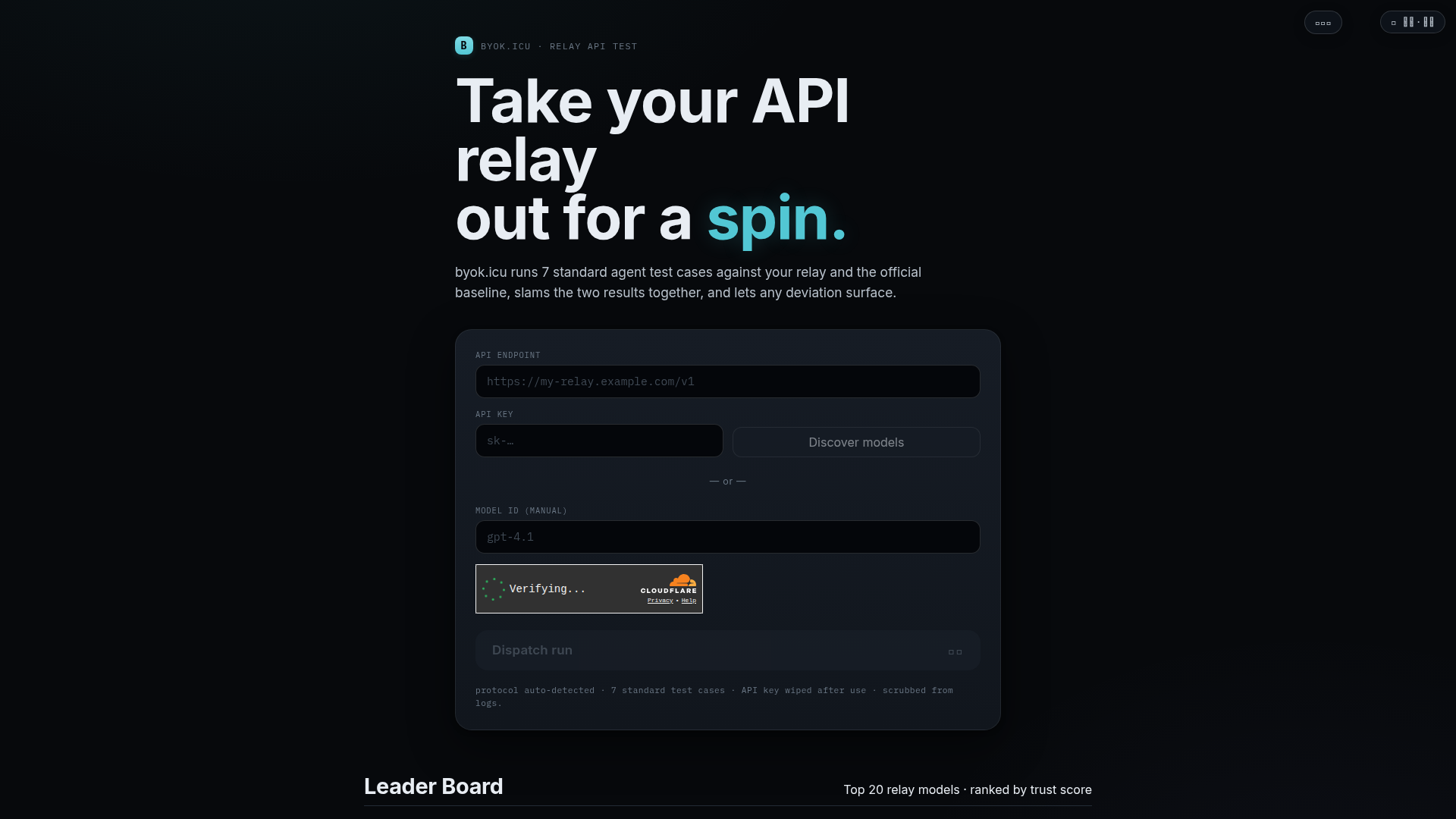
byok.icu is a free, browser-based testing and trust-scoring service for AI API relays — the third-party gateways that resell or forward access to models such as OpenAI's GPT and Anthropic's Claude. Its positioning is that of an independent verification layer for a market where users can see the price but not the behaviour: byok.icu runs 7 standardised agent test cases against a submitted relay and against the official upstream API, then compares the two result sets side by side so any deviation becomes visible. The target audience is developers, AI agent builders, indie hackers, startups and cost-conscious engineering teams who route real traffic through cheap relays and need evidence about protocol fidelity, latency and reliability before they commit. Core features include automatic protocol detection (OpenAI-compatible or Anthropic-compatible), model discovery or manual model-id entry, a live pass/fail view of each test case, a 0–100 trust score with verdict labels (trusted, solid, passable, weak), per-case latency and drift measurements, token-count and request-parameter verification, secret-pattern and prompt-injection flagging, and a public leader board ranking the top 20 relay models. The five evaluation dimensions are protocol compatibility, agent readiness, observability, performance and reference deviation, covering tool calls, chained calls, error recovery, multi-file synthesis, model-context synthesis and long-context recall. Content-wise the site leans on transparent, data-first presentation: comparison tables, explicit flags behind every score, and plain-language explanations of what each metric means. User experience is deliberately minimal — paste an endpoint and key, pass a quick human check, dispatch the run, then read a verdict table you can share or compare. Technically it is a lightweight web application that dispatches parallel test runs, auto-detects API dialects, discards submitted keys after dispatch and scrubs them from logs, and stores completed evaluations as public leader board entries. A Chinese-language version is available for the large Chinese-speaking relay-user community.
Over 80+ AI Tool Categories
Explore the best AI tools in 80+ categories
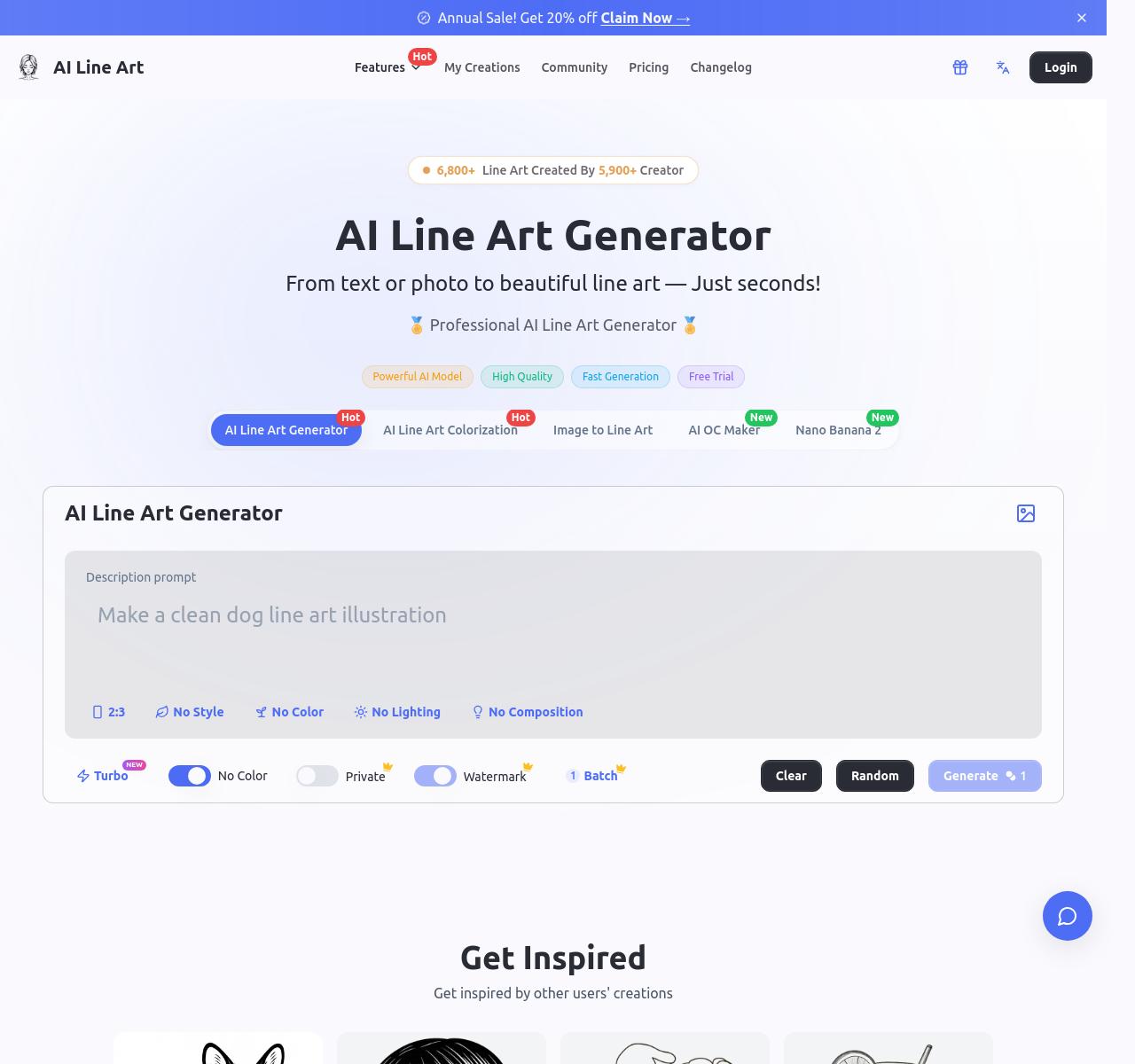
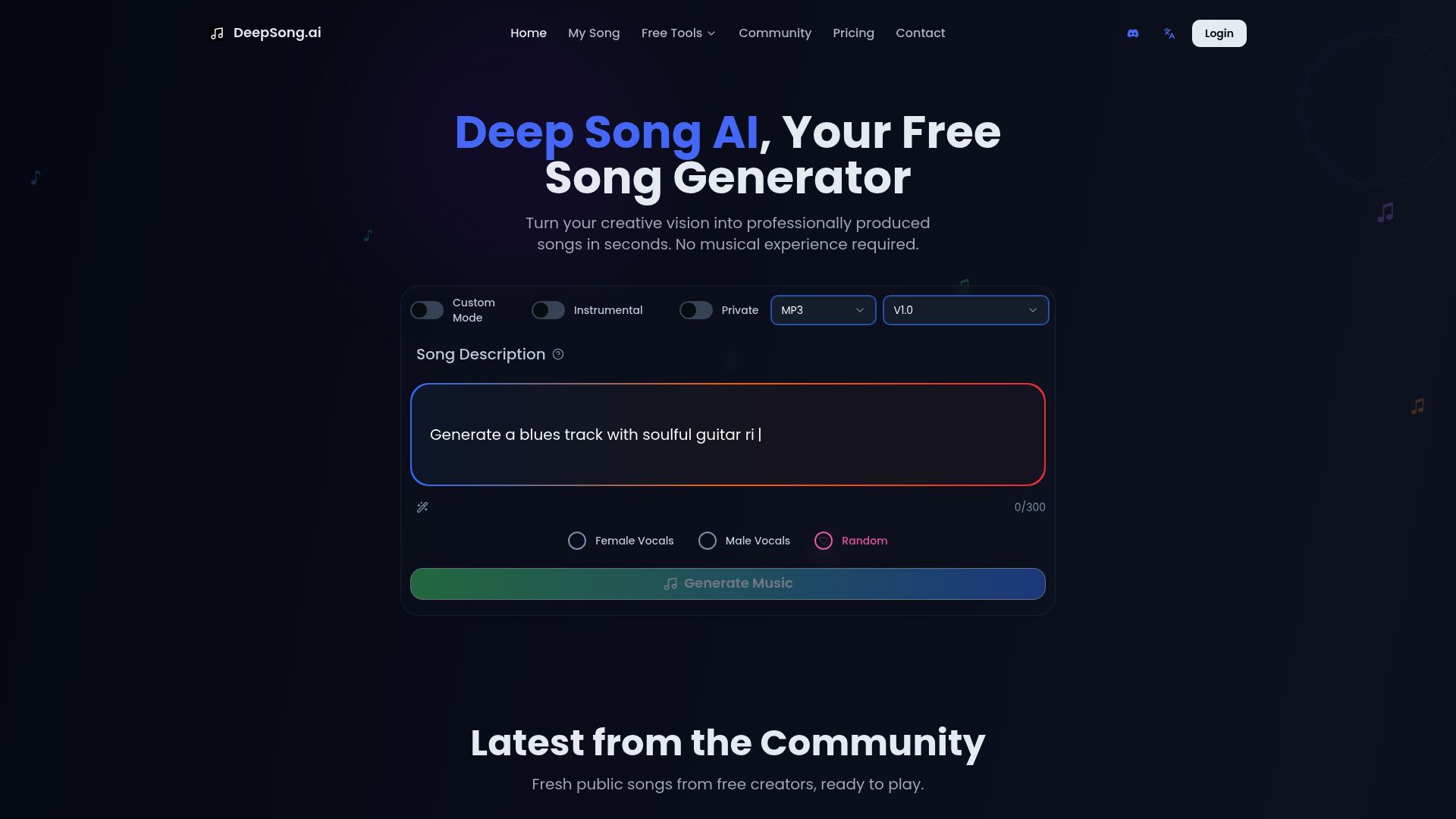
Follow our Official Social Media Channels
Follow/subscribe on Youtube, Instagram, X, TikTok & Youtube to learn more about AI every day! 🎯